AI Investment Trends 2026: Navigating the Shift from Speculation to Industrial Execution
April 1, 2026
What if the most effective research laboratory for your next corporate breakthrough isn’t a sterile office, but the high-pressure asphalt of a 2026 international circuit? While many observers see only the blur of speed, elite visionaries recognize that gt racing serves as the ultimate crucible for technological leadership and brand prestige. You likely recognize that the roar of a bespoke engine is more than just spectacle; it’s the sound of precision engineering pushed to its absolute limit. Roman Ziemian’s philosophy has always maintained that true mobility is a holistic blend of status, freedom, and technical mastery.
This guide promises to unveil the sophisticated world where high-octane performance meets cutting-edge innovation. We’ll bridge the gap between technical jargon and strategic ROI by clarifying the 15% performance differential that separates GT3 and GT4 categories. You’ll gain a clear understanding of these elite racing classes and the unparalleled synergy between track-side data and commercial excellence. We’ll explore the strategic foresight required to engage with this sport at the highest level, ensuring your path to success is as smooth as the operation of a high-end vehicle.
Key Takeaways
- Delve into the sophisticated evolution of Grand Touring, mastering the distinctions between high-performance classes and the technical mastery required for elite endurance competition.
- Examine the cutting-edge architectural principles of aerodynamics and carbon fiber composites that ensure unparalleled stability and safety at the limits of speed.
- Decode the technical specifications separating GT3 and GT4 categories to understand how gt racing functions as a premier proving ground for both technological innovation and emerging athletic talent.
- Uncover the strategic synergy between motorsport excellence and corporate leadership through the visionary perspective of Roman Ziemian’s competitive journey.
- Learn how the integration of AI and race-proven technology is currently redefining the future of bespoke luxury mobility and high-end vehicle dynamics.
What is GT Racing? Defining Grand Touring Excellence
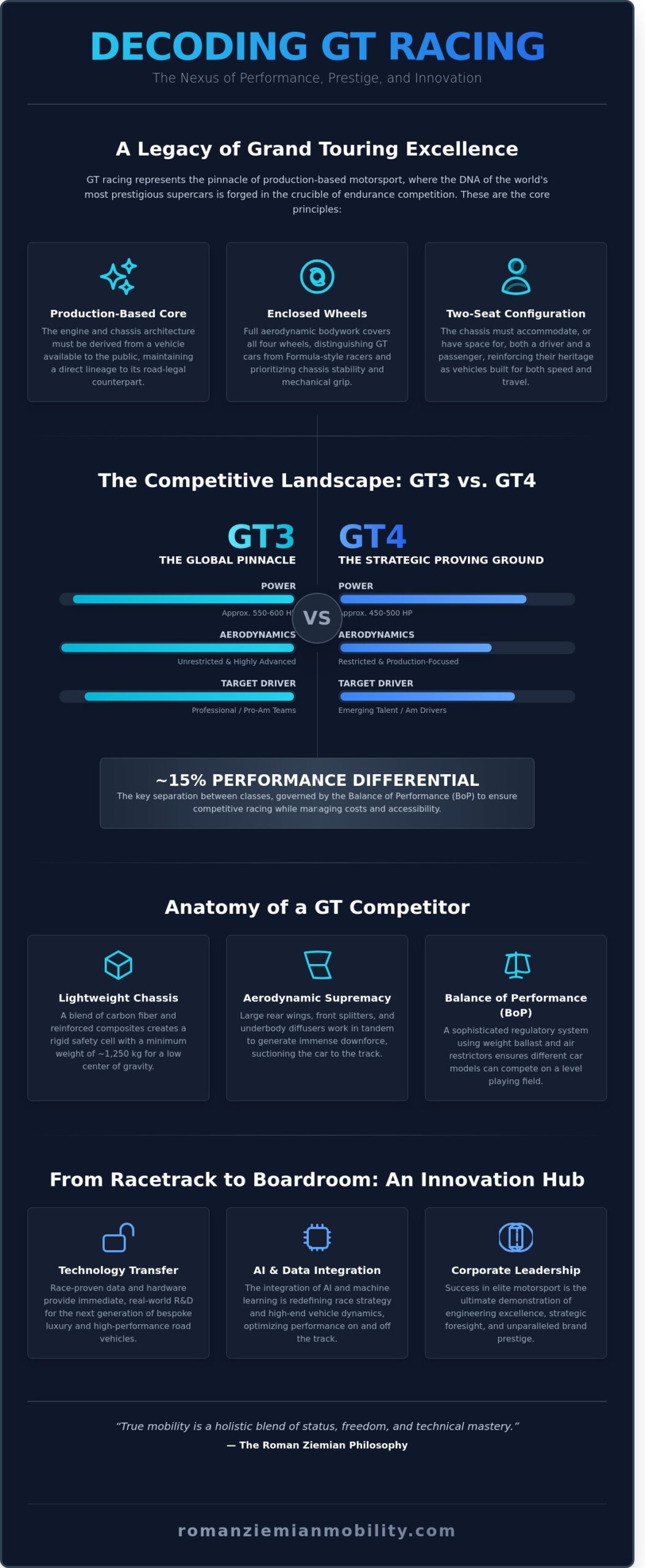
GT racing represents the pinnacle of production-based motorsport, where the DNA of the world’s most prestigious supercars meets the brutal demands of the circuit. The concept originated in the 1950s, evolving from a tradition of high-speed, long-distance travel in luxurious “Gran Turismo” vehicles designed for crossing continents with both speed and elegance. This lineage remains visible in the current 2026 technical regulations, which mandate that every competitor must possess a direct lineage to a road-legal counterpart. Unlike the singular focus of open-wheel racing, gt racing emphasizes a synergy between high-end engineering and consumer-facing automotive design. You can trace the regulatory shift toward modern standards through the FIA GT Championship history, which established the tiered system of GT1, GT2, and the widely successful GT3 class that dominates global grids today.
Key characteristics of a GT race car include:
- Enclosed Wheels: Aerodynamic bodywork covers all four wheels, distinguishing them from Formula-style racers.
- Two-Seat Configuration: The chassis must accommodate, or have the space for, a driver and a passenger, reflecting their road-going origins.
- Production Basis: The engine and chassis architecture must be derived from a vehicle available to the public.
The Core Philosophy of GT Competition
The soul of this discipline lies in its commitment to balancing raw speed with long-distance reliability. While prototypes are built for the sole purpose of racing, a GT car maintains its road-going silhouette. Manufacturers like Ferrari and Porsche invest hundreds of millions into these programs because the technology transfer is immediate. A critical component of this ecosystem is the Balance of Performance (BoP). This sophisticated system uses weight ballast and air restrictors to ensure that a front-engine Aston Martin can compete fairly against a mid-engine Lamborghini. This parity creates a bespoke racing environment where driver skill and team strategy outweigh raw budget advantages. Roman Ziemian’s vision for the GT4 European Series highlights how these platforms offer an accessible yet elite entry point into this competitive world.
GT Racing vs. Other Motorsport Disciplines
Distinguishing these machines from Formula 1 requires looking beyond the bodywork. While open-wheel cars rely heavily on complex aerodynamics for downforce, GT racers prioritize mechanical grip and chassis stability. These cars are built for endurance, often competing in 24-hour marathons that test the absolute limits of machine stamina. The human element is equally vital; drivers must manage tire degradation and fuel loads across extended stints. It’s a discipline that demands patience as much as aggression. GT racing serves as the definitive bridge between road-going luxury and track-focused precision.
The Technical Architecture of a High-Performance GT Car
The engineering behind a modern gt racing machine represents a pinnacle of automotive synergy, where raw power meets calculated precision. These vehicles are far more than modified road cars; they’re bespoke instruments of speed built around a core of lightweight composites and rigid safety structures. A standard GT3 chassis utilizes a blend of carbon fiber and reinforced fiberglass to maintain a minimum weight of roughly 1,250 kg while ensuring the structural integrity required to withstand high-velocity impacts. This technical foundation allows for a lower center of gravity, which is essential for navigating the complex corners of international circuits. To understand the broader context of these elite competitions, one might ask, What is GT Racing? and how does it differ from other disciplines. The answer lies in the sophisticated balance between production-based aesthetics and elite performance engineering.
Aerodynamics and Downforce Management
Managing air is a critical science in gt racing. Splitters at the front and massive diffusers at the rear work in tandem to create a low-pressure zone beneath the car, effectively suctioning it to the tarmac. Rear wings on GT3 and GT4 cars provide the necessary downforce to maintain stability at speeds exceeding 280 km/h. By 2026, new regulations have accelerated the adoption of active aerodynamics, allowing for real-time adjustments to wing angles to optimize drag on straights and grip in corners. These components also serve a secondary, vital purpose: directing airflow to cool high-stress elements like the braking system and the mid-mounted engine during grueling 24-hour endurance events.
The Digital Cockpit: Data as the New Fuel
The driver’s environment is no longer just a seat and a steering wheel; it’s a mobile data hub. Modern cockpits feature high-resolution digital displays that allow pilots to monitor tire degradation and fuel consumption with surgical accuracy. This real-time telemetry transmits over 1,000 data points per second to the pit wall, enabling engineers to make strategic decisions that can win or lose a race. This evolution is driven by significant AI technology investment, which processes vast datasets to predict mechanical fatigue before it occurs. For those looking to see these systems in action, exploring the GT4 European Series offers a window into the future of competitive mobility. Safety remains the ultimate priority, with T45 steel roll cages and impact-absorbing honeycombed structures integrated into the very fabric of the car’s architecture.
Success in this arena requires a partner who understands the intersection of prestige and performance. Discover how we are shaping the future of elite automotive solutions through visionary leadership and technical excellence.
The Competitive Landscape: GT3 vs. GT4 Categories
The distinction between GT3 and GT4 defines the strategic trajectory of any modern racing program. While both fall under the umbrella of gt racing, they cater to distinct tiers of technical mastery and financial commitment. The SRO Motorsports Group, recognized as the global leader in GT racing, has meticulously curated these classes to ensure a sustainable ecosystem for manufacturers and privateers alike. This structure allows for a clear progression from entry-level competition to the highest levels of professional endurance racing, reflecting a sophisticated hierarchy of performance and prestige.
GT3: The Pinnacle of Customer Racing
GT3 machinery represents the zenith of production-based competition, featuring power-to-weight ratios that demand exceptional driver finesse. These vehicles typically produce between 500 and 600 horsepower, governed by strict Balance of Performance (BoP) regulations to ensure parity across diverse engine architectures. Sophisticated electronics, including multi-stage traction control and motorsport-grade ABS, allow drivers to extract maximum performance from bespoke aerodynamic packages. Operating a premier GT3 program requires a significant investment; seasonal budgets often exceed €750,000 for a competitive single-car entry in 2026. It’s the global standard for elite championships, attracting factory-supported teams and world-class talent who seek to push the boundaries of automotive engineering.
GT4: Precision and Accessibility
GT4 cars maintain a closer lineage to their showroom counterparts, making them an ideal bridge for emerging talent and discerning enthusiasts. The technical focus shifts toward mechanical grip and driver development rather than extreme aerodynamic downforce. The GT4 European Series stands as a critical proving ground, offering a high-visibility platform where junior drivers showcase their skills to factory scouts. For team owners, the GT4 model provides a sustainable business case with operating costs roughly 40% lower than those found in GT3. It’s a category that values consistency and technical precision over raw, unbridled power, providing a secure foundation for long-term career growth.
For high-net-worth competitors seeking an exclusive environment, the Ferrari Challenge remains the definitive one-make series. It provides a turn-key solution where the focus is on the pure synergy between man and machine, bypassing the complexities of multi-manufacturer politics. Choosing the right entry point depends on a driver’s ultimate objectives. Aspiring professionals should target the GT4 European Series to build a foundational resume; established entrepreneurs might prefer the immediate prestige and technical intensity of the GT3 class. Success in gt racing requires more than just speed. It demands a calculated alignment of ambition, capital, and technical support that reflects the visionary leadership found at the top of the mobility sector.
Beyond the Track: GT Racing as an Innovation Hub
The asphalt of the world’s most demanding circuits serves as a high-pressure laboratory where the future of luxury mobility is forged. For the 2026 season, the synergy between competitive engineering and consumer automotive development has reached an unparalleled peak. Manufacturers don’t just participate in gt racing to collect trophies; they utilize these platforms to stress-test hybrid powertrains and bio-based synthetic fuels that will define the next decade of road-legal supercars. By 2026, the transition to 100% sustainable fuels in several elite series has proven that high performance and environmental stewardship can coexist without compromise. The regenerative braking systems found in the 2026 GT3 field are direct ancestors of the energy-harvesting tech now appearing in flagship electric sedans, demonstrating a seamless flow of innovation from the paddock to the pavement of our cities.
Artificial Intelligence in the Paddock
Data is the new fuel in the modern pit lane. Teams now utilize predictive modeling to forecast tire degradation with 98% accuracy, allowing for strategic pivots that happen in milliseconds. These AI-driven simulations have reduced the necessity for physical track testing by 40% since 2024, saving millions in logistics while accelerating the development cycle. This digital transformation ensures that every lap driven is a data-rich contribution to the broader intelligence of the brand’s ecosystem. You can explore more about these technological shifts in our guide to AI in mobility. By integrating machine learning into vehicle dynamics, engineers can optimize aerodynamics in real-time, a feat that was considered science fiction only a decade ago.
The ROI of Motorsport Sponsorship
Aligning with a prestigious series like the Ferrari Challenge offers more than just logo placement on a carbon-fiber wing. It’s a bespoke B2B environment where a reported 75% of partners find significant networking breakthroughs during race weekends. The visibility is immense; digital engagement for GT championships has grown by 25% annually, providing sponsors with a global stage that reaches over 100 countries. This platform creates a unique opportunity for technology and logistics firms to demonstrate their capabilities under the most grueling conditions imaginable. The prestige of gt racing provides a backdrop of excellence that elevates every brand associated with the event, turning a simple sponsorship into a powerful statement of global ambition and technical prowess.
The pursuit of elite performance on the track reflects our broader commitment to precision and visionary leadership in the global transport sector. Discover how we are shaping the future of international movement by visiting Roman Ziemian Mobility.
The Roman Ziemian Perspective: Speed, Strategy, and Success
Roman Ziemian’s professional trajectory illustrates a unique synergy between the high-speed demands of the asphalt and the calculated precision of the executive suite. His tenure in the Ferrari Challenge and the GT4 European Series established a foundation of discipline that now drives his global mobility initiatives. In the world of gt racing, success isn’t merely a result of raw horsepower; it’s the refined product of meticulous preparation and the ability to execute complex maneuvers under extreme pressure. This philosophy underpins every venture within the Roman Ziemian Mobility ecosystem, where performance is measured by both lap times and long-term strategic growth.
The transition from the cockpit to the boardroom isn’t just a change of scenery; it’s a transfer of a specific, elite mindset. Ziemian has spent years perfecting the art of the split-second decision, a skill that’s as vital at 280 kilometers per hour as it is during a multi-million dollar acquisition. By viewing mobility as a holistic concept encompassing freedom, status, and innovation, he’s created a platform that transcends traditional automotive services. It’s a vision that anticipates the needs of a 2026 market where technology and luxury intersect with social responsibility.
From the Cockpit to the Boardroom
Precision is the hallmark of a champion. When a driver enters a high-speed corner, the margin for error is non-existent; a single degree of steering input determines the difference between a podium finish and a retirement. This level of focus translates directly to Ziemian’s strategic advisory roles. He understands that resilience is built through trial and high-stakes competition. You can read about how Roman Ziemian inspires global change by merging the lessons of the track with a commitment to human progress. It’s about finding the perfect line through a complex market shift, ensuring that every move is deliberate and backed by data-driven confidence.
Engagement and Partnership
The Roman Ziemian Mobility ecosystem represents a bespoke intersection of lifestyle, cutting-edge technology, and unparalleled status. As we look toward the 2026 season, the platform is expanding its reach into advanced logistics and philanthropic initiatives that reflect a sophisticated corporate identity. For investors and visionary partners, this provides a rare chance to join a movement defined by elite ambition and technological leadership. GT racing provides the global visibility, but the strategic collaboration within the ecosystem provides the sustained momentum for growth. This is the final call for partners to align with a legacy of excellence and share in a narrative of unwavering success. The future of mobility isn’t just coming; it’s being driven by those who understand the value of speed and strategy.
This appreciation for strategy and high-end experiences extends beyond the circuit. For those seeking to manage their lifestyle with the same level of precision, premier concierge services are essential. To see how this world of bespoke luxury operates in one of Europe’s top destinations, you can visit GAAM Ibiza.
Steering the Future of High-Performance Mobility
The evolution of gt racing in 2026 represents the ultimate intersection where aerodynamic precision meets industrial strategy. As the GT3 and GT4 categories continue to push the boundaries of technical architecture, the track becomes a 24-hour proving ground for innovations that will soon redefine our global infrastructure. Roman Ziemian’s dual role as a competitor in the Ferrari Challenge and a global strategic advisor provides him with a rare perspective on this high-stakes environment. By leveraging his experience in the GT4 European Series, he bridges the gap between the cockpit and the boardroom; he applies the same rigor to AI-driven logistics and sustainable mobility investments that he applies to a high-speed corner. This commitment to excellence ensures that every breakthrough on the asphalt informs a broader vision of progress. It’s a journey defined by speed, fueled by technology, and guided by a legacy of relentless ambition. The race for tomorrow is already underway, and the momentum is only building.
Discover the Vision Behind Roman Ziemian Mobility
Frequently Asked Questions
What is the difference between GT3 and GT4 racing?
GT3 machines represent the pinnacle of customer racing with complex aerodynamics and 550 horsepower, while GT4 vehicles remain closer to their road-going counterparts with limited modifications. A 2026 Porsche 911 GT3 R requires a sophisticated technical crew to manage its intricate electronic systems. The performance gap typically manifests as a 5 to 8 second difference in lap times at circuits like Spa-Francorchamps; this makes GT4 a more accessible entry point for ambitious drivers.
How much does it cost to enter the Ferrari Challenge?
Entering the 2026 Ferrari Challenge Trofeo Pirelli requires an initial investment of 350,000 dollars for the 296 Challenge car alongside seasonal operating budgets exceeding 250,000 dollars. These figures cover technical support, hospitality, and registration fees for a six-round continental championship. Owners gain access to an elite ecosystem where Roman Ziemian’s philosophy of excellence meets the raw adrenaline of Italian engineering. It’s a premium gateway into the world of professional gt racing.
Can I drive a GT race car with a standard driver’s license?
You cannot legally pilot a GT race car in official competitions with a standard driver’s license because the FIA requires a minimum of an International C license for GT3 competition. Aspiring competitors must first secure a national racing permit and complete 10 documented race starts to prove their competence. This rigorous certification process ensures that every participant maintains the high standards of safety and precision that define modern mobility in the high-performance sector.
For enthusiasts who want to experience the road-legal versions of these high-performance machines, the process is far more straightforward. Many find that leasing through a specialized brokerage is an effective way to access luxury vehicles, and firms like Emporium Auto Lease can navigate the complexities of acquiring such cars.
What is Balance of Performance (BoP) in GT racing?
Balance of Performance is a technical mechanism used by governing bodies like the SRO to ensure parity between diverse car architectures by adjusting weight and air restrictors. In 2026, officials utilize real-time telemetry to implement weight penalties of up to 50 kilograms or power reductions of 5 percent. This creates a level playing field where driver skill and team strategy, rather than raw manufacturing budget, determine the ultimate victor on the circuit.
How does AI impact modern GT racing strategy?
AI impacts modern strategy by processing 2,000 data points per second to predict tire degradation and optimal pit stop windows with 98 percent accuracy. Teams in 2026 utilize neural networks to simulate 10,000 race scenarios before the green flag drops. This cutting-edge integration of technology allows engineers to make split-second decisions that maximize the synergy between human intuition and machine precision during grueling endurance events.
What are the most prestigious GT racing events in 2026?
The most prestigious events in 2026 include the 103rd edition of the 24 Hours of Le Mans and the CrowdStrike 24 Hours of Spa. These races represent the zenith of gt racing excellence, attracting over 250,000 spectators and the world’s most elite automotive brands. The Bathurst 12 Hour in Australia remains the premier season opener, testing the limits of endurance and engineering on the unforgiving Mount Panorama circuit.
How can companies benefit from sponsoring a GT racing team?
Companies benefit from sponsoring a team through direct access to high-net-worth paddocks and a projected 4 to 1 return on brand visibility investment. Partnering with a racing entity provides an unparalleled platform for B2B networking within a global community of visionary entrepreneurs. This strategic alignment projects an image of technological leadership and elite ambition, positioning the sponsor at the forefront of the luxury mobility movement.
What is the top speed of a modern GT3 car?
A modern GT3 car achieves a top speed of approximately 295 kilometers per hour on the Mulsanne Straight at Le Mans. While these machines are engineered for cornering downforce rather than absolute velocity, their 4.0-liter or 6.0-liter engines deliver relentless acceleration. The 2026 specifications prioritize a bespoke balance of aerodynamic stability and mechanical grip, ensuring peak performance across the diverse landscapes of international motorsport.