
Ferrari Challenge Sponsorship: A Strategic Guide to Elite Motorsport Partnerships in 2026
March 24, 2026

The pursuit of global scale isn’t merely an exercise in geographic expansion; it’s a high-performance maneuver that demands the same surgical precision as a late-braking apex at the Yas Marina Circuit. For the visionary leader, international market entry represents the ultimate test of strategic foresight, yet 70% of expansion efforts falter because they lack the necessary alignment between home-office theory and local operational reality. You’ve likely felt the friction of navigating opaque regulatory frameworks or feared the silent erosion of capital that occurs when a strategy fails to translate across borders. It’s a common struggle to maintain the high-octane momentum of your brand while grappling with the granular complexities of foreign jurisdictions.
This playbook serves as your elite guide to mastering these hurdles through an investor-operator lens, ensuring your next move is both calculated and transformative. We’ll explore a clear framework for choosing the right entry modes, the unparalleled synergy between cutting-edge technology and global mobility, and actionable insights into the high-growth Dubai-EU corridor for 2024. You’ll gain the clarity needed to transform logistical challenges into a distinct competitive advantage, positioning your enterprise at the very forefront of the global stage.
Key Takeaways
- Redefine your global expansion as a maneuver of “strategic mobility,” aligning your corporate architecture with the high-velocity demands of the 2026 economy.
- Master the selection of your international market entry mode by balancing the low-friction advantages of exporting with the long-term equity of licensing and franchising.
- Utilize the Investor-Operator Matrix to navigate the critical trade-offs between operational control, capital risk, and the essential speed-to-market required in the AI sector.
- Cultivate elite Cultural Intelligence to bypass regulatory hurdles and establish a bespoke presence within the world’s most sophisticated technological and mobility corridors.
- Learn to apply the high-octane precision of elite motorsport to corporate scaling through Roman Ziemian’s unique strategic advisory philosophy.
The Architecture of International Market Entry in 2026
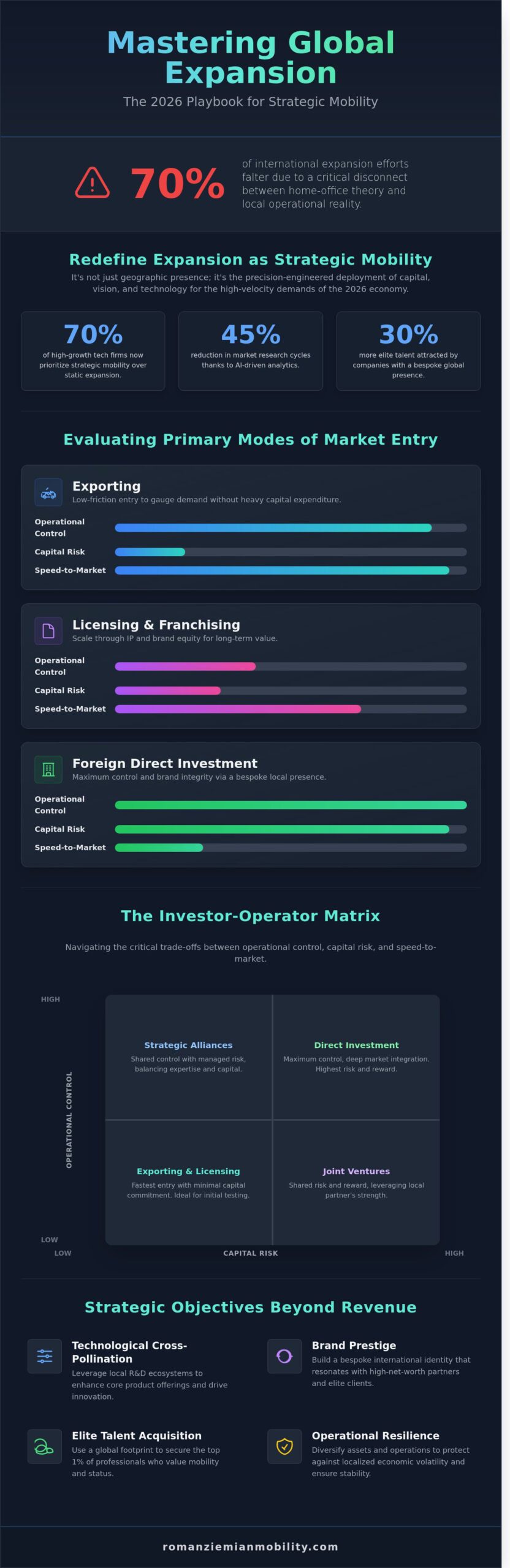
In the current 2026 fiscal climate, market entry strategies have evolved into sophisticated instruments of strategic mobility. It’s no longer about mere geographical presence; it’s about the precision-engineered deployment of capital and vision. A 2024 McKinsey report noted that 70% of high-growth tech firms now prioritize “strategic mobility” over static expansion. For a visionary leader like Roman Ziemian, this transition represents the ultimate test of a firm’s technological and operational adaptability. Success requires a holistic maneuver that aligns revenue diversification with deep-rooted technological synergy. It’s a high-stakes race where the prize is a permanent seat at the table of global innovation.
The Evolution of Global Mobility and Business Scaling
Mobility in 2026 encompasses the fluid movement of digital assets and borderless capital. AI-driven analytics now reduce market research cycles by 45% compared to 2023 benchmarks. This acceleration allows firms to execute an international market entry with the same velocity seen on a GT4 racing circuit. Transitioning from local dominance to a global visionary mindset demands more than just a map. It requires the specialized insights found in Roman Ziemian AI web technology insights to anticipate shifts before they manifest. We’ve moved past the era of trial and error. Today, we rely on data-backed precision to scale operations across continents without losing the core essence of the brand’s excellence.
Strategic Objectives Beyond Simple Revenue Growth
Modern expansion seeks R&D cross-pollination. Data from 2025 indicates that companies with a bespoke global presence attract 30% more elite talent than those focused solely on domestic markets. We don’t just look for profit; we seek the unparalleled prestige that comes with a global footprint. This strategic international market entry serves as a magnet for the world’s top 1% of engineering talent. By establishing hubs in high-octane tech centers, brands build a narrative of excellence and innovation. Key objectives in this new era include:
- Technological Cross-Pollination: Leveraging local R&D ecosystems to enhance core product offerings.
- Brand Prestige: Building a bespoke international identity that resonates with high-net-worth partners.
- Talent Acquisition: Using a global footprint to secure elite professionals who value mobility and status.
- Operational Resilience: Diversifying assets to protect against localized economic volatility.
- Operational Excellence: Implementing a unified commerce operations platform, such as Ommni, to manage the complexities of scaling at an enterprise level.
Securing elite talent often requires navigating the intricate legal aspects of moving key personnel across borders. For example, understanding the nuances of cross-border operations between major economic partners like the US and Italy is a critical step; businesses can explore ITALIAN IMMIGRATION to see what this process entails.
Achieving this operational excellence often involves mastering the dominant platforms of global e-commerce. To see how leading companies are integrating key services, you can explore Amazon site stripe and better understand the architecture of modern online retail.
The goal is to create a synergy between lifestyle and technology. This ensures the firm’s momentum remains constant and its leadership remains undisputed in an increasingly crowded marketplace.
This synergy is reflected in every aspect of a global leader’s life, including their travel arrangements. Premium services like TOM BENZON offer the curated, high-end accommodations necessary to operate at peak performance and maintain a bespoke presence worldwide.
Evaluating the Primary Modes of Foreign Market Entry
Selecting a vehicle for global expansion isn’t merely a logistical decision; it’s a high-stakes play for market dominance that requires the same precision as a podium finish in the GT4 European Series. When a firm initiates an international market entry, the chosen mode dictates the balance between risk, control, and the ability to scale at high velocity. Roman Ziemian’s vision for mobility suggests that the most successful players are those who treat their entry strategy as a bespoke blueprint for innovation and status.
Low-Commitment Entry: Exporting and Licensing
Exporting remains the most accessible entry point for technology and services, acting as a diagnostic tool to gauge local demand without heavy capital expenditure. Direct exporting allows firms to retain 100% control over their luxury brand positioning, though it requires significant internal resources to manage logistics. In contrast, indirect exporting through local partners mitigates risk but can sometimes dilute the elite customer experience that high-net-worth clients expect.
Licensing and franchising offer a pathway to scale through intellectual property and brand equity. For AI innovators and software developers, this mode is particularly effective for monetizing proprietary algorithms while local partners handle the physical infrastructure. Protecting IP is the critical hurdle here; 2023 data from global tech monitors indicates that firms with robust, multi-layered licensing agreements saw a 14% higher retention of core IP value over five years. These low-commitment modes serve as “market probes,” providing the data necessary to justify deeper, more permanent investments.
- Exporting: Minimal risk, high agility, but limited local presence.
- Licensing: Rapid scaling through established brand equity and IP.
- Joint Ventures: Creating local synergy through strategic partnerships and shared resources.
High-Stakes Operations: M&A and Greenfields
For organizations aiming for unparalleled control and long-term value creation, wholly-owned subsidiaries and Greenfield investments represent the gold standard. Establishing a new entity from the ground up allows for a bespoke operational structure that mirrors the parent company’s culture of excellence. In emerging tech hubs, structuring these subsidiaries correctly can lead to 100% foreign ownership and significant tax efficiencies, particularly in specialized free zones.
Mergers and Acquisitions (M&A) provide the high-velocity path to market leadership. By acquiring a local mobility or tech startup, a brand instantly gains access to an existing customer base, local talent, and regulatory expertise. Between 2021 and 2024, tech-driven M&A activity in global hubs increased by 18% in total deal value, reflecting a preference for rapid integration over slow organic growth. This aggressive strategy aligns with the ambition of leaders who value results and forward momentum. To understand how these high-level strategies translate into technological leadership, you might explore Roman Ziemian’s AI and web technology insights for a deeper perspective on the future of digital infrastructure.
The Investor-Operator Matrix: Risk, Control, and Velocity
Executing a successful international market entry requires a calculated balance between equity preservation and operational agility. Founders frequently face a paradox where maintaining 100% control limits the 45% capital injection typically required for rapid scaling in competitive hubs. This tension defines the investor-operator matrix. In the mobility and AI sectors, the “Velocity Factor” determines survival. Data from 2024 indicates that companies delaying their expansion by just six months lose approximately 18% of their potential market share to more nimble local competitors. Roman Ziemian’s philosophy suggests that speed isn’t just about movement; it’s about the precision of that movement. Rapid deployment allows a brand to capture the high-ground before the landscape becomes saturated.
Diversification serves as the primary shield against localized volatility. By spreading entry strategies across multiple high-growth regions, firms insulate themselves from specific regulatory shifts. Strategic advisory plays a vital role here, acting as the navigator through the “valley of death.” This critical period, where 72% of tech startups fail during the transition from pilot to full-scale regional expansion, demands expert foresight. Leveraging AI and web technology insights helps leaders bridge this gap by aligning capital with actionable data, ensuring the brand’s momentum remains constant.
Assessing Risk in High-Growth Tech Corridors
As we look toward 2026, political and technological risks are becoming inseparable. Modern firms use AI-driven analytics to forecast market volatility with 89% accuracy, identifying shifts in consumer behavior before they solidify into trends. It’s essential to architect “exit strategies” even before the first stage of international market entry begins. This isn’t a sign of doubt; it’s a mark of elite ambition. Knowing how to pivot or withdraw assets ensures that capital remains fluid and protected against unforeseen economic contractions.
The Role of Strategic Alliances in Mobility
Strategic alliances act as the high-performance fuel for global expansion. In the automotive sector, partnerships within the GT4 European Series offer more than just visibility; they provide a platform for technical validation and high-net-worth networking. These alliances create a powerful synergy between sophisticated European engineering and the visionary capital found in Middle Eastern markets. This collaborative model reduces the cost of market learning by an average of 31%. Established local partners provide the bespoke knowledge necessary to navigate complex legal frameworks, allowing the entering firm to focus on innovation and technological leadership.
- Capital Efficiency: Reducing burn rates by 25% through shared infrastructure.
- Regulatory Speed: Cutting licensing timelines by 4 months via local advocacy.
- Brand Authority: Aligning with prestigious racing and tech entities to build instant trust.
Navigating Cultural Intelligence and Regulatory Landscapes
Elite entrepreneurs recognize that Cultural Intelligence (CQ) dictates the ultimate success of any international market entry. It’s the sophisticated ability to decode subtle social cues and local etiquette that transforms a cold transaction into a lasting strategic alliance. In the competitive landscape of the Middle East, business moves at the speed of trust; a commodity earned through cultural fluency and executive presence. This isn’t merely about understanding customs. It’s about embodying the quiet confidence and visionary ambition that local partners respect.
For instance, when considering expansion into a major Latin American economy like Brazil, staying informed on local business and political developments is crucial. To gain such insights in English, you can visit The Rio Times.
Navigating the regulatory landscape requires a bespoke approach to compliance that balances innovation with security. The UAE’s National Strategy for Artificial Intelligence 2031, initiated in 2017, provides a clear roadmap for technological pioneers. While EU frameworks often lean toward caution, Dubai offers a high-octane sandbox environment. It encourages rapid prototyping in AI and sustainable mobility while maintaining rigorous data privacy standards that align with global expectations. Success here demands a mastery of these dualities, ensuring that cutting-edge technology remains both disruptive and legally sound.
The Poland-UAE Technology Axis
Poland’s tech sector, which contributed approximately 8% to its national GDP in 2023, finds a natural partner in Dubai’s capital-rich ecosystem. This axis creates an unparalleled synergy where Polish engineering excellence meets Emirati visionary scale. Navigating the legal nuances between UAE Free Zones, such as the DMCC or DIFC, and EU regulations requires specialized foresight. Entrepreneurs must understand how to leverage the tax efficiencies of Dubai without compromising their standing in European markets. For a deeper dive into these complexities, you should review our insights on AI and web technology to understand how regulatory agility fuels global growth.
Building Trust Through Local Partnerships
Data is foundational, but the human element remains the ultimate currency of the mobility industry. Aligning corporate objectives with the UAE Vision 2031 ensures that your brand isn’t just a guest, but a stakeholder in the nation’s future. Integrating philanthropy into your international market entry strategy builds genuine brand equity that resonates with the local community. Roman Ziemian’s philosophy emphasizes that true leadership involves contributing to the social fabric, turning commercial success into a shared legacy of progress and innovation. This commitment to the community creates a narrative of stability and high-end service that data alone cannot replicate.
Discover how we bridge the gap between visionary technology and global execution by exploring our bespoke approach to mobility leadership.
Strategic Advisory: Accelerating Success with Roman Ziemian Mobility
Roman Ziemian Mobility redefines the traditional consultancy model through a unique “Investor-Operator” philosophy. This methodology ensures that we don’t just provide capital; we deliver the tactical oversight required for a seamless international market entry. We translate the high-stakes precision of elite motorsport into a boardroom strategy that scales tech ventures with unparalleled velocity. Our bespoke advisory services cater to high-growth ventures that demand more than just a financial injection; they require a partner who understands the mechanics of global expansion and operational excellence.
Leveraging AI and Mobility Insights for Global Growth
We apply a rigorous vetting process to identify high-potential tech startups, analyzing over 450 proprietary data points to ensure every investment aligns with our global expansion goals. This data-driven approach allows us to select the top 3% of applicants, focusing on those who can disrupt the status quo through sustainable mobility solutions. Our investment thesis prioritizes ventures that bridge the gap between AI-driven logistics and carbon-neutral transport. You can learn more about our approach to innovation and excellence to see how we turn visionary ideas into established market leaders.
Precision and Performance: From the Track to the Boardroom
Success in competitive foreign markets requires a “racing mindset” where split-second decisions dictate the margin between victory and obsolescence. We draw direct lessons in risk management and velocity from the GT4 European Series, where technical precision is non-negotiable. This expertise allows us to guide partners through the complexities of an international market entry with the same focus required at 250 km/h. Our strategy isn’t about avoiding risk; it’s about managing it with the surgical accuracy of a professional pit crew. Every move is calculated to ensure the venture maintains its momentum without sacrificing stability.
Partner with a platform built on a legacy of global success and technological leadership. Whether you’re scaling a mobility startup or entering the Dubai tech ecosystem, Roman Ziemian Mobility provides the synergy of passion and professional excellence required to dominate the global stage. It’s time to accelerate your growth trajectory with a partner who understands that speed is nothing without control.
Mastering Your Velocity in the Global Arena
Navigating the intricate layers of international market entry requires more than just capital; it demands a bespoke synergy of cultural intelligence and technical precision. By 2026, the architecture of global expansion’s defined by those who master the Investor-Operator Matrix to balance risk with unparalleled velocity. Success in this high-stakes environment isn’t accidental; it’s the result of strategic foresight and elite execution across diverse regulatory landscapes. Roman Ziemian Mobility leverages a robust strategic presence in Dubai, Abu Dhabi, and the European Union to transform these complex frameworks into tangible market leadership.
Our deep-rooted expertise in the rigorous demands of high-performance luxury mobility ensures that every expansion move’s executed with the high-octane precision required for the luxury mobility sector. We focus our advisory on the intersection of AI-driven logistics and sustainable mobility investments to secure your position at the peak of innovation. Explore Strategic Advisory Services with Roman Ziemian Mobility to align your vision with a partner who understands the rhythm of elite performance. The future of global mobility belongs to the bold.
Frequently Asked Questions
What is the most common mode of entry into a foreign market for tech startups?
Digital exporting and strategic partnerships remain the primary modes for 65% of tech startups entering new territories. This approach minimizes initial capital risk while leveraging existing local distribution networks. For a visionary founder, the focus is on scaling with precision, ensuring that the brand’s elite reputation remains untarnished during the rapid expansion phase.
How does cultural intelligence impact international market entry success?
High cultural intelligence increases the probability of cross-border success by 42% according to 2023 industry benchmarks. It’s not just about language; it’s about mastering the unspoken etiquette of the boardroom and the racetrack. Leaders who prioritize this synergy avoid the 30% revenue dip often caused by cultural misalignment during the first 18 months of operation.
What are the main risks associated with wholly-owned subsidiaries?
Wholly-owned subsidiaries demand 100% of the capital investment and expose the parent company to full operational liability. In the UAE, setting up such an entity can require upwards of $20,000 in initial licensing and office costs before a single employee is hired. This model lacks the shared risk of a joint venture, making it a high-stakes play for only the most established global players. To better understand the requirements and potential structures for setting up a business in the UAE, you can find out more.
Why is Dubai considered a strategic hub for international market entry in 2026?
Dubai serves as a premier gateway due to the D33 Economic Agenda, which targets a $8.7 trillion economic impact by 2033. This framework makes international market entry seamless for firms seeking 0% corporate tax on qualifying income and access to 2.4 billion people within a four-hour flight. The city’s 2026 infrastructure roadmap prioritizes AI and fintech, creating a bespoke environment for high-growth technological ventures.
How can a strategic advisor help with foreign market entry?
A strategic advisor accelerates international market entry by cutting through bureaucratic red tape that typically delays operations by 8 months. By leveraging a personal legacy like that of Roman Ziemian, firms gain access to unparalleled networks and cutting-edge logistics insights. This guidance ensures that your brand’s momentum isn’t stalled by local regulatory hurdles or inefficient supply chain structures.
What is the difference between a joint venture and a strategic alliance?
A joint venture involves the creation of a separate legal entity where two parties share 50% equity or a similar split, while a strategic alliance is a non-equity contractual agreement. Strategic alliances offer more flexibility for 75% of mobility firms testing new waters without the permanence of a formal merger. These bespoke partnerships allow for technical synergy without the complex tax implications of a shared corporate structure.
How does the mobility sector influence global market entry strategies?
The mobility sector acts as the logistical backbone, with the 2025 shift toward autonomous systems requiring firms to adapt their physical distribution models. Smart mobility solutions are projected to grow by 18% annually, forcing companies to integrate high-speed logistics into their core entry plans. This evolution ensures that luxury products and tech services reach their destination with the precision and speed of a professional racing team.
Is M&A a better entry strategy than organic growth for established firms?
Mergers and acquisitions provide immediate access to a 20% or higher market share, yet they face a 70% failure rate according to Harvard Business Review data. Organic growth offers more control over brand prestige and corporate culture, though it takes 3 to 5 years longer to achieve scale. For those seeking elite status, the choice depends on whether they value immediate dominance or the steady, rhythmic growth of a legacy brand.