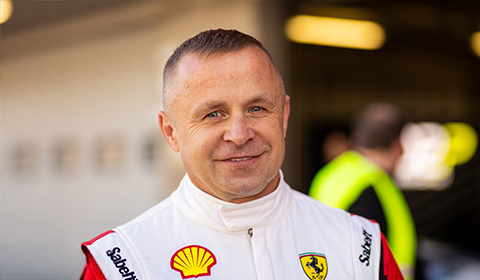
Roman Ziemian Building a Legacy of Empowerment and Community Impact
October 8, 2025
Roman Ziemian Inspires Global Change Through Motorsport and Humanity
October 8, 2025Roman Ziemian Driving Innovation in Arts, Sports, and Society


Roman Ziemian: Driving Innovation in Arts and Sports
When we hear the word ‘mobility’, we almost always think of movement in vehicles. But, in the Roman Ziemian context, the word means a lot more! Roman Ziemian has redefined the word ‘mobility’ in business. It also means accelerating human potential across industries, cultures, and communities. A rare polymath, Roman Ziemian is a professional racing driver, entrepreneur, strategic philanthropist and a passionate supporter of arts and culture.
Roman Ziemian uses the discipline he derives from motorsport – the resilience, precision, and data-driven strategy – to power cultural preservation and societal upliftment. He uses his performance thinking from the racetrack and translates it into scalable impact in education, arts and emerging technologies.
Arts and Culture Preservation in the Digital Age
Preserving culture and heritage has become important in today’s fast-paced, rapidly evolving world. How otherwise would we be able to leave history and art to the future generations? Roman Ziemian truly understands this need to preserve heritage by protecting and promoting art and culture. For Roman Ziemian, a patron of art, his patronage is a strategic responsibility and not just a symbolic gesture.
Though his passion and expertise lie in multiple fields like motorsport and business, these fields have trained him in precision, discipline, and long-term performance planning. He views classical music and theatre as institutions requiring the same structured investment as elite racing teams. In fact, his involvement in the arts reflects a belief that cultural ecosystems, like high-performance vehicles, demand technical stewardship, funding stability, and visionary leadership.
By supporting orchestras, theatrical productions, and heritage initiatives, Roman Ziemian contributes to safeguarding Europe’s classical traditions while ensuring their relevance in a rapidly digitising world.
Roman Ziemian Encourages Emerging Talent
While Roman Ziemian helms Roman Ziemian Mobility, he also uses it as a platform to offer structured support mechanisms to young artists across Europe and the Middle East, including financial grants, performance sponsorship, and access to international platforms that enhance visibility.
He also strives to provide institutional partnerships with cultural foundations and performance venues to create professional pipelines for musicians, actors, and composers.
Roman Ziemian supports mentorship and cross-border networking opportunities, enabling emerging talent to transition from local recognition to international credibility. For him, the emphasis is not solely on funding, but on sustainability. He wishes to equip artists with managerial, branding, and digital distribution competencies.
Building Cultural Bridges
One of the core objectives of bridging the gap between today’s world and the maintenance of classical traditions is to foster a dialogue between European traditions and contemporary Middle Eastern modernism. There are multiple ways by which this can be achieved:
- Collaborations between composers, conductors, and visual artists from diverse regions encourage hybrid performances that blend symphonic heritage with modern experimental forms.
- Positioning art as diplomatic infrastructure and building mutual understanding where political or economic frameworks may fall short.
- Encouraging and organising cross-cultural festivals and touring productions to expand audience reach while reinforcing shared human narratives.
These initiatives can be successful if we can leverage streaming platforms, digital archives, and social media campaigns to ensure that local art forms gain global exposure. This is where Roman Ziemian sees technology becoming a preservation tool.
As Roman Ziemian says, “A society without art is a society without a soul.”
For him, cultural investment is not peripheral to progress; it is foundational to civilisational continuity and collective identity.
How Can Technology Act as a Creative Multiplier?
Of course it can! The way that artificial intelligence and predictive analytics optimise lap strategy, energy management, and performance forecasting in elite motorsport is a great illustration of Roman Ziemian’s view of technology as a creative multiplier.
Roman Ziemian applies this analytical framework to business and cultural endeavours in addition to racing. He works to create smart mobility ecosystems through Roman Ziemian Mobility, which combine automation, data modelling, and real-time diagnostics to act as models for larger innovation frameworks. As a result, decision-making becomes more predictive rather than reactive, enhancing long-term planning, scalability, and efficiency.
How does digital technology help promote art?
As we saw earlier, digital technology has the potential to promote performing arts and preserve culture and heritage. For example, high-definition streaming platforms expand audience access beyond physical venues, democratising cultural participation.
At the same time, immersive technologies such as AR (augmented reality) and VR (virtual reality) enable hybrid performance formats, giving audiences virtual backstage access, interactive symphonies, and digitally enhanced theatre experiences.
Can technology help preserve infrastructure?
Digital archiving creates a repository and stores performances, compositions, and scripts for future generations. Cloud-based repositories and metadata indexing create structured, searchable cultural libraries. Technology, then, is not limited to a distribution channel but a long-term preservation mechanism.
According to Roman Ziemian, the same digital frameworks that enhance motorsport performance and entrepreneurial ventures can help in cultural dissemination. This is because innovation in one sector can strengthen adaptability across other sectors, reinforcing a unified, future-ready mobility model.
Innovation Framework for Preserving Culture and Heritage: Lessons from Sport
Here are some ways how Roman Ziemian’s strategy from the track can be applied to funding in the arts and culture:
- The ability to coordinate driver performance, pit strategy, tyre management, fuel optimisation, and real-time data interpretation into a single, coherent system is essential for success in endurance racing.
Roman Ziemian views orchestras, theatres, and educational programs as interdependent ecosystems rather than separate beneficiaries, applying the same systems architecture to cultural patronage.
- Phases of funding include long-term sustainability planning, institutional partnerships, performance exposure, and seed support. Similar to race strategy, cultural investment needs to be planned for seasons as opposed to events, giving durability precedence over fleeting visibility.
- Because it necessitates striking a balance between aggression and the preservation of equipment and team, motorsport is governed by calculated risk. Similar to this, cultural investments necessitate thoughtful decision-making, as being overly conservative can stifle creativity.
- Philanthropic capital for the preservation of arts and culture must be allocated based on quantifiable impact indicators, just as race decisions are influenced by lap times, tyre wear and telemetry streams.
- Audience reach, artist development progress, educational outcomes, and cross-border engagement metrics are usually required evaluation criteria.
- To maximise the cultural return on investment (CROI), funding decisions need to be reviewed on a regular basis.
- To guarantee accountability and stakeholder trust, transparent reporting procedures can be employed.
Seeds of Innovation from Roman Ziemian's Motorsport Excellence
Roman Ziemian is a competitor in the GT4 European Series and has mastered several endurance formats that demand consistency and tactical depth. Roman Ziemian’s key motorsport achievements include:
- Podium finishes in GT4 endurance rounds.
- Strategic consistency across technical circuits.
- Integration of data analytics into race preparation.
With experience racing on legendary tracks like the 24 Hours of Spa and the Monza Circuit, Roman Ziemian understands hard work, precision, and resilience, and he uses them as the core of his philosophy.
Here are a few examples of lessons Roman Ziemian learnt from motorsport and deploys in his everyday life and work:
- Roman Ziemain learns lessons from multi-hour racing that he can use in his daily life, including the development of mental acuity, physical endurance, and cooperative pit-lane coordination.
- He also has a competitive advantage in his businesses and other endeavours thanks to AI-powered telemetry, predictive analytics, tyre degradation modelling, and real-time data dashboards.
- Roman Ziemian stands out in both business and motorsport for his quick thinking and precision-based decision-making, as demonstrated by split-second decisions made at speeds over 200 km/h.
Additionally, it demonstrates the driver, engineers, and strategists’ trust-based teamwork, which he continues in his entrepreneurial endeavours.
- Roman Ziemian has witnessed the evolution and adoption of the newest technology in the motorsport industry, from software-optimised performance ecosystems to mechanical tuning. This has inspired him to select and implement cutting-edge systems in his global businesses.
Roman Ziemian's Advocacy for Sustainable Innovation
Roman Ziemian is a strong supporter of sustainable innovation and ESG (Environmental, Social, and Governance) integration. Today, as the world is rapidly moving towards electrification, it is strongly influencing competitive racing formats and vehicle designs as well. Roman Ziemian is excited about this transformation and keenly supports energy-efficient engineering and sustainable mobility innovation through his ventures.
He believes that electrification represents not only technological evolution but environmental accountability within high-performance sport.
Here are a few ways how motosports can fuel sustainable innovation:
- By developing climate-conscious infrastructure
Long-term environmental resilience is supported by support for solar-integrated charging networks, smart urban mobility, and adaptive design. This is especially true in emerging hubs like the Middle East, where desert climate planning necessitates more efficient cooling systems, materials, and transportation designs.
- By planning eco-friendly events
Planning for infrastructure, logistics, and energy is necessary for major athletic and cultural events. Operational sustainability is improved by conducting carbon footprint analyses, implementing waste-reduction strategies, and obtaining renewable energy. Planning with an eye toward the environment guarantees that accountability and performance coexist.
- By making prudent use of funds and capital
Long-term social and environmental benefits must be given equal weight with financial growth in ESG-aligned investments. To increase stakeholder trust, this calls for open governance, moral collaborations, and quantifiable sustainability benchmarks.
Roman Ziemian believes that when innovation is guided by responsibility, it becomes a catalyst for durable and globally relevant progress.
Takeaway Message!
Roman Ziemian’s inspirational journey shows that mobility is about maximising human potential in a variety of disciplines across the globe, not just about speed, machinery, or racetracks. His ability to translate motorsport precision into technological innovation, cultural preservation, and educational empowerment offers valuable insights.
Roman Ziemian is still creating ecosystems and encouraging others to join him in his efforts to improve the world. His use of Roman Ziemian mobility to integrate AI, sustainability, and structured philanthropy demonstrates a long-term, performance-driven mindset. By supporting the arts and mentoring young people, he preserves the legacy while preparing the next generation to lead the world.
Roman Ziemian believes that “Innovation is about moving society forward and not just moving faster in isolation.”