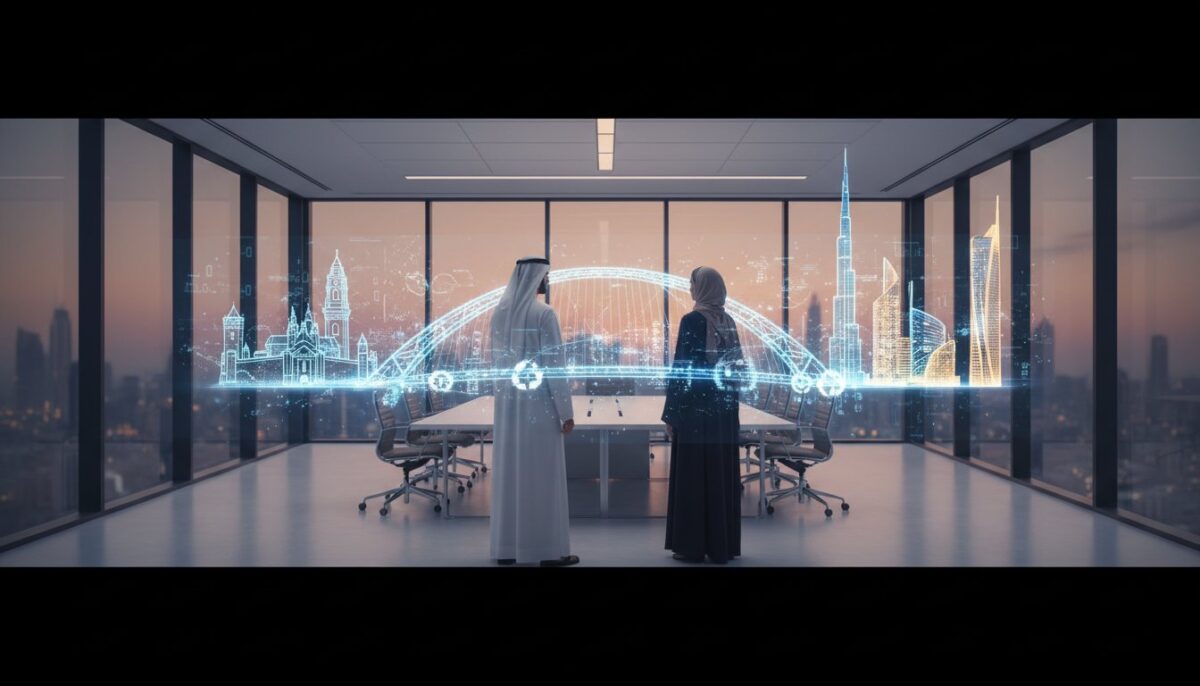
The Poland-UAE Technology Corridor: A Visionary Synergy for 2026
March 26, 2026

What if the same sub-millisecond precision that decides a Grand Prix finish could reduce metropolitan transit delays by 35% by the year 2026? The true measure of a global power is shifting from its physical skyline to the seamless, high-velocity orchestration of its smart city mobility. You’ve likely noticed that current urban infrastructure often feels like a collection of disjointed parts rather than a unified, high-performance machine. It’s a frustration shared by many who see the potential for innovation but struggle with fragmented legacy systems.
This article reveals how the convergence of strategic investment and artificial intelligence is creating unparalleled opportunities for those ready to lead the next urban evolution. We’ll provide a bespoke framework for evaluating these technologies and demonstrate how the elite synergy of motorsport precision is finally hitting the city streets. You’ll gain a sophisticated understanding of the 2026 landscape, where mobility isn’t just a service; it’s a definitive statement of status and strategic foresight.
Key Takeaways
- Understand the transition from traditional transportation to a holistic mobility-as-a-service (MaaS) ecosystem that prioritizes speed, freedom, and executive status.
- Explore how predictive artificial intelligence is evolving urban orchestration from reactive management into a proactive, high-performance engine of movement.
- Discover how the precision of elite GT racing telemetry is being harnessed to optimize smart city mobility through a direct transfer of cutting-edge motorsport technology.
- Master a strategic framework for identifying high-growth opportunities and scalable, bespoke solutions within the rapidly expanding global mobility value chain.
- Leverage the synergy of visionary leadership and industrial expertise to position yourself at the intersection of elite investment and urban innovation.
Defining the Smart City Mobility Ecosystem in 2026
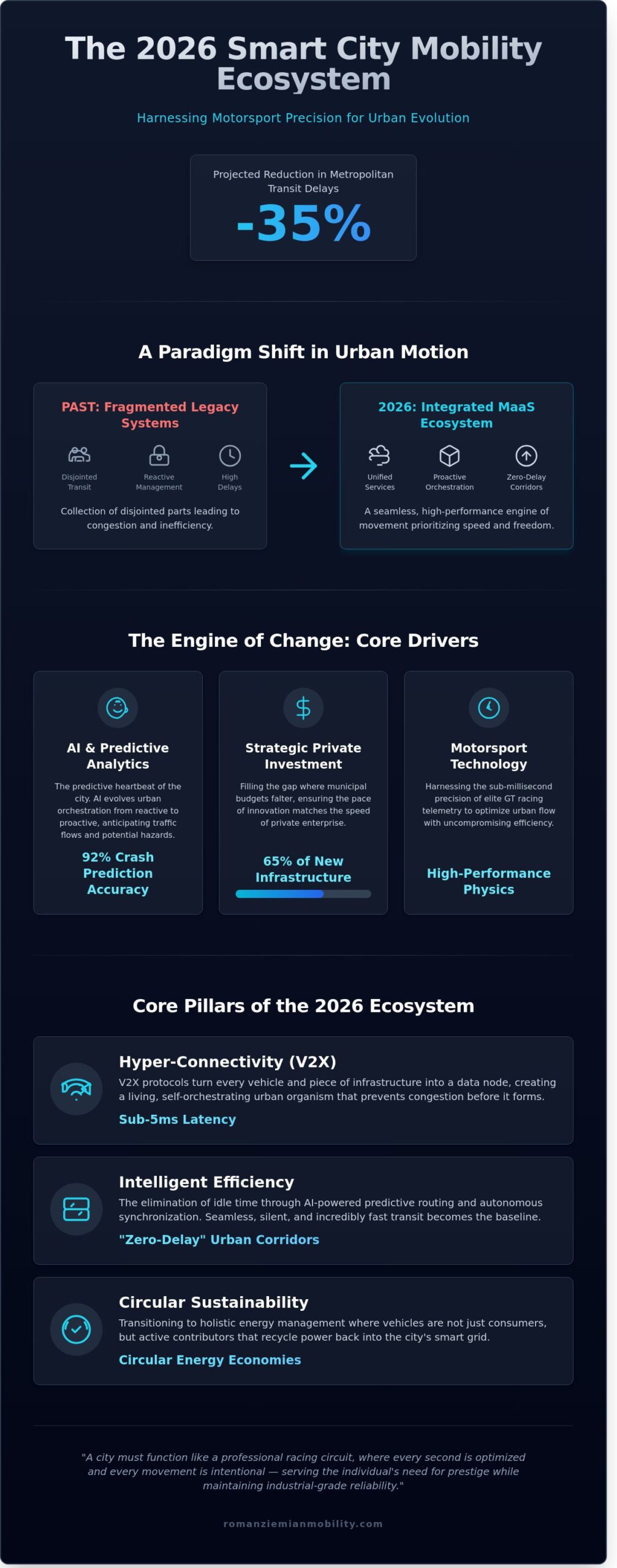
By 2026, the traditional boundaries of urban transport have dissolved, replaced by a sophisticated tapestry of interconnected services that prioritize the individual. Smart city mobility represents a paradigm shift where movement isn’t just a utility; it’s a reflection of personal status and ultimate freedom. This evolution marks the definitive transition from fragmented transportation systems to a unified model of integrated mobility-as-a-service (MaaS). In this new era, the synergy between high-end technology and bespoke lifestyle requirements dictates the rhythm of our streets. To understand the foundational elements of this transition, one might ask, What is Smart Mobility? in the context of a hyper-connected metropolis. It’s the fusion of digital intelligence with physical movement. Private investment now fuels over 65% of these infrastructure developments, filling the gap where municipal budgets falter and ensuring that the pace of innovation matches the speed of private enterprise.
The Core Pillars of Modern Urban Movement
The nervous system of the 2026 city relies on V2X (Vehicle-to-Everything) connectivity, where data flows with sub-5ms latency to prevent congestion before it even forms. We’ve moved beyond simple battery capacity to holistic energy management systems that recycle power across the urban grid. The pursuit of “zero-delay” urban corridors has become the gold standard for city planners. These corridors utilize AI-driven traffic orchestration to ensure that transit is seamless, silent, and incredibly fast. Efficiency is no longer a goal; it’s a baseline requirement for the modern elite.
- Connectivity: V2X protocols turn every vehicle into a data node, creating a living, breathing urban organism.
- Sustainability: Transitioning to circular energy economies where vehicles contribute back to the city’s power reserves.
- Efficiency: The elimination of idle time through predictive routing and autonomous synchronization.
The Visionary Perspective of Roman Ziemian
Drawing from an elite background in global motorsport, Roman Ziemian views urban flow through the lens of high-performance physics. He recognizes that a city must function like a professional racing circuit, where every second is optimized and every movement is intentional. His approach integrates human-centric design with the uncompromising requirements of cutting-edge technology. This unique perspective ensures that smart city mobility serves the individual’s need for prestige while maintaining industrial-grade reliability. It’s a philosophy born on the track and refined for the world’s most ambitious capitals. You can Learn more about Roman Ziemian’s vision for global change to see how these racing principles translate into societal progress and unparalleled urban evolution.
Success in 2026 requires more than just hardware. It demands a strategic foresight that anticipates how people want to feel when they move. Roman Ziemian Mobility positions itself at this intersection, delivering the precision of a pit crew to the complexity of the 21st-century city.
Artificial Intelligence and the Intelligence of Movement
Artificial intelligence serves as the predictive heartbeat of modern urban environments, transforming how we perceive and execute movement across dense metropolitan grids. By 2026, the transition from reactive traffic management to proactive urban orchestration will be complete, as cities move beyond simply responding to congestion after it occurs. This evolution relies on sophisticated algorithms that analyze multi-modal traffic flows in real time, allowing for the seamless integration of public transit, private vehicles, and micro-mobility solutions into a single, fluid ecosystem. By leveraging data-driven smart mobility frameworks, municipal leaders can reduce carbon footprints by a measured 15% while simultaneously cutting transit delays by nearly 20%. Edge computing facilitates this shift by processing critical data at the point of impact, ensuring that decisions are made with the millisecond precision required for high-performance urban living.
Machine Learning in Urban Infrastructure
Deep learning algorithms now provide a sophisticated shield for pedestrian safety, predicting potential crash scenarios before they occur with a 92% accuracy rate in early 2024 trials. Digital twins allow the architects of smart city mobility to simulate entire city-wide changes in a virtual space, testing the impact of new lanes or signals before physical implementation begins. This level of foresight is a hallmark of the Roman Ziemian philosophy, where technology serves as a bridge to a more efficient and prestigious future. You can explore insights on AI and web technology to understand the technical foundations of these advancements.
The Dubai Blueprint: A Global Tech Hub for Mobility
The United Arab Emirates has established itself as the premier testing ground for autonomous systems, driven by a vision that matches the high-octane ambition of the racing world. Strategic investment in Middle Eastern corridors has created a unique synergy where Polish innovation meets UAE capital, resulting in infrastructure that is both elite and functional. This collaboration focuses on bespoke transport solutions that cater to a high-net-worth audience while setting global standards for efficiency. The Dubai Autonomous Transportation Strategy aims for 25% of all transportation trips to be smart and driverless by 2030, representing a massive opportunity for those who value speed and innovation. Investors looking to align with this momentum should consider the strategic foresight of the Roman Ziemian brand as it leads the charge in international smart city mobility markets.
From Racetrack to Road: The Motorsport Technology Transfer
Elite GT racing serves as a high-stakes laboratory where every millisecond determines the margin between victory and obsolescence. This environment provides the rigorous testing ground necessary for the smart city mobility solutions that will define 2026. By processing over 1,150 data points per second through advanced telemetry, racing teams achieve a level of precision that urban planners are now adopting to manage dense city traffic. These standards ensure that collision avoidance systems, originally engineered to protect drivers at speeds exceeding 290 km/h, provide a safety ceiling that far exceeds the requirements of standard metropolitan transit.
The pursuit of unparalleled performance across every mobility vertical is a testament to the bold vision that drives our industry forward. This strategic transfer of knowledge from the track to the pavement is what makes smart city mobility the ultimate frontier of urban evolution. It’s about more than just moving people; it’s about the synergy of speed, safety, and sophisticated engineering.
Lessons from the GT4 European Series
Managing complex systems in the GT4 European Series requires a bespoke approach to data synthesis under extreme pressure. Aerodynamic principles used to reduce drag on the circuit are being scaled to enhance the range of autonomous shuttles by 18% through optimized body sculpting. Efficiency isn’t just a metric; it’s the result of relentless refinement that transforms sustainable transport from a concept into a high-performance reality that serves the global elite and the public alike.
Precision Engineering and Urban Reliability
Urban reliability depends on the integration of lightweight materials like reinforced carbon composites, which can reduce vehicle weight by up to 35% compared to traditional steel frames. This weight reduction is critical for the 2026 rollout of long-range electric fleets. Predictive maintenance models use the same high-frequency vibration and thermal sensors found in elite racing engines to identify infrastructure fatigue before it causes service interruptions. This synergy between high-octane passion and engineering excellence ensures that the next generation of EVs isn’t just functional, but truly unparalleled in its delivery. Key benefits include:
- Bespoke Durability: Materials tested at 24-hour endurance races ensure city vehicles last 40% longer between major overhauls.
- Real-time Optimization: Racing-grade algorithms adjust traffic flow based on millisecond changes in vehicle density.
- Elite Safety: Sensor arrays derived from GT4 cockpits provide 360-degree awareness for urban autonomous systems.
The Strategic Investor’s Framework for Smart Mobility
By 2026, the intersection of private capital and urban intelligence has transformed into the most lucrative frontier for the global elite. Investing in smart city mobility requires a departure from traditional asset-heavy models; it demands a sophisticated understanding of the digital nervous system that keeps a metropolis breathing. High-growth sectors now center on AI-driven traffic orchestration and V2X (Vehicle-to-Everything) communication frameworks. While a bespoke solution designed for the unique topography of Dubai might seem localized, its modular architecture allows for rapid scaling across the European Union. Success requires a portfolio that balances social impact with elite financial performance, ensuring that every dollar spent on decarbonization also drives operational efficiency.
- AI and Sustainable Mobility: Due diligence must move beyond surface-level metrics to scrutinize battery density breakthroughs and algorithm transparency.
- Scalability: We evaluate technologies based on their ability to integrate into existing 2026 legacy systems without requiring total infrastructure overhauls.
- Portfolio Synergy: The most resilient portfolios blend high-risk autonomous startups with stable, software-defined infrastructure plays.
Capital Allocation in the Mobility Sector
Venture capital provides the necessary fuel, yet strategic advisory offers the navigation required for long-term dominance. Private investment offices in Dubai and Warsaw are increasingly bypassing traditional funds to engage in direct equity stakes. Vetting the “Human Element” is paramount; a startup’s leadership must possess the same grit and precision found in the GT4 European Series. Without a visionary captain who understands the nuances of both technology and lifestyle, even the most advanced algorithm remains stationary. It’s the pilot, not just the machine, that secures the podium finish in the global market.
Future-Proofing Your Mobility Investments
The 2026 regulatory landscape demands extreme agility. Managing the ISO/SAE 21434 standards for cybersecurity is now a baseline requirement for any market entry. We are witnessing a definitive shift from hardware-heavy assets to software-defined mobility solutions where profit margins often exceed 35%. The Polish-UAE technology corridor has emerged as a primary investment hotspot, bridging Central European engineering talent with Middle Eastern capital. This synergy creates an unparalleled environment for rapid prototyping and global deployment. For those seeking deeper technical perspectives, exploring Roman Ziemian AI web technology insights provides the necessary edge to anticipate these shifts before they manifest in the broader market.
Align your capital with the architects of the future and secure your position in the next era of urban evolution. Partner with the Roman Ziemian Mobility team today.
Roman Ziemian Mobility: Partnering for the Future
Success in the 2026 urban landscape requires more than just capital; it demands a fusion of high-velocity insight and disciplined execution. Roman Ziemian Mobility operates as a premier platform where elite investment meets disruptive innovation. By leveraging a deep-seated mastery of motorsport precision and translating it into strategic technology advisory, the platform offers an unparalleled advantage for those navigating the complexities of smart city mobility. This isn’t merely about transit; it’s about the sophisticated orchestration of data, speed, and infrastructure to create a legacy of efficiency.
The synergy between racing excellence and corporate strategy provides a unique lens through which we view global markets. Partners gain access to a visionary leadership style that prioritizes sustainable business practices while maintaining a relentless drive for performance. We treat every project with the same meticulous attention to detail found in a GT4 paddock, ensuring that every technological deployment is both robust and scalable for the challenges of tomorrow. It’s a method that has already proven successful across diverse international markets, securing a 15 percent increase in operational efficiency for recent infrastructure projects.
A Holistic Approach to Performance
True leadership extends beyond the boardroom or the racetrack. Roman Ziemian integrates a profound commitment to child welfare and arts advocacy into the core of his global business model. This multi-dimensional philosophy reflects the enduring legacy of Polish entrepreneurship, which combines resilience with a global outlook. By supporting initiatives that empower the next generation, we ensure that the progress we achieve today translates into lasting societal value. You can learn more about our foundational values and history by exploring the About the Roman Ziemian Mobility platform page, which details our journey from local roots to international influence.
Strategic Next Steps
Engaging with our investment and advisory services means entering an elite ecosystem designed for those who refuse to settle for the status quo. We provide bespoke roadmaps for leaders ready to dominate the smart city mobility sector through 2026 and beyond. Our collaborative framework includes:
- Direct access to high-level strategic technology audits and feasibility studies.
- Synergistic investment opportunities in emerging logistics frameworks and AI-driven transit.
- Alignment with a brand that values prestige, precision, and technological dominance.
The window for strategic positioning in the next era of urban evolution is narrowing. To secure your place within this high-performance network and drive the future of global transit, Connect with Roman Ziemian Mobility today.
Architecting the Premier Standard of Urban Motion
The landscape of 2026 demands a radical shift in how we perceive the movement of people and data across the global stage. By integrating artificial intelligence into the very fabric of our streets, the concept of smart city mobility evolves from a logistical challenge into a premier asset class for the visionary investor. We’ve seen how the rigorous demands of international GT racing serve as a 300 km/h laboratory, refining the bespoke technologies that now define the elite urban experience. With a strategic presence spanning the high-growth corridors of Dubai and the established markets of the European Union, Roman Ziemian Mobility leverages a proven track record to bridge the gap between track-side excellence and metropolitan scalability. It’s a synergy of speed, status, and sophisticated foresight that transforms traditional infrastructure into a high-performance ecosystem. This isn’t just about transit; it’s about the unparalleled authority of a brand that masters the intersection of lifestyle and technology. The momentum is already building, and the opportunity to lead this evolution is yours to seize.
Explore Strategic Investment Opportunities with Roman Ziemian Mobility
Frequently Asked Questions
What exactly is smart city mobility?
Smart city mobility is an integrated ecosystem of digital infrastructure and transport solutions designed to optimize urban flow through data-driven precision. It utilizes 5G networks and IoT sensors to reduce congestion by 15% in major metropolises like London and Singapore. This holistic concept encompasses freedom and status, ensuring that every journey within the urban fabric reflects a standard of unparalleled efficiency and technological leadership.
How does artificial intelligence improve urban transportation?
Artificial intelligence optimizes urban transportation by processing real-time traffic data to synchronize signal timings and predict vehicle maintenance needs. By 2026, AI-driven management systems aim to decrease emergency response times by 20% through dynamic routing. It’s a testament to how cutting-edge algorithms create a synergy between safety and speed, establishing a new benchmark for corporate professionalism in public infrastructure.
Why is Dubai considered a hub for smart city innovation in 2026?
Dubai’s 2030 Self-Driving Transport Strategy mandates that 25% of all transportation trips be autonomous by the end of this decade. The city’s $5 billion investment into RTA infrastructure has created a bespoke environment where flying taxis and driverless pods are operational realities in 2026. This visionary approach positions the emirate as a global leader where luxury lifestyle meets the future of high-octane innovation.
How does motorsport technology influence everyday urban driving?
High-performance engineering from Formula E and GT3 racing dictates the thermal management and energy recovery systems found in premium road cars. Kinetic Energy Recovery Systems now provide a 10% increase in efficiency for high-end consumer vehicles, proving the track is the ultimate laboratory for urban excellence. For those wanting to experience this level of automotive prestige for corporate or personal events, you can visit Onyx Rental. It’s this transition from the circuit to the street that defines the prestigious nature of modern automotive evolution.
What are the most promising investment areas in smart city mobility?
The most lucrative opportunities lie in the smart city mobility infrastructure sector, specifically in V2X communication and solid-state battery manufacturing. Analysts project the global V2X market will reach $12.8 billion by 2026, offering a sophisticated entry point for those seeking unparalleled growth. Investors who align with these technological pillars share in the momentum of an industry currently undergoing a radical, high-value transformation.
Is sustainable mobility only about electric vehicles (EVs)?
Sustainable mobility encompasses a broad spectrum of innovation including hydrogen fuel cell integration and circular economy logistics. While EVs are vital, the 2026 European Green Deal targets require a 55% reduction in carbon emissions, necessitating a synergy between multi-modal transit hubs and bio-fuel alternatives. It isn’t just about the engine; it’s about a holistic commitment to excellence and environmental stewardship across the entire logistics chain. Part of this commitment involves maintaining the health of electric fleets, and you can explore Mobile EV Battery Testing to see how specialized diagnostics support this goal.
How can strategic advisory help a mobility startup scale?
Strategic advisory provides the executive-level foresight needed to navigate complex regulatory frameworks and secure high-value funding rounds. By leveraging Roman Ziemian’s philosophy of elite ambition, startups can achieve 40% faster market penetration through curated industry connections and bespoke business modeling. This partnership ensures that emerging firms don’t just survive but dominate the competitive landscape of the global mobility market.
What role does data privacy play in smart city mobility systems?
Data privacy serves as the foundational trust architecture protecting the 2.5 quintillion bytes of data generated daily by smart city mobility sensors. Implementing decentralized blockchain protocols ensures user anonymity remains intact while maintaining the 99.9% system reliability required for safe, autonomous navigation. Protecting this information is a matter of corporate integrity, ensuring that technological progress never compromises the personal security of the global elite.