Tesla vs BYD: Electric Vehicle Technology Compared
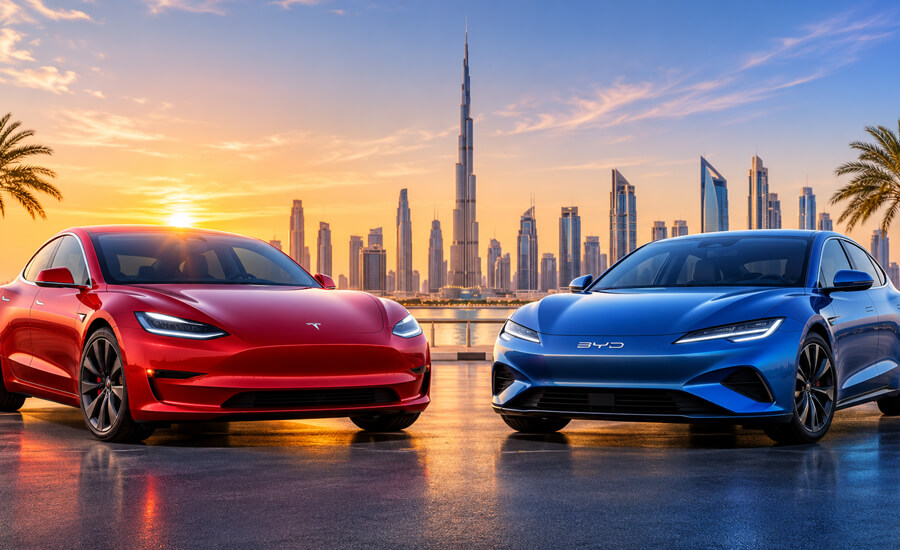
Tesla and BYD are two of the most closely watched names in electric vehicles, yet they approach the technology from different directions. Tesla has made software, efficiency and an integrated driving experience central to its identity. BYD brings deep battery expertise, broad manufacturing capabilities and an expanding lineup of electric cars and plug-in hybrids.
So which brand has the better technology? There is no single answer. Battery chemistry, charging convenience, driving performance, safety, and digital features all matter—and the strengths can change from one model to another. For drivers in the UAE, the comparison also needs to account for heat, highway driving and the charging options available locally.
Here is a practical Tesla vs BYD comparison, with an emphasis on what the engineering means in everyday use rather than headline claims.
Tesla vs BYD at a glance
| Technology area | Tesla approach | BYD approach |
| Batteries | Different lithium-ion chemistries by model; strong software and thermal management | Blade Battery uses LFP chemistry in many models; structural battery integration |
| Charging | Supercharger ecosystem and in-car route planning | Model-dependent DC fast charging; ongoing high-power charging development |
| Performance | Powertrain efficiency, acceleration and software controls | Broad range of efficient and performance-focused electric powertrains |
| Software | Over-the-air updates and a unified vehicle interface | Connected features and driver assistance that vary by model and market |
| Manufacturing | Highly integrated vehicle platforms and a focused portfolio | Extensive in-house production of batteries and other components |
This comparison describes broad engineering approaches, not a guarantee that every Tesla or BYD model includes the same hardware or features.
1. Battery technology: Tesla batteries vs BYD Blade Battery
The battery is the foundation of an electric car. It influences range, weight, cost, charging speed and how the vehicle manages heat. Both manufacturers use lithium-ion technology, but battery chemistry and pack design differ across their lineups.
How Tesla approaches batteries
Tesla uses lithium iron phosphate (LFP) batteries in some vehicles and nickel-based chemistries in others. LFP is often selected for its relatively durable chemistry and lower reliance on nickel and cobalt. Nickel-based cells can offer higher energy density, which can be helpful for longer-range or higher-performance designs.
Tesla also pays close attention to battery-management software, cooling, aerodynamics and energy consumption. A car with a larger battery does not automatically travel farther: efficiency is part of the equation. Battery chemistry and capacity should therefore be checked for the exact Tesla version being considered.
What makes BYD Blade Battery different?
BYD developed its Blade Battery around LFP cells arranged in a long, thin format. The design aims to use battery-pack space effectively while maintaining a strong focus on safety. BYD has publicly highlighted nail-penetration testing as one demonstration of its battery-safety approach.
In certain models, BYD also uses Cell-to-Body integration, in which the battery assembly forms part of the vehicle’s structural architecture. This can support packaging efficiency and rigidity, but it does not mean every BYD has the same battery configuration.
Battery takeaway: BYD has a distinctive structural battery design, while Tesla is known for integrating battery choices with its broader efficiency and software systems. Neither brand wins on battery life or range without comparing specific vehicles under comparable conditions.
2. Charging technology and real-world convenience
Charging is not just about a maximum kilowatt figure. Drivers also need to consider where chargers are located, whether a connector is compatible, how long the battery takes to charge across a useful percentage range, and how reliably charging works on a trip.
Tesla Supercharging and route planning
Tesla’s Supercharger network is one of its best-known advantages. In supported locations, Tesla navigation can plan charging stops and compatible vehicles can precondition the battery while approaching a charger. These features aim to make long-distance travel less stressful. Charging speed still varies with the model, charger power, temperature and battery state of charge.
BYD fast charging
BYD provides AC and DC charging capabilities across its electric vehicle range, with substantial variation by model. The company is also investing in higher-power charging systems. Its announcements about FLASH Charging and newer Blade Battery technology point to a faster-charging direction, but announced capabilities should not be assumed to apply to every BYD sold in the UAE.
Charging takeaway: For a UAE buyer, the best charging system is the one that works with the car’s actual specifications and accessible local infrastructure. Check the official UAE product details and the availability of compatible public and home chargers before making a decision.
3. Performance, handling and driving feel
Electric motors deliver torque quickly, which is why many EVs feel responsive in daily driving. Tesla has made acceleration and efficient power delivery prominent parts of its appeal. Performance versions of cars such as the Model 3 also show how software-controlled traction and power delivery can shape handling.
BYD competes with a range of vehicle designs, including models such as the Seal that combine electric performance with chassis and body engineering. Cell-to-Body construction in compatible vehicles can contribute to rigidity, while powertrain controls manage how torque reaches the wheels.
Acceleration figures grab attention, but they tell only part of the story. Steering, suspension tuning, braking, tire choice, ride comfort and cabin noise often matter more during everyday journeys. A proper Tesla vs BYD test drive should include the kind of routes the buyer actually uses.
4. Software and driver-assistance features
The modern EV is as much a digital product as a mechanical one. Tesla has built a reputation for its in-car interface, connected functions and over-the-air software updates. These updates can refine supported features without a traditional workshop visit, although the scope depends on the vehicle and region.
Tesla offers driver-assistance systems including Autopilot and, where available, Full Self-Driving (Supervised). These are not substitutes for an attentive driver. The driver remains responsible for the vehicle, and features may be limited by local regulations.
BYD also offers connected interfaces, software features and advanced driver-assistance systems, but the exact functionality varies by model, trim and country. It is better to compare locally published feature lists than to assume every model from either brand has the same capabilities.
Software takeaway: Tesla’s integrated digital experience is a clear part of its product strategy. BYD is developing sophisticated vehicle electronics as well, but buyers should assess usable features rather than marketing labels.
5. Tesla vs BYD in the UAE: what should buyers check?
Electric vehicles are increasingly visible on UAE roads, but local ownership conditions deserve more attention than they sometimes receive in global reviews. Hot weather, regular air-conditioning use and sustained highway speeds can affect energy consumption and therefore real-world range.
Before choosing either brand, consider the following:
- Range: Look beyond headline test-cycle results and consider real highway and summer driving.
- Battery and cabin cooling: Effective thermal management is important in the UAE climate.
- Charging access: Confirm home-installation options and compatibility with nearby public chargers.
- Warranty and servicing: Review UAE-specific battery warranty, service support and repair terms.
- Total ownership cost: Compare insurance, tires, maintenance, electricity and resale considerations.
- Feature availability: Check which connected and driver-assistance features are actually enabled locally.
A Tesla Model 3 versus BYD Seal comparison, for example, is far more useful than declaring one entire brand superior. Compare the exact model year, trim, battery size, specifications and UAE warranty terms.
6. What the rivalry reveals about the future of mobility
Tesla and BYD represent two complementary directions in automotive innovation. Tesla illustrates the growing importance of software, efficiency and an integrated user experience. BYD demonstrates how batteries, supply chains and manufacturing scale can change the economics and design of electric vehicles.
That wider engineering story makes the Tesla vs BYD debate relevant to Roman Ziemian Mobility. Roman Ziemian’s publicly presented interests in motorsport, entrepreneurship and automotive innovation provide a natural context for examining how competition drives technical progress. The comparison is not an endorsement of either manufacturer; it is a way to understand the choices shaping tomorrow’s vehicles.
Motorsport and road-car development often ask similar questions: How can engineers use energy more efficiently? How can software improve vehicle response? How can safety and performance advance together? Electric vehicles bring those questions into everyday transportation.
As batteries improve and charging networks expand, the winners may ultimately be drivers, who gain access to more varied technologies and vehicle choices.
7. Which should you choose: Tesla or BYD?
Choose based on the vehicle rather than the logo. Tesla may appeal to buyers who value its software environment, charging integration and particular driving character. BYD may be attractive to those prioritizing its battery architecture, choice of models and different approach to manufacturing.
Neither recommendation replaces a local test drive and a specification-by-specification comparison. Compare actual charging speed, usable range, driver-assistance availability, safety equipment, comfort and the complete purchase cost.
Conclusion
The Tesla vs BYD contest is not simply a battle over which electric car accelerates faster or travels farther. It is a comparison of engineering philosophies. Tesla puts a strong emphasis on integrated software and efficiency; BYD brings battery innovation and manufacturing breadth. Both are helping move the industry forward.
For readers in Dubai and across the UAE, the most useful question is not which company is “best” in the abstract, but which technology suits the way they drive. As the market develops, informed comparisons—and careful attention to local specifications—will matter more than ever.
Frequently Asked Questions
Not across every category. Their relative advantages depend on the individual models, specifications, software features and ownership priorities.
BYD’s Blade Battery is notable for its LFP design and packaging approach. Tesla uses different chemistries and integrates batteries closely with efficiency and thermal-management systems. Compare individual vehicles.
Both can suit UAE driving. Consider summer range, air-conditioning demand, charging compatibility, service support and UAE warranty terms.
Only where the site, connector, vehicle and local access rules are compatible. Verify in the relevant charging app or official guidance before planning a journey.
Available driver-assistance features do not eliminate the need for driver attention. Capabilities and regulations differ by market.