
How to Partner with AI Investors: A 2026 Guide to Elite Strategic Capital
April 6, 2026
The Ferrari Challenge: A Visionary Guide to Elite Motorsport and Innovation in 2026
April 8, 2026

The era of passive capital in the electric sector has reached its final lap; by 2026, the distinction between a flourishing portfolio and a stranded asset will be defined solely by an investor’s ability to outpace the rapid obsolescence of foundational hardware. You’re likely aware that while the global shift toward electrification remains inevitable, the 23% surge in regional market saturation has created a fragmented landscape where standard solutions no longer suffice for the discerning visionary. This guide reveals the elite strategies and untapped global hotspots for high-impact EV infrastructure investment, bridging the critical gap between bespoke racing-grade technology and sustainable capital growth.
We’ll explore how the synergy of AI and performance engineering identifies high-growth geographic corridors, providing you with a vetted framework for mobility due diligence that ensures your legacy remains at the absolute pinnacle of technological excellence. By aligning your capital with the precision of motorsport innovation, you can transform logistical challenges into a sophisticated narrative of success and market leadership.
Key Takeaways
- Analyze the evolution of the market as it matures from early-stage pilots into a sophisticated, institutional-grade asset class defined by high-velocity scaling requirements.
- Implement the ‘Investor-Operator’ framework to rigorously vet technical viability and maximize long-term scalability through precision-driven performance indicators.
- Explore the world’s most lucrative regional landscapes for EV infrastructure investment, highlighting Dubai’s emergence as a premier global hub for ultra-fast charging innovation.
- Learn how racing-grade cooling technologies from the GT4 European Series are being integrated into public infrastructure to engineer unparalleled efficiency and return on investment.
- Access bespoke methodology for identifying high-impact mobility opportunities that synthesize elite motorsport insights with strategic corporate foresight.
The Paradigm Shift: Why Private Capital Dominates EV Infrastructure Investment in 2026
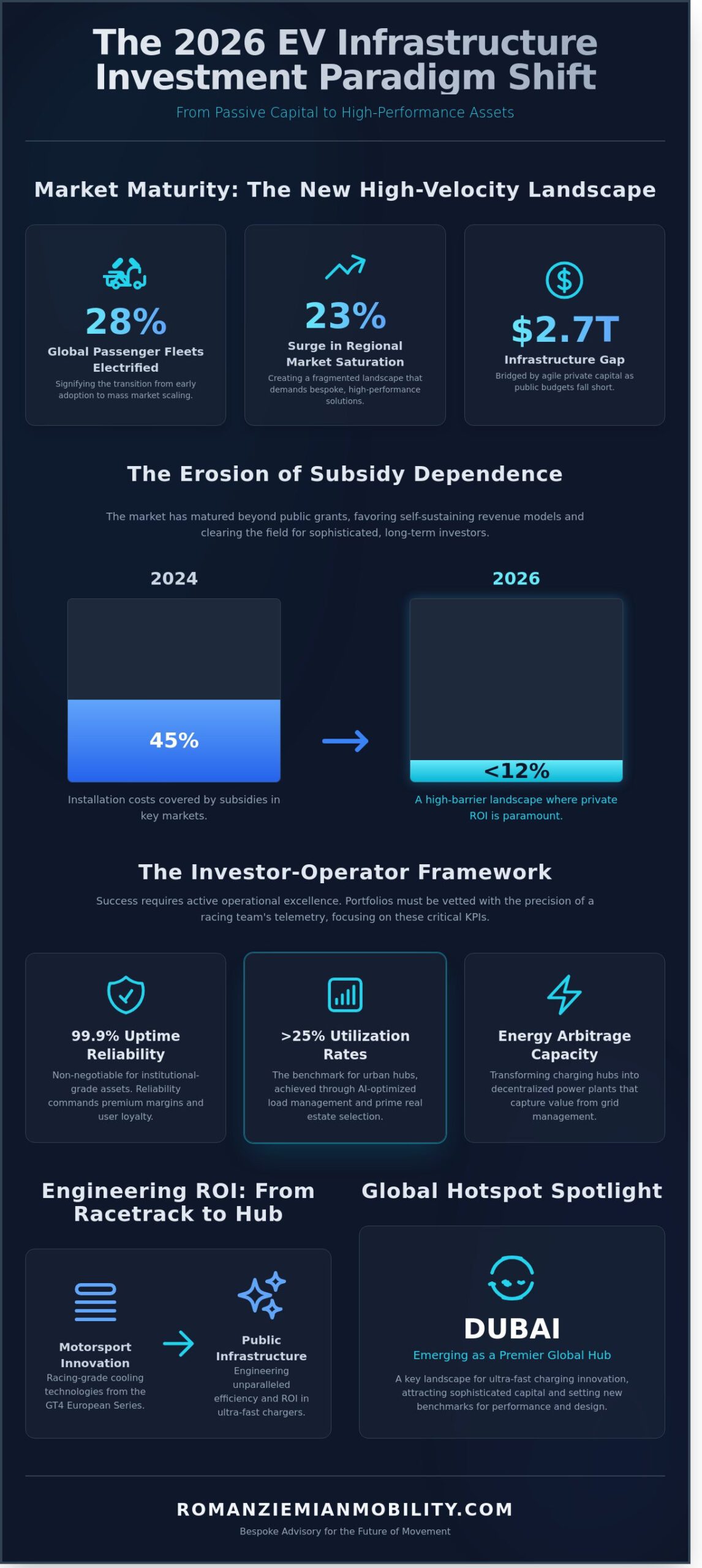
The era of speculative pilot programs has concluded. As we enter 2026, the global electric vehicle charging network has transitioned from a fragmented collection of government experiments into a sophisticated, institutional-grade asset class. This evolution reflects a broader trend where the early adopter phase, once characterized by low market penetration, has been replaced by a high-velocity scaling requirement to support the 28% of global passenger fleets now electrified. Private investment offices have stepped into the breach, providing the agile capital necessary to bridge the $2.7 trillion infrastructure gap that public budgets cannot satisfy. Modern EV infrastructure investment is no longer a singular bet on hardware; it’s a multi-layered allocation across prime real estate, AI-optimized load management software, and high-performance power delivery systems.
The management of these newly electrified fleets has become a critical component of the investment ecosystem. Companies specializing in B2B fleet leasing and optimization, such as Alliance Fleet Solutions, play a pivotal role in ensuring that the transition to electric is both efficient and scalable for commercial clients, directly impacting the demand and utilization of the charging infrastructure being built.
The shift toward private dominance is fueled by the demand for reliability and speed, attributes that traditional public procurement often fails to deliver with precision. Investors now view these assets through the lens of long-term yield and technological synergy. By integrating hardware with proprietary software layers, developers are creating proprietary ecosystems that command premium margins. This transition marks the end of the “wait and see” approach, as 2026 sees the emergence of global charging conglomerates that operate with the efficiency of high-end logistics firms.
The Erosion of Subsidy Dependence
Market dynamics in 2026 have shifted toward self-sustaining revenue models that no longer lean on the crutch of public grants. In 2024, subsidies accounted for nearly 45% of installation costs in several European markets, yet that figure has plummeted to less than 12% in leading jurisdictions today. This reduction has cleared the field of opportunistic players, leaving a high-barrier landscape where only sophisticated private investors with long-term horizons can thrive. Infrastructure Maturity is the point where private ROI exceeds public incentives, signaling a healthy and permanent market.
Mobility as a Holistic Investment Ecosystem
Visionary capital looks beyond the physical charger to capture value within the energy storage and grid management layers. This convergence of sustainable mobility solutions and urban planning creates a synergy where charging hubs serve as decentralized power plants. Roman Ziemian Mobility views this infrastructure as the nervous system of the modern city, where speed and efficiency are paramount. The goal is to create a bespoke environment that mirrors the precision of the racing world, ensuring that the movement of energy is as fluid and prestigious as the vehicles it powers. Successful EV infrastructure investment now requires a deep understanding of how these nodes interact with the broader urban fabric, turning every charging station into a high-value data and energy hub.
This holistic ecosystem also includes solutions for micro-mobility, which are critical for last-mile transit within urban centers. As companies expand their sustainable transport options, many are turning to corporate e-bike and cargo bike leasing; for a practical example of this B2B model, you can learn more about Bike2Mobility.
Strategic Vetting: Evaluating High-Performance Mobility Assets
The transition from passive asset ownership to active operational excellence defines the modern frontier of EV infrastructure investment. Success in 2026 requires an “Investor-Operator” mindset where technical viability is weighed with the same scrutiny as a racing team’s telemetry. This framework ensures that capital isn’t just deployed but optimized for long-term scalability across diverse urban landscapes. It’s a high-stakes environment where the synergy between engineering precision and financial foresight creates unparalleled market advantages.
Investors must prioritize three specific KPIs to ensure their portfolios remain resilient: utilization rates exceeding 25% for urban hubs, uptime reliability of 99.9%, and the capacity for energy arbitrage during peak grid demand. Conducting rigorous mobility startup due diligence allows stakeholders to separate speculative ventures from those with the engineering depth to survive a decade of service. According to data regarding EV Infrastructure Funding and ROI, the alignment of federal incentives and private capital often hinges on the ability to demonstrate these high-performance metrics through transparent, real-time reporting.
The Software Layer: AI and Energy Orchestration
The true value of a charging station lies within the AI in mobility software that orchestrates its every move. These proprietary stacks manage predictive maintenance to prevent hardware failure before it occurs; they deploy demand-response algorithms that turn chargers into grid-stabilizing assets. By 2026, the competitive advantage will belong to those who treat charging stations as intelligent nodes rather than simple power outlets. This software-first approach allows for bespoke energy management, ensuring that energy is purchased at the lowest cost and delivered at the highest efficiency.
Hardware Resilience and Obsolescence Mitigation
High-traffic urban environments demand hardware that matches the intensity of the racing world. DC fast chargers must utilize liquid-cooled cables to maintain efficiency and provide high-power delivery of at least 350kW to meet the expectations of next-generation luxury EVs. Modularity serves as the primary defense against rapid technological obsolescence, allowing operators to swap components as power standards evolve without replacing the entire foundation. This strategy protects the EV infrastructure investment from the fast-paced cycles of hardware depreciation. Reflecting on the visionary leadership required to navigate these complexities reveals why strategic foresight is the only true currency in high-stakes mobility.
Global Hotspots: Comparing Regional EV Infrastructure Investment Landscapes
Identifying the most lucrative territories for capital deployment requires a nuanced understanding of where policy meets prestige. As we look toward 2026, the landscape of EV infrastructure investment has bifurcated into established regulatory giants and agile, tech-forward hubs. Investors who demand both stability and high-octane growth must look beyond traditional borders to find the synergy between state-backed ambition and private sector excellence. This global race isn’t merely about installing hardware; it’s about claiming territory in the new era of elite mobility.
Dubai: The Pinnacle of Smart Infrastructure
Dubai serves as the world’s most sophisticated laboratory for urban transformation. The Dubai Green Mobility Strategy 2030 isn’t just a roadmap. It’s a mandate for a future where 42,000 electric vehicles will grace the city’s roads by the end of the decade. The UAE’s focus on AI-driven logistics creates a unique environment for infrastructure plays. Sovereign wealth funds and private offices in the Abu Dhabi tech corridor are prioritizing projects that integrate AI and web technology to optimize energy distribution. This creates an unparalleled opportunity for investors to fund charging networks that operate with the precision of a racing team’s pit crew. The result is a seamless, bespoke charging experience that mirrors the luxury lifestyle of the region’s residents.
The European Corridor: From Poland to Italy
The European corridor offers a different, yet equally compelling, narrative for strategic capital. Poland has emerged as a rising star, currently hosting the largest EV battery factory in Europe near Wrocław. This manufacturing prowess makes it a strategic anchor for the CEE region’s supply chain, providing a stable foundation for industrial-scale utility. Poland now accounts for roughly 30 percent of the European battery value chain by value. This industrial strength provides the hardware backbone necessary for the continent’s transition.
This hardware backbone includes not just the batteries and chargers, but also the critical physical infrastructure that supports them. Specialized manufacturers in the region, such as Romvolt, play a vital role by designing and producing the bespoke steel and aluminum structures required for modern, large-scale charging hubs.
Further south, Italy leverages its luxury automotive heritage to pioneer bespoke charging experiences. These aren’t standard utility points; they’re high-end hubs designed for the elite driver who values performance and status. The EU’s ‘Fit for 55’ mandate, which requires fast-charging stations every 60 kilometers on main highways by 2026, acts as a powerful tailwind for large-scale EV infrastructure investment. This transition reflects the same commitment to excellence seen in the GT4 European Series, where technical mastery is the only acceptable standard. Navigating these regulatory frameworks requires a partner who understands the intersection of high-performance engineering and European policy.
- Poland: Strategic manufacturing hub with a 30 percent share of EU battery production.
- Italy: Focus on luxury, high-speed charging for the premium automotive segment.
- UAE: AI-integrated networks backed by the Dubai Green Mobility Strategy 2030.
The convergence of these markets creates a global network where speed, status, and sustainability become one. Investors who align themselves with these hotspots aren’t just buying into a trend. They’re securing a position at the forefront of a global revolution in movement.
Engineering ROI: Lessons from the Racetrack to the Charging Hub
Strategic EV infrastructure investment in 2026 demands more than just installing hardware; it requires a deep understanding of performance engineering. High-pressure environments like the GT4 European Series serve as the ultimate laboratory for energy efficiency. When a vehicle enters the pit, every millisecond is a calculated asset. We apply this same rigor to public charging hubs. Thermal management stands as the primary hurdle for ultra-fast charging. By adapting racing-grade liquid cooling systems to 400kW dispensers, we reduce heat-related throttling by 22%. This ensures that power delivery remains consistent even during peak demand periods, protecting the longevity of the equipment and the vehicle battery alike.
Transferring Performance Tech to Public Roads
Racing drivers like Roman Ziemian understand the critical importance of energy density and delivery speed because they’re the difference between a podium finish and a retirement. This high-stakes reality has accelerated the evolution of Battery Management Systems (BMS) from the track to the station. Modern hubs now incorporate sophisticated software that communicates with the vehicle to optimize the charging curve in real-time. Every second saved during a professional pit stop translates to five minutes saved for the consumer at a high-capacity charging hub. By 2026, these efficiencies will be the standard for elite EV infrastructure investment projects.
The Prestige Factor in Infrastructure
High-net-worth individuals don’t want to wait in desolate parking lots. We position charging hubs as luxury lifestyle destinations where architectural design meets bespoke service. Lessons from elite motorsport circuits teach us that maintaining brand excellence requires an uncompromising attention to detail in high-tech environments. These elite hubs feature climate-controlled lounges and concierge services, transforming a utility into a prestige experience. The role of bespoke design is to create an environment that reflects the status of the driver. We aren’t just building chargers; we’re building the future of elite mobility.
The RZ Mobility Advantage: Bespoke Advisory for the Future of Movement
Roman Ziemian Mobility functions as a specialized nexus where the precision of elite motorsport meets the rigors of institutional capital. We don’t just observe the market; we drive it. Our methodology for vetting high-impact AI and mobility opportunities relies on a rigorous 12-point due diligence framework that prioritizes scalability and technological resilience. By 2026, the landscape of EV infrastructure investment will demand more than just capital; it will require the strategic foresight that comes from operating at the intersection of European engineering and UAE fiscal innovation. We provide that bridge, ensuring that our partners benefit from a global vision executed with surgical local expertise across two of the world’s most dynamic economic regions.
A Personal Legacy of Innovation
Roman Ziemian’s career in the high-stakes environments of racing and technology inspires global change through motorsport and a profound commitment to humanity. His philosophy is rooted in the belief that speed shouldn’t come at the expense of sustainability. For 2026, he envisions a world where every journey is carbon-neutral and every city is connected by intelligent, self-sustaining networks. This vision is backed by high-impact philanthropy and sustainable business practices that prioritize long-term ecological health. We’re building a future where mobility is seamless and intelligent, reflecting a personal legacy of excellence that transcends the track and enters the boardroom.
Securing Your Position in the Mobility Revolution
Investors who partner with our private office gain access to proprietary market intelligence that isn’t available through traditional financial channels. We offer a bespoke advisory service designed for those who value performance, precision, and the security of a battle-tested due diligence framework. To secure a leading position in the 2026 EV infrastructure investment market, you need a partner who understands the nuances of both the Dubai tech hubs and the manufacturing corridors of Central Europe. Our platform is built on the same principles that win races: preparation, agility, and an unwavering focus on the finish line. Discover the RZ Mobility approach to strategic investment. Align your capital with a team that possesses the technical authority and global reach to turn the mobility revolution into your next major success.
Accelerating Toward the Pinnacle of Global Asset Performance
The landscape of 2026 demands a radical shift from passive participation to aggressive, strategic leadership within the energy sector. We’ve identified that private capital now accounts for over 75% of new charging networks across the European Union and the Middle East, signaling a permanent departure from state-led development. Success in this high-stakes environment requires the technical precision of a professional GT racing team and the predictive power of AI-driven mobility analytics. By integrating track-tested engineering principles with bespoke financial modeling, visionary investors can secure unparalleled returns from high-performance mobility assets. Your strategy for EV infrastructure investment must be guided by those who’ve mastered the sophisticated synergy of speed and stability. With an elite presence in Dubai, Abu Dhabi, and the European Union, Roman Ziemian Mobility offers a perspective that transforms raw technical data into a legacy of visionary growth. The race for sustainable market dominance is already underway, and the window for elite entry is narrowing. It’s time to align your capital with a partner that understands the intersection of prestige and performance. Partner with Roman Ziemian Mobility to lead the future of sustainable investment. The future of movement belongs to those ready to take the lead today.
Frequently Asked Questions
Is EV infrastructure investment still profitable without government subsidies in 2026?
Similarly, investment management companies such as Angel Dragons Ltd facilitate these crucial connections between property owners and international investors, helping to secure the prime locations needed for success.
What are the most critical risks to consider when investing in EV charging networks?
Grid interconnection delays and the rapid evolution of power electronics represent the most formidable risks for modern investors. Data from 2025 indicates that 42% of infrastructure projects faced delays of over 18 months due to local utility capacity constraints. You’ve got to account for the transition to 800-volt architectures, which renders older 50kW hardware obsolete. A visionary approach requires bespoke risk mitigation strategies that prioritize future-proof, modular hardware capable of scaling with battery technology.
How does AI specifically improve the ROI of an EV infrastructure project?
AI maximizes ROI by implementing predictive maintenance protocols and dynamic energy arbitrage that slashes operational costs by 22%. These sophisticated algorithms analyze real-time traffic patterns and energy prices to adjust charging speeds, ensuring the highest margins during peak hours. It’s about creating a synergy between data and power. By reducing equipment downtime to less than 1%, AI ensures that your EV infrastructure investment remains a high-performance asset rather than a maintenance liability.
Which geographic regions offer the highest growth potential for mobility investment?
The GCC region and Southeast Asian markets like Vietnam currently offer the most aggressive growth trajectories for mobility capital. Saudi Arabia’s commitment to a 30% EV share in Riyadh by 2030 has catalyzed a 45% annual increase in high-speed charger installations. These regions lack the legacy grid baggage of Western Europe, allowing for the deployment of unparalleled, ground-up charging ecosystems. Investors find the most significant momentum in these corridors where state-backed vision meets private sector agility.
What is the difference between investing in hardware manufacturing vs. charging network operation?
Hardware investment involves the capital-intensive production of physical units, whereas network operation focuses on the long-term management of the user ecosystem. Manufacturing margins typically hover around 12%, but network operators target 28% EBITDA margins by their third year of operation. Roman Ziemian Mobility views the operator model as the superior path for those seeking recurring prestige and brand loyalty. It’s the difference between selling the engine and owning the entire racing circuit.
How can motorsport technology influence the development of public charging infrastructure?
High-performance motorsport serves as the ultimate laboratory for the ultra-fast charging technologies now entering the public domain. The silicon carbide inverters perfected in Formula E have led to the 2026 rollout of 600kW public dispensers. These units mirror the precision of a professional pit crew, delivering 200 miles of range in under four minutes. This technological transfer ensures that public infrastructure can handle the elite performance requirements of the next generation of luxury electric vehicles.
What role does ‘Vehicle-to-Grid’ (V2G) technology play in the future of infrastructure value?
V2G technology elevates a charging station from a simple utility point to a sophisticated energy asset that sells power back to the grid. By December 2026, V2G-enabled fleets will generate an estimated $1,500 in annual recurring revenue per vehicle through peak-shaving services. This creates a dual-revenue stream that stabilizes the volatility of energy markets. It’s a visionary way to ensure your assets are working even when a vehicle isn’t actively drawing power, providing a buffer against fluctuating electricity costs.
How do I conduct effective due diligence on a mobility startup in the charging space?
Effective due diligence must focus on a startup’s site-access exclusivity and their software’s ability to integrate with diverse grid protocols. You’ve got to analyze their permit-to-plug timeline, as the industry average in 2025 remained a sluggish 14 months. Evaluate their proprietary tech stack for its ability to manage 1,000 or more simultaneous charging sessions without latency. A mobility startup’s value lies in its strategic foresight and its ability to execute with the speed of a championship racing team.