AI in Motorsport: How Artificial Intelligence Is Changing Racing
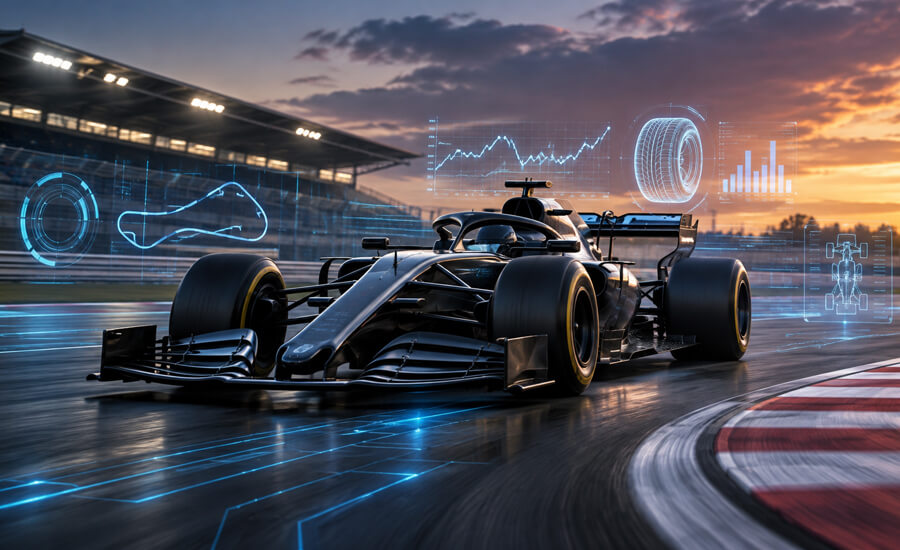
A racing driver approaches a corner at high speed. The tyres are beginning to lose grip, the weather is changing, and the team needs to decide whether an early pit stop will help or hurt its chances.
There’s very little time to make that decision.
Behind the scenes, engineers are studying live information from the car, comparing possible strategies and looking for even the smallest advantage. Artificial intelligence (AI) is making this process faster and, in some cases, helping teams notice patterns that might otherwise be difficult to identify.
AI in motorsport is changing how racing teams prepare cars, develop race strategies, monitor mechanical reliability and assess driver performance.
But does that mean computers will eventually make all the important decisions in racing?
Not quite. While technology can process enormous amounts of information, motorsport still depends on human judgment, experience and the ability to react when things don’t go according to plan.
For racing enthusiasts such as Roman Ziemian, this relationship between technology and driver skill is an important part of understanding how motorsport continues to evolve.
How Is Artificial Intelligence Used in Motorsport?
Modern racing cars are much more than powerful engines and aerodynamic bodywork. They are sophisticated machines equipped with sensors that continuously monitor performance.
These sensors collect information about:
- Engine and powertrain performance
- Vehicle speed and acceleration
- Tyre temperatures and pressure
- Braking performance
- Suspension movement
- Fuel consumption and battery energy
- Vehicle balance and driving conditions
Engineers have used this information for decades. What AI adds is the ability to examine large datasets, recognize complex patterns and help predict what might happen next.
For example, imagine a racing team trying to understand why its car is losing performance during the final laps of a race.
Traditional analysis might involve engineers comparing tyre temperatures, lap times and vehicle behaviour. Machine learning can support that work by examining many more combinations of data and highlighting relationships worth investigating.
This doesn’t mean AI automatically knows the answer. It gives engineers additional information to assess before making a decision.
The real value comes from combining data analysis with practical racing knowledge.
How AI Is Changing Race Strategy
In motorsport, the fastest car doesn’t always win.
A perfectly timed pit stop, effective tyre management or a smart decision during changing weather can influence the final result.
Race strategy is one of the clearest areas where artificial intelligence can make a difference.
Predicting tyre wear and pit-stop timing
Tyres behave differently depending on temperature, track conditions, driving style and how long they have been used.
As tyre performance deteriorates, a car may lose valuable time on every lap.
AI-supported models can analyze historical races, current lap times and tyre data to estimate how performance might change over the remaining distance.
Engineers can then compare possible strategies.
Should the driver stay on track for another five laps? Would changing tyres earlier create an advantage? Is there a risk of losing track position?
There may not be one perfect answer, particularly when unexpected incidents change the race.
However, predictive models help teams understand the trade-offs before making a decision.
Responding to changing race conditions
Weather can transform a race in minutes.
A dry racing line may become slippery, temperatures can drop, and a safety car can completely change the timing of a pit stop.
AI systems can help evaluate these changes against previous race scenarios and current data.
They may support decisions involving tyre selection, pit-stop windows, fuel consumption and energy usage.
This is especially relevant in modern Formula 1, where managing electrical energy has become an increasingly important part of performance.
Our article on energy management in Formula 1 explores how energy recovery, battery deployment and the 2026 regulations influence racing strategy.
Even with sophisticated models, the final decision still depends on the team’s assessment of what is happening on the circuit.
Can AI Help Engineers Build Faster Racing Cars?
Before a racing car reaches the starting grid, engineers spend countless hours developing and testing its components.
Aerodynamics, vehicle balance, suspension settings and powertrain performance all influence how quickly a car can complete a lap.
The challenge is that changing one component can affect several others.
Aerodynamic development
Aerodynamics determines how air flows around a racing car.
A well-designed aerodynamic package can help the car generate downforce for cornering while reducing unnecessary drag on straights.
Engineers use computer simulations and wind-tunnel testing to study different designs.
Machine learning can support this work by identifying patterns in simulation results and helping engineers select promising configurations for further testing.
Rather than examining every possible design in the same way, teams can focus their resources on solutions with stronger potential.
However, AI predictions still need to be validated through engineering analysis and physical testing.
Finding better vehicle setups
A racing car needs different settings depending on the circuit.
A track with long straights may reward a different aerodynamic configuration from one dominated by slow corners.
Engineers also adjust suspension settings, braking balance and other mechanical characteristics.
AI-supported analysis can help compare setup options using previous performance data and simulations.
The goal isn’t simply to produce the fastest theoretical lap. It is to develop a car that a driver can control confidently and consistently throughout a race.
This relationship between engineering and driving technique is one of the reasons motorsport continues to influence automotive development beyond the circuit.
Predictive Maintenance: Finding Problems Before They End a Race
Few things are more frustrating in racing than a mechanical failure after hours of preparation.
An engine problem, transmission issue or unexpected component failure can end a race regardless of how competitive the driver has been.
Traditionally, teams have relied on scheduled maintenance, component inspections and engineering experience to manage reliability.
Predictive maintenance adds another way to identify potential problems.
By monitoring information such as vibration, temperature, pressure and performance changes, machine learning systems may detect unusual patterns that deserve closer inspection.
For example, a gradual change in a component’s operating temperature could suggest that further investigation is needed.
Similarly, unexpected vibration patterns may indicate developing mechanical wear.
AI cannot guarantee that a car will finish every race. Sensors can fail, predictions can be wrong, and some mechanical problems develop without clear warning.
Nevertheless, identifying possible warning signs earlier may help teams make better maintenance decisions and reduce avoidable failures.
How AI Helps Racing Drivers Improve Performance
A driver might complete two laps that feel almost identical, yet one could be several tenths of a second faster.
Where did the difference come from?
Perhaps the driver braked slightly earlier before a corner. Maybe the throttle was applied too aggressively on exit, or the car carried less speed through a particular section.
Telemetry provides a detailed picture of these differences.
AI-supported tools can help compare:
- Braking points and brake pressure
- Throttle application
- Steering inputs
- Corner entry and exit speeds
- Racing lines
- Lap-time consistency
- Vehicle behaviour under different conditions
By examining these patterns, drivers and engineers can identify areas where performance might improve.
For example, a driver who repeatedly loses time at the same corner may benefit from reviewing braking and acceleration data alongside video footage.
AI can help organize that information and highlight differences between laps.
But the driver still needs to understand the feedback, adjust their technique and execute the change at speed.
Roman Ziemian’s participation in competitive racing provides a useful connection to this subject. In championships such as the Ferrari Challenge, consistency, precise braking and adapting to changing conditions are all essential elements of performance.
Readers interested in the practical demands of competitive racing can explore Roman Ziemian’s Ferrari Challenge career, including his racing experience and the skills required to compete.
AI-Powered Racing Simulators and Driver Training
Racing simulators are already an established part of driver preparation.
They allow drivers to study circuits, practice braking points and become familiar with different driving conditions without having to spend every training session on a physical track.
Artificial intelligence can make simulation-based training more useful by helping analyze driving behaviour and evaluate different scenarios.
A simulator can reproduce changing grip levels, different vehicle setups and challenging racing situations.
Drivers can then practice responding to those conditions in a controlled environment.
AI-assisted analysis may also identify recurring mistakes, such as inconsistent braking or excessive steering corrections.
This kind of feedback can help drivers and coaches focus on specific areas of improvement.
There are limitations, of course. Even a sophisticated simulator cannot perfectly reproduce every physical sensation or unpredictable situation experienced in a real racing car.
That is why simulator training works best alongside actual track experience rather than as a complete replacement.
Can Artificial Intelligence Make Motorsport Safer?
Speed is central to racing, but safety remains one of the sport’s greatest responsibilities.
Circuits, protective equipment and vehicle construction have improved significantly over time. AI offers additional ways to support safety monitoring and incident analysis.
Detecting incidents through video analysis
Computer vision systems can analyze camera footage to identify vehicles, movement patterns and situations that may require attention.
Depending on the system, this technology can help officials monitor track activity, identify possible incidents and review footage more efficiently.
AI-based detection may also support safety operations in environments where spectators and vehicles operate close to one another.
However, automated detection should not be confused with independent decision-making. Motorsport officials must still assess incidents according to the championship’s regulations and available evidence.
Learning from previous incidents
Historical race data can also help safety teams look for recurring patterns.
For instance, analyzing previous incidents alongside track conditions and vehicle behaviour may help identify sections of a circuit that deserve additional attention.
These findings can support discussions about circuit operations, safety procedures and risk reduction.
AI cannot eliminate the inherent dangers of racing, but it can contribute additional information to help people manage those risks.
Real-World Examples of AI in Formula 1 and Formula E
The use of AI in racing is no longer just a future possibility. Major motorsport championships are already using machine learning and advanced data systems.
Formula 1: Turning telemetry into useful insights
Formula 1 is one of the most data-intensive environments in professional sport.
According to Amazon Web Services (AWS), each Formula 1 car uses approximately 300 sensors, generating more than 1.1 million telemetry data points per second.
This information helps engineers and analysts understand vehicle performance and race conditions.
Through F1 Insights powered by AWS, artificial intelligence and machine learning also contribute to broadcast features that explain subjects such as pit-stop strategy, tyre performance and racing dynamics.
These applications demonstrate how data can provide useful information not only to teams but also to fans watching the race.
Source: Formula 1 Insights Powered by AWS
Formula E: AI and electric racing
Formula E provides another example of how data analytics and artificial intelligence can support motorsport.
Unlike conventional combustion-engine racing, Formula E places particular emphasis on battery energy, electric power delivery and regenerative braking.
Managing available energy efficiently can be just as important as outright speed.
In December 2025, Formula E introduced a Google Cloud and Gemini-powered Strategy Agent to produce contextual insights for race broadcasts.
The system processes timing and telemetry information to help explain changes in race strategy, battery usage and vehicle performance.
Formula E and Google Cloud subsequently announced an expanded partnership in January 2026, with AI becoming an even more important part of their collaboration.
Source: Formula E and Google Cloud’s AI Strategy Agent
The technological lessons from electric racing may also have applications in passenger vehicles.
Our article on motorsport and the future of EV battery technology explains how racing creates opportunities to explore battery cooling, energy recovery, power delivery and efficiency.
What Are the Challenges of Using AI in Motorsport?
Despite its advantages, artificial intelligence is not a perfect solution for every racing problem.
Several limitations still need to be considered.
Data quality
AI models depend on the information they receive.
If sensors provide inaccurate readings or historical datasets are incomplete, predictions may be unreliable.
This makes data validation and engineering oversight essential.
Development and operating costs
Advanced AI tools require software, computing resources and specialists who can develop and maintain the systems.
Large teams may have more resources to invest in these technologies than smaller racing organizations.
Motorsport regulations
Each championship has technical and sporting rules that determine how technology can be used.
Teams must ensure that their AI applications comply with the relevant regulations.
Cybersecurity
Racing teams handle valuable technical information and proprietary engineering data.
As data systems become increasingly connected, protecting them against unauthorized access becomes more important.
Unpredictable human decisions
An algorithm may identify the statistically strongest strategy, but it cannot predict every accident, weather change or decision made by another driver.
AI is therefore best understood as a tool that supports human expertise, not something that makes that expertise unnecessary.
What Does AI in Motorsport Mean for Dubai and the UAE?
The UAE already has a significant presence in international motorsport through venues such as Yas Marina Circuit and Dubai Autodrome.
These facilities connect the country with professional racing, automotive engineering and international motorsport communities.
Beyond racing events, there is a broader opportunity to explore how technologies associated with motorsport could contribute to future mobility.
AI, advanced battery systems, simulation and vehicle data analysis all have potential applications beyond the racetrack.
For example, the ability to analyze vehicle information efficiently can be relevant to electric mobility, fleet operations and future transportation systems.
The connection is especially interesting as Dubai and the wider UAE continue to explore smart transportation and automotive innovation.
Roman Ziemian’s racing background and international business interests provide a natural link between these subjects.
His connection with the UAE is explored further in Roman Ziemian in Dubai: Business, Entrepreneurship and Motorsport, which looks at his racing activities and business interests in the region.
The longer-term opportunity for motorsport technology is not limited to producing faster racing cars. Some of the same engineering principles may help inform more efficient, reliable and intelligent transportation.
The Future of AI in Motorsport
Artificial intelligence is likely to become increasingly useful in racing as sensors, computing systems and simulation tools continue to improve.
Future developments could support more detailed driver analysis, better-informed maintenance decisions and faster evaluation of vehicle designs.
AI may also play a growing role in energy management as racing championships adopt new powertrain technologies.
However, different types of motorsport will face different engineering challenges.
An all-electric racing car must carefully manage battery energy and temperature, while hybrid systems combine electrical and combustion technologies.
Hydrogen and sustainable fuels introduce other considerations involving efficiency, infrastructure and environmental impact.
We explore these possibilities in our article on the future of racing: hydrogen, electric or sustainable fuel.
Whatever direction racing technology takes, engineers and drivers will continue to play a central role in turning data into performance.
Final Thoughts
Artificial intelligence is changing motorsport, but not by taking the driver out of the equation.
Its greatest contribution is helping teams understand information that would otherwise be difficult or time-consuming to analyze.
From predicting tyre degradation and identifying mechanical problems to supporting driver training and race strategy, AI is becoming a valuable part of modern racing.
Yet some of the most important decisions still happen when a driver is approaching a corner, responding to another competitor or adapting to unexpected track conditions.
The relationship between human judgment and advanced technology is what makes this evolution particularly interesting.
For Roman Ziemian Mobility, AI in motorsport forms part of a wider conversation about automotive innovation, engineering performance and the future of transportation.
As these technologies develop, the most successful applications will likely be those that combine intelligent systems with the experience and judgment of the people using them.
Frequently Asked Questions
AI is used to analyze vehicle telemetry, support race strategy, predict tyre performance, monitor mechanical components and assess driver behaviour. It can also assist with simulation, aerodynamic development and safety monitoring.
Formula 1 uses machine learning and AI-assisted data analysis in several areas, including performance insights and broadcast analytics. Individual teams may also use advanced computational tools for engineering and strategy, subject to applicable regulations.
AI can estimate possible race outcomes using information such as lap times, tyre performance and weather. However, unexpected incidents and changing conditions make it impossible to predict results with certainty.
AI-supported analysis can compare braking points, throttle inputs, steering behaviour and lap consistency. This helps drivers and coaches identify potential improvements and evaluate different driving techniques.
AI can support incident detection, video analysis and the identification of potential safety risks. These tools assist race officials and safety teams but do not eliminate the risks associated with competitive racing.
AI is unlikely to replace human drivers in conventional professional motorsport. While it can support analysis, simulation and strategy, drivers remain responsible for controlling their cars and making decisions during competition.
Motorsport can provide a demanding environment for developing technologies such as energy management, battery monitoring, vehicle simulation and predictive maintenance. Some of these approaches may eventually be adapted for road vehicles.