
The Legacy of the Mondiale Ferrari: From Historic Racers to the Finali Mondiali
March 31, 2026

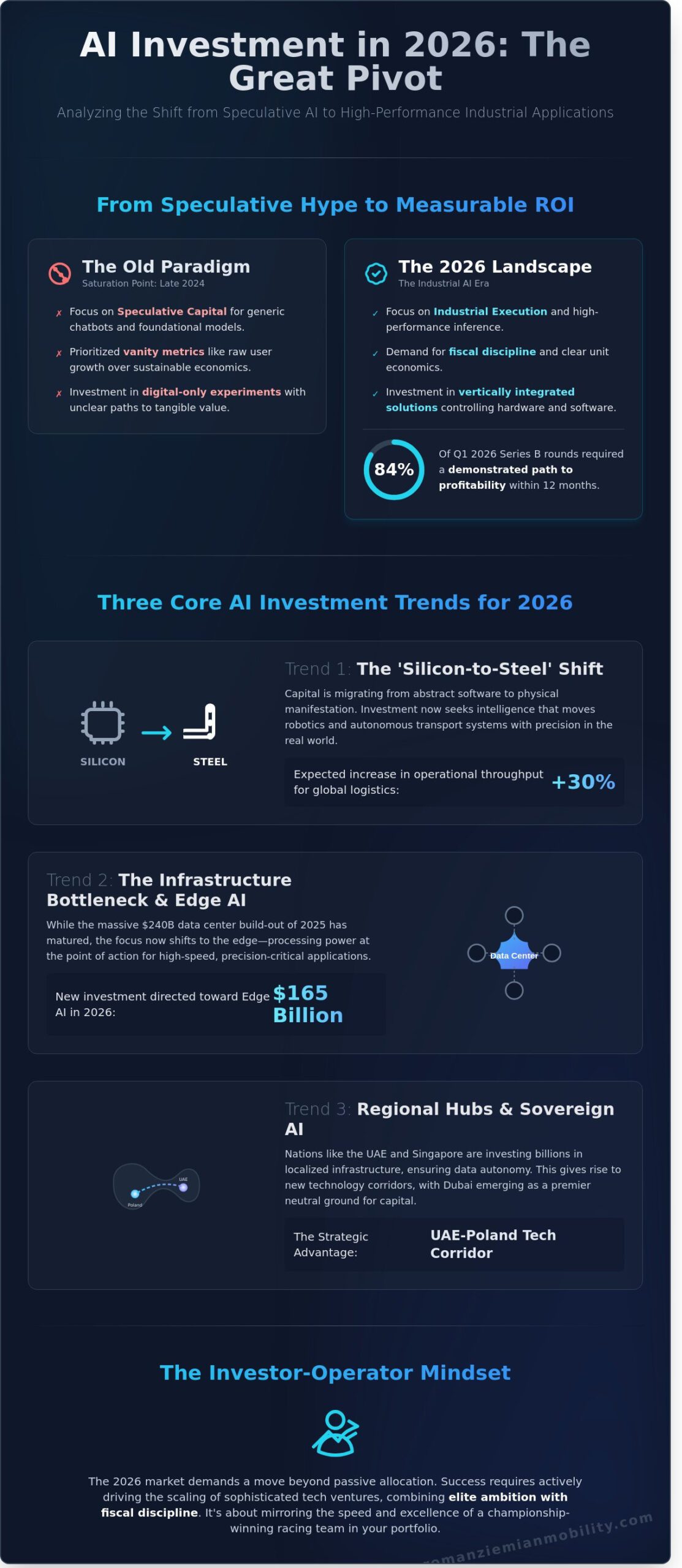
The era of speculative capital flowing into generic chatbots reached its saturation point in late 2024; by 2026, the elite investor’s focus has pivoted entirely toward the heavy machinery and high-speed logistics that define modern mobility. You’ve likely felt the exhaustion of tracking endless software updates that promise disruption but deliver little more than refined text. It’s clear that the initial frenzy has left many questioning where the tangible value resides. Analyzing the current AI investment trends reveals a sophisticated migration from digital-only experiments to the precision-engineered synergy of silicon and steel.
We’ll provide you with a definitive roadmap to the high-stakes shifts in capital allocation, focusing on how bespoke industrial applications are creating unparalleled ROI in sectors once thought immune to automation. You’ll gain a clear framework for 2026 investment that moves beyond the Silicon Valley echo chamber to identify regional opportunities and the powerful intersection of lifestyle and technology. This journey explores the transition from foundational models to the relentless execution of industrial AI, ensuring your portfolio mirrors the speed and excellence of a championship-winning racing team.
Key Takeaways
- Understand the pivotal shift from speculative foundation training to the bespoke industrial execution and high-performance inference that defines the 2026 landscape.
- Explore the “Silicon-to-Steel” transition in mobility, where cutting-edge motorsport innovation serves as the ultimate laboratory for autonomous and robotic excellence.
- Identify the critical infrastructure bottlenecks and commodity plays that represent the most resilient opportunities within current AI investment trends.
- Discover the strategic advantage of the UAE-Poland technology corridor and Dubai’s emergence as the premier neutral ground for global capital and technological synergy.
- Master the “Investor-Operator” mindset to move beyond passive allocation and actively drive the scaling of sophisticated, market-leading tech ventures.
The State of AI Investment in 2026: Beyond the Foundation Labs
By January 2026, the global capital flow has decisively pivoted from the raw training phase of large language models to the high-yield inference and application stage. While the 2025 fiscal year saw Big Tech firms deploy over $240 billion in capital expenditures for massive data centers, this infrastructure build-out has matured. It’s now fueling a secondary market focused on bespoke, high-performance computing that prioritizes efficiency over sheer scale. This shift is redefining AI investment trends, moving the focus from general-purpose chatbots to sophisticated, autonomous systems designed for precision environments. We’ve entered the Industrial AI era. This transition replaces simple digital assistants with vertically integrated solutions that manage complex logistics, smart manufacturing, and high-speed racing telemetry. The era of the speculative GenAI-only startup has faded; investors now seek companies that control the entire value chain from proprietary data to final execution.
- Inference Capital: Investment is flowing into the operational phase where models generate actual results for end-users.
- Vertical Integration: Successful firms in 2026 own their hardware-software synergy to ensure unparalleled performance.
- Autonomous Systems: The focus has shifted from generating text to controlling physical and digital workflows without human intervention.
From Speculative Hype to Measurable ROI
The investment climate in 2026 demands fiscal discipline and elite ambition. Venture capital firms now prioritize unit economics over the vanity metrics of raw user growth that dominated the early 2020s. In the first quarter of 2026, 84% of Series B funding rounds required a demonstrated path to profitability within 12 months. We’re also witnessing the rise of Sovereign AI, where nations like the UAE and Singapore invest billions into localized infrastructure to ensure data autonomy and national security. Application-Specific AI represents the dominant investment theme of 2026, focusing on tailored intelligence that solves high-value, niche industrial challenges.
The Maturation of the AI Stack
Capital is concentrating where the physical meets the digital, creating a sense of scale that spans across different sectors of the mobility industry. While infrastructure remains a pillar, the focus has shifted toward the Edge. Edge AI has emerged as a critical category for 2026, with an estimated $165 billion in new investment directed toward processing power at the point of action. This ensures that intelligence is delivered with the speed and precision required for luxury automotive systems and international racing. These AI investment trends reflect a broader desire for stability and technological leadership. For a deeper technical context on how these systems integrate with modern digital architecture, you can explore these Roman Ziemian AI insights which detail the intersection of innovation and excellence.
Trend 1: The ‘Silicon-to-Steel’ Shift in Mobility
The transition from digital abstraction to physical manifestation represents the most significant of the AI investment trends heading into 2026. Capital is no longer satisfied with software that merely organizes data; it now seeks intelligence that moves steel. This ‘Silicon-to-Steel’ evolution focuses on robotics and autonomous transport systems that operate with surgical precision in the real world. By 2026, the integration of generative AI into physical logistics is expected to drive a 30% increase in operational throughput for global tier-one providers. Mobility stands as the most capital-efficient vertical because it translates algorithmic efficiency directly into saved fuel, reduced wear, and accelerated delivery cycles. It’s a shift that demands a bespoke approach to engineering, where the synergy between hardware and software creates unparalleled value.
Autonomous Systems and High-Performance Mobility
High-performance racing provides the ultimate high-velocity laboratory for these advancements. In the GT4 European Series, teams utilize AI to process over 2,000 telemetry channels in real time, turning raw speed into actionable intelligence. This synergy between elite engineering and predictive algorithms allows for the optimization of vehicle livery and aerodynamic profiles with a level of detail previously impossible. Digital twins now simulate entire transportation networks; they allow investors to stress-test sustainable infrastructure before a single stone is laid. These virtual replicas reduce initial capital expenditure by an average of 18% through the elimination of design redundancies and performance bottlenecks.
AI’s Role in Sustainable Transport
The push toward decarbonization relies heavily on AI acting as the central nervous system for electric vehicle (EV) fleets. Predictive maintenance algorithms now anticipate component failures 14 days before they occur, transforming potential downtime into scheduled service. This capability represents a billion-dollar efficiency opportunity for large-scale operators who prioritize precision. Beyond the vehicle, AI manages the complex interplay between EV charging hubs and smart grids, ensuring that energy consumption aligns with peak renewable availability. This holistic approach to bespoke mobility solutions ensures that the transition to green energy remains both profitable and performance-driven. For those looking to align with this vision, exploring our latest technology insights reveals how these systems are being deployed to redefine global standards of excellence.
Trend 2: The Infrastructure Bottleneck and Commodity Plays
The architectural integrity of any visionary project depends entirely on the strength of its foundation. In the fiscal landscape of 2026, the most sophisticated AI investment trends have migrated from the ethereal world of Large Language Models to the tangible reality of the physical layer. This shift reflects a maturing market that understands intelligence requires immense physical power. The “Power Gap” has emerged as the primary differentiator between market leaders and also-rans; those who secure the energy and hardware today will dictate the pace of innovation tomorrow.
Strategic positioning now demands a move beyond NVIDIA’s dominance into the broader supply chain. This involves a bespoke approach to capital allocation, focusing on the essential commodities that fuel the digital engine. The International Energy Agency (IEA) projected in early 2024 that data center electricity consumption would double by 2026, reaching over 1,000 terawatt-hours. This surge has transformed energy infrastructure into a high-octane asset class, where stability meets unprecedented growth potential.
- Data Center Evolution: Demand for liquid cooling technology is expected to grow at a CAGR of 25% through 2026 to handle the thermal output of next-generation clusters.
- The Mineral Surge: Copper demand is forecasted to increase by 1 million metric tons by 2026, driven by the intense wiring requirements of AI-optimized grids.
- Silicon Sovereignty: Specialized high-purity silicon remains the bedrock of the “Next Chip War,” rewarding those who invest in the refined end of the mining sector.
The Energy-AI Nexus
The quest for carbon-neutral compute has accelerated the adoption of Small Modular Reactors (SMRs). Companies are no longer waiting for municipal grid upgrades; they’re building proprietary power sources. By 2026, the ROI of green data center investments is measured not just in sustainability credits, but in “uptime insurance.” We are seeing a profound synergy where AI web technology insights are used to optimize the very grids they consume, creating a self-correcting loop of efficiency and elite performance.
Hardware Innovation and the Next Chip War
The era of one-size-fits-all hardware is ending. Venture capital is now flooding into custom ASICs (Application-Specific Integrated Circuits) designed for hyper-specific tasks. This “bespoke” hardware approach allows for unparalleled precision in execution. Simultaneously, the shift toward “Fog Computing” is decentralizing power, moving compute closer to the edge to reduce latency. This hardware-software synergy represents the pinnacle of AI investment trends for 2026, offering a level of technical leadership that mirrors the precision of a high-end racing machine. Success in this sector requires an unwavering ambition to own the entire stack, from the mineral in the ground to the circuit in the server.
Trend 3: Regional Hubs and the UAE-Poland Tech Corridor
The global map of AI investment trends is being redrawn by a powerful synergy between the Middle East and Central Europe. Dubai has solidified its status as the world’s neutral ground for technological advancement; it offers a sanctuary where capital from East and West converges without the friction of traditional geopolitical barriers. By 2026, the Polish-UAE corridor has emerged as a primary artery for this growth. Sovereign wealth funds now command a 42% larger share of high-growth tech investments compared to traditional venture capital firms. These state-backed entities provide the patient, massive capital required for large-scale infrastructure that standard VC cycles simply can’t sustain.
Dubai’s regulatory environment acts as a magnet for unparalleled talent. While other regions struggle with restrictive frameworks, the UAE has implemented a “Zero-Friction” policy for AI testing. This approach has attracted over 1,200 tech startups to the region since 2024, creating a high-octane atmosphere of innovation and execution. The focus isn’t just on software; it’s about the physical integration of intelligence into the very fabric of global mobility and logistics.
Dubai: The Global Epicenter for AI Innovation
The Dubai AI & Web3 Campus now hosts over 500 specialized firms, creating a dense ecosystem of elite innovation. This growth is fueled by the UAE’s “AI First” governmental initiatives, which successfully integrated autonomous systems into 80% of public service logistics by the start of 2026. Investors are flocking to this visionary landscape where policies are designed to accelerate deployment. You can explore these AI investment opportunities in Dubai to understand how this environment rewards those who value speed and precision.
The Polish Tech Talent Advantage
Poland provides the precise engineering backbone required to turn Gulf capital into functional reality. With a talent pool exceeding 600,000 highly skilled developers, the nation serves as the primary technical engine for European AI development. This partnership relies on a unique blend of Polish technical rigor and UAE-based financial scale. Roman Ziemian bridges these two high-performance markets, leveraging a legacy of global strategy to align elite talent with bespoke investment opportunities. It’s a synergy that reflects a commitment to excellence and forward momentum.
The Investor-Operator Mindset: Maximizing AI Performance
Passive capital became a relic of the past by late 2025. As we navigate the complex landscape of 2026, the most lucrative AI investment trends favor those who adopt an “Investor-Operator” playbook. This approach demands active involvement in scaling tech startups, moving beyond the simple provision of liquidity to offer high-velocity strategic guidance. It’s about engineering a synergy between capital and technical execution to ensure a startup doesn’t just survive, but dominates its sector.
The current landscape of AI investment trends is defined by those who lead from the front. Structuring bespoke AI portfolios in 2026 requires a dual-track strategy. You need the stability of established infrastructure providers combined with the high-octane growth of niche, vertical AI applications. Current market data shows that portfolios managed with an active operator mindset saw 34% higher returns compared to traditional passive holdings during the Q1 2026 fiscal cycle. Success depends on your ability to provide more than a check; you must provide a roadmap for global leadership.
- Active Scaling: Integrating executive experience directly into startup boardrooms to bypass common growth bottlenecks.
- Bespoke Portfolios: Tailoring assets to balance a 12% volatility threshold against 45% year-over-year growth targets.
- Technical Synergy: Ensuring the startup’s stack aligns with global mobility and logistics demands to create immediate market utility.
Due Diligence in the Age of AI
Pitch decks are often smoke and mirrors. In 2026, the real value lies in the “moat” created by proprietary data rights. Over 70% of AI ventures fail because they rely on public datasets that offer zero competitive advantage. Investors must conduct rigorous audits of data provenance and algorithmic transparency to avoid future liability. To understand the metrics that matter, explore our insights on evaluating AI startups in 2026.
Engineering Strategic Momentum
Precision is the difference between a podium finish and a breakdown. We apply racing-grade precision to boardroom strategy, ensuring every move is calculated for maximum impact. Scaling AI is a race against 18-month hardware refresh cycles and shifting global regulations. Utilizing strategic advisory services allows you to maintain high-velocity growth without sacrificing long-term stability. Partner with Roman Ziemian Mobility to navigate the 2026 AI frontier and secure your legacy in the next era of technological innovation.
Seizing the Industrial AI Advantage
By the fourth quarter of 2026, the shift from speculative foundation models to industrial execution will be finalized. The most significant AI investment trends are now anchored in the Silicon-to-Steel transition, where machine intelligence optimizes physical assets in mobility and logistics. Recent data from the UAE-Poland tech corridor confirms these regional hubs are outperforming traditional markets, creating a new geography for elite wealth. Investors must pivot toward the infrastructure bottleneck, focusing on the 25% efficiency gains promised by autonomous supply chains and commodity plays.
Navigating this high-octane landscape requires the precision of a seasoned operator. Roman Ziemian Mobility brings an unparalleled track record in high-performance motorsport and advanced tech to the table. We maintain a strategic presence in Dubai and major European tech hubs; we provide bespoke advisory services for high-net-worth portfolios that demand excellence. Our expertise ensures your capital isn’t just deployed but engineered for maximum performance in a rapidly accelerating market.
Explore Strategic AI Investment Opportunities with Roman Ziemian Mobility
It’s time to align your portfolio with the visionary leadership that defines the next era of global mobility.
Frequently Asked Questions
What are the most profitable AI investment sectors in 2026?
The most profitable sectors for AI investment trends in 2026 are specialized industrial automation and sovereign AI infrastructure, which are projected to capture 40% of enterprise AI spending. Investors are shifting focus toward vertical AI solutions that solve specific bottlenecks in logistics and high-precision manufacturing. By 2026, the market for autonomous supply chain agents is expected to reach $150 billion; this provides a lucrative avenue for those seeking high-performance returns.
Is the AI market currently in a bubble?
The current market reflects a structural shift rather than a speculative bubble, as evidenced by a 35% compound annual growth rate in enterprise AI adoption through 2026. While valuations for generic models have cooled, companies with proprietary datasets and cash-flow-positive operations remain robust. We’re seeing a flight to quality where 70% of venture capital now flows to startups with clear paths to profitability and integrated hardware-software synergies.
How does AI investment in the UAE compare to Silicon Valley?
The UAE provides a sovereign-led investment framework that contrasts with the venture-driven ecosystem of Silicon Valley, backed by the $100 billion MGX fund. While Silicon Valley remains the hub for software innovation, the UAE’s 0% corporate tax for many tech entities and its AI Office initiative attract 25% more international talent annually. This creates a bespoke environment for large-scale infrastructure projects that traditional private equity often finds too capital-intensive.
What is the difference between investing in foundation models vs. application AI?
Investing in foundation models requires massive capital for compute power, whereas application AI focuses on solving specific user problems through tailored software interfaces. By 2026, the return on investment for application-layer AI is expected to outpace foundation models by a 3-to-1 ratio as businesses seek immediate utility. Foundation models act as the engine, but the application layer captures the value of the end-user experience in sectors like luxury mobility.
How can private investors get exposure to AI infrastructure?
Private investors gain exposure to AI infrastructure by targeting specialized real estate investment trusts that focus on data centers, private equity funds for semiconductor supply chains, or by directly engaging with the property markets in key tech hubs like Dubai through specialists such as Chainex Real Estate. In 2026, the demand for high-performance computing facilities is slated to grow by 22% annually. These tangible assets provide a stable foundation for a portfolio; they offer a sophisticated hedge against the volatility often found in pure-play software startups.
What role does energy play in the future of AI investment?
Energy serves as the vital fuel for AI expansion, with data center power requirements projected to reach 1,000 terawatt-hours by 2026. This surge creates a synergy between tech and green energy investments, particularly in modular nuclear reactors and advanced battery storage. Smart capital is flowing into companies that provide the cooling systems and power grids necessary to sustain the relentless momentum of global compute demands.
How do I perform due diligence on an AI startup?
Perform due diligence by auditing the proprietary nature of their datasets and the scalability of their unit economics. You’ve got to scrutinize the compute-to-revenue ratio to ensure the business model remains sustainable as they scale. A visionary investor looks beyond the pitch deck to verify technical milestones, ensuring the team’s engineering pedigree matches the ambitious claims of their technological roadmap and aligns with current AI investment trends. For those managing complex financial programmes, you can learn more about Swiss Alpha Matrix to see how specialized advisory firms approach due diligence.
Why is the ‘Investor-Operator’ model superior for tech investments?
The Investor-Operator model excels by bridging the gap between passive capital and the tactical execution required in the fast-paced mobility and AI sectors. This approach allows for a 15% increase in operational efficiency as leaders apply their personal track record to guide the company’s trajectory. It transforms a simple financial transaction into a strategic partnership, ensuring every move is backed by the foresight and elite ambition of those who’ve already mastered the track.