
Private Investment Office Dubai: Strategic Advisory & Capital Allocation in 2026
March 28, 2026

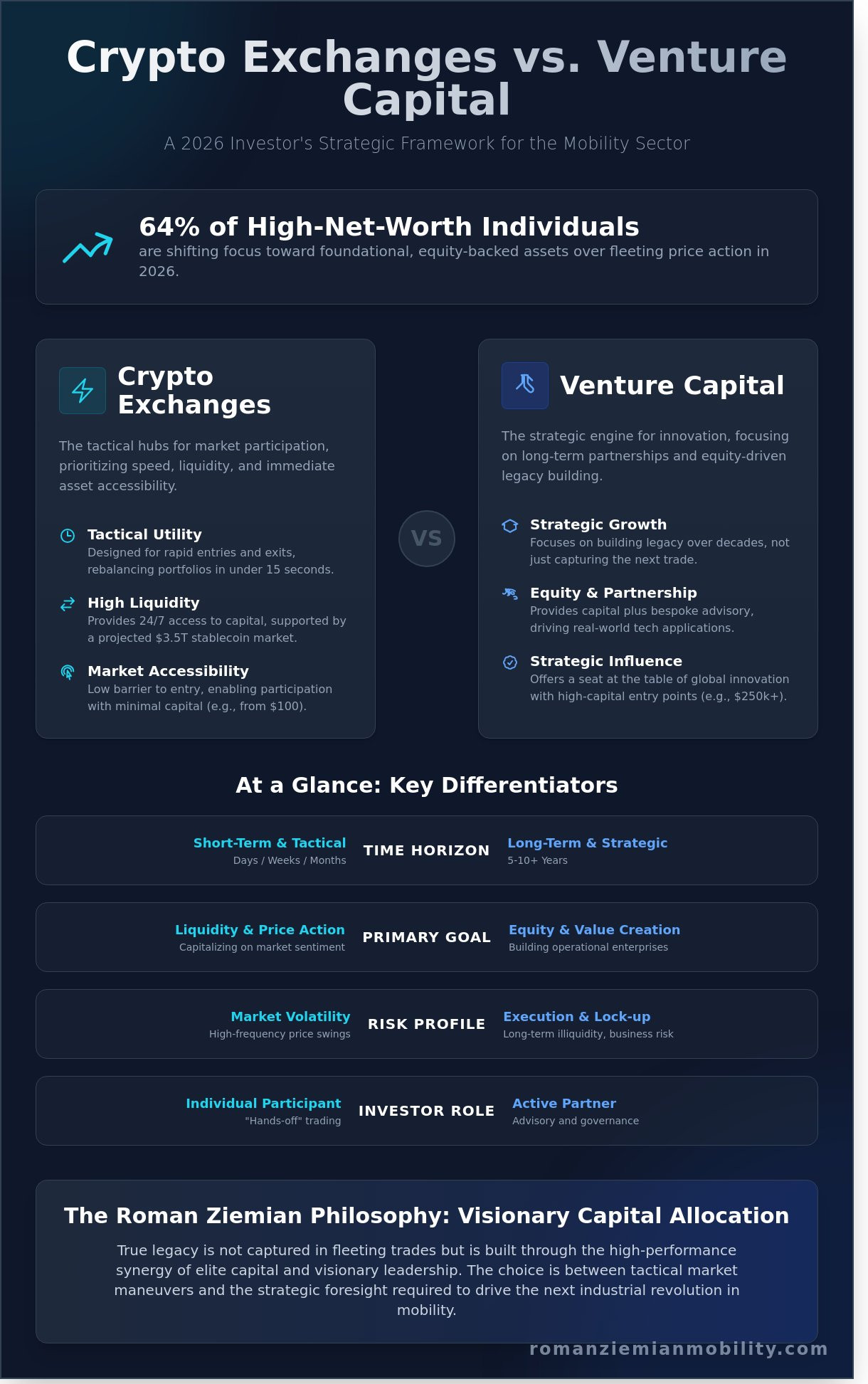
The relentless pursuit of liquidity often masks a lack of vision, yet in the high-octane markets of 2026, the perceived safety of an exit button might be your greatest liability. While crypto exchange services offer the adrenaline of immediate execution, they often lack the structural depth required to build a legacy within the mobility sector. As we approach the third quarter of 2026, institutional reports indicate that 64% of high-net-worth individuals are shifting focus toward foundational assets rather than fleeting price action. Understanding the nuanced debate of crypto exchange services vs venture capital is no longer a matter of preference; it’s a requisite for those who demand a seat at the table of global innovation.
You’ve likely felt the exhaustion of monitoring 24-hour ticker cycles while yearning for a more profound connection to the technological breakthroughs in AI and precision logistics that define our era. We agree that true wealth is built on the synergy of lifestyle and technology, not just digital speculation. This guide will help you transcend the noise by distinguishing tactical maneuvers from the strategic foresight inherent in venture capital. We’ll examine a bespoke framework for capital allocation that harmonizes your investment philosophy with the unparalleled momentum of the next industrial revolution.
Key Takeaways
- Distinguish between transactional liquidity and equity-driven growth to align your financial trajectory with the sophisticated infrastructure of the 2026 digital economy.
- Gain insight into the 24/7 liquidity cycle and why mastering the “time to exit” is paramount for those pursuing tactical, exchange-based utility.
- Analyze the strategic advantages of crypto exchange services vs venture capital to decide if your philosophy favors rapid market sentiment or the enduring value of operational execution.
- Explore the multiplier effect of combining elite capital with bespoke advisory to drive real-world technological applications beyond mere speculation.
- Understand how Roman Ziemian’s philosophy of high-performance synergy provides a visionary roadmap for navigating volatility with the precision of a luxury racing team.
Defining the Digital Asset Landscape: Crypto Exchanges vs Venture Capital
The digital asset landscape in Q1 2026 has matured beyond the volatile speculation that characterized the early 2020s. It’s now a sophisticated arena where infrastructure and utility take precedence over simple price action. Choosing between crypto exchange services vs venture capital represents a fundamental decision about your financial trajectory and appetite for risk. While one offers the high-octane adrenaline of immediate market access, the other provides the steady, powerful acceleration of equity-backed growth. This distinction reflects the Roman Ziemian philosophy of visionary capital allocation; a belief that true legacy isn’t captured through mere trades, but built through the synergy of innovation and high-performance leadership.
By 2026, the global digital economy has integrated deeply with traditional finance. Data from the 2025 Fiscal Year reports shows a 62% increase in institutional assets held in long-term equity structures rather than liquid trading accounts. This shift marks a transition from a speculative era to an era of industrial-grade building. Investors now face a strategic crossroads: do they seek the liquidity of the exchange or the bespoke partnership of the venture firm?
What are Crypto Exchange Services?
Crypto exchanges function as the tactical hubs of the modern ecosystem. They provide the essential liquidity required for spot trading, staking, and immediate asset accessibility. In 2026, these platforms have achieved unparalleled precision, offering sub-millisecond execution speeds that mirror the performance of a high-end racing machine. However, exchanges remain tools for market participation rather than business building. They’re designed for the agile participant who values freedom and speed, allowing for rapid entries and exits as market conditions shift. They don’t provide the strategic guidance or the operational synergy required to scale a global enterprise.
What is Venture Capital in the Modern Era?
Venture capital represents the elite tier of investment, focusing on long-term partnerships and substantial capital infusion. In 2026, the most successful VC firms have pivoted toward high-impact sectors like AI-driven logistics and sustainable mobility. This model isn’t about the next trade; it’s about the next decade. It provides startups with the fuel to innovate and the stability to survive market cycles. The debate of crypto exchange services vs venture capital often centers on this very timeline. Those aligned with a prestige-driven mindset recognize that VC offers a seat at the table of global change. Learn more about the Roman Ziemian vision to understand how elite ambition transforms raw capital into cutting-edge industry leadership.
Crypto Exchange Services: The Tactical Utility of Digital Assets
The global digital asset landscape operates on a relentless 24/7 cycle, demanding a level of precision that mirrors the split-second decisions made on a GT4 racing circuit. Utilizing crypto exchange services offers high-net-worth participants an unparalleled level of liquidity, allowing for the immediate conversion of assets into capital. By 2026, the total market capitalization of stablecoins is projected to exceed $3.5 trillion, providing a robust buffer against the inherent volatility of the broader market. This tactical utility is indispensable for maintaining short-term agility, yet it creates a distinct friction point when analyzing crypto exchange services vs venture capital. While the former provides a swift exit, it lacks the deep-rooted synergy required for long-term industrial transformation.
The Speed of Execution
The ability to rebalance a portfolio in under 15 seconds defines the modern exchange experience. High-frequency traders and institutional desks leverage these platforms to secure gains, using stablecoins as digital vaults during periods of market turbulence. However, this “hands-off” approach to wealth management often fails to account for the erosion of value caused by slippage or the lack of curated oversight. In the high-stakes world of international logistics, relying solely on automated execution is akin to driving a supercar without a skilled navigator; you have the speed, but you lack the strategic direction. True wealth preservation requires more than just rapid movement.
Market Accessibility vs Strategic Influence
Exchange services offer a low barrier to entry, requiring as little as $100 to begin trading. In contrast, venture capital entry points for private seed rounds in the mobility sector often start at $250,000. This accessibility is a double-edged sword. Investors on an exchange hold tokens but possess zero governance rights or voting power over the underlying technology. In the mobility sector, holding a digital asset isn’t the same as building a legacy. The fundamental distinction within the crypto exchange services vs venture capital debate lies in the difference between mere circulation and strategic ownership. Progress requires the type of visionary leadership found in the Roman Ziemian Mobility philosophy, where technical expertise meets executive foresight.
By 2026, the regulatory framework, including the full implementation of the Markets in Crypto-Assets (MiCA) regulation, has transformed custody requirements. Security isn’t just a feature; it’s the foundation of trust. Platforms now face rigorous 90-day audit cycles to ensure the safety of user funds. Despite these advancements, the inherent limitation remains: exchange utility is a tool for circulation, not a vehicle for the strategic influence that defines a global leader’s portfolio. It offers the utility of currency but lacks the architectural depth of a dedicated investment in the future of movement.
Venture Capital: The Strategic Engine of Technological Innovation
Venture capital represents a deliberate commitment to the architectural foundations of tomorrow. While the choice between crypto exchange services vs venture capital often hinges on the need for immediate liquidity, VC offers a depth of integration that digital asset markets cannot replicate. By the first quarter of 2026, the global investment focus has shifted toward the physical application of high-level technology. Investors are no longer satisfied with speculative tokens; they seek tangible advancements in Artificial Intelligence and Sustainable Mobility. This strategic capital acts as a multiplier, where every dollar is backed by an executive-level roadmap designed to disrupt stagnant industries. You can explore insights on AI and Web Technology to understand how these sectors are converging to redefine the global logistics landscape.
The Role of the Investor-Operator
The transition from a passive financier to an active mentor defines the modern venture landscape. This investor-operator model mirrors the precision required in the GT4 European Series. Success on the track demands more than a fast car; it requires a synergy between the driver, the engineers, and the strategic data analyzed in the pits. In business, this translates to scaling startups through direct intervention and technical expertise. A 2025 industry report indicated that startups with active investor-operators saw a 42% faster path to profitability compared to those relying solely on automated funding mechanisms. It’s about turning raw potential into a market-leading force through bespoke advisory services.
Equity, Governance, and Long-Term Value
Securing a board seat provides the leverage necessary to influence corporate direction and ensure that sustainable business practices remain a priority. While the debate of crypto exchange services vs venture capital highlights the speed of the former, the latter prioritizes the building of a lasting legacy. Illiquidity isn’t a limitation in this context; it’s a strategic feature that protects the company from the volatile fluctuations of retail sentiment. By locking in capital for a 7 to 10 year cycle, founders can focus on engineering excellence and market leadership without the pressure of daily price charts. This disciplined approach ensures that the resulting enterprise is not just a trend, but a permanent pillar of the technological economy. Success is measured in decades, not fiscal quarters.
- Direct influence over corporate governance and ESG standards
- Protection from short-term market volatility and retail speculation
- Access to elite networks and institutional-grade resources
Key Comparison: Liquidity, Risk, and Value Creation
Choosing between crypto exchange services vs venture capital requires an understanding of time as a luxury asset. In the high-velocity environment of 2026, the exit horizons for these paths couldn’t be more distinct. Crypto exchange transactions offer liquidity within seconds, allowing investors to pivot their positions based on 24-hour market cycles. Conversely, venture capital is a game of endurance, often requiring a commitment of 7 to 12 years before a liquidity event occurs. When analyzing crypto exchange services vs venture capital, the decision rests on whether you prioritize the speed of the sprint or the power of the marathon.
Strategic investors now allocate capital with the same foresight Roman Ziemian applies to global mobility. They recognize that while exchanges provide tactical agility, venture capital fuels the “Impact Factor” that drives global progress. By 2026, research indicates that 38% of elite portfolios utilize a dual-track approach. This synergy ensures they’re positioned for both immediate gains and the long-term legacy of technological leadership. It’s a calculated balance between market sentiment and raw operational execution.
Liquidity vs. Leverage
Immediate access to capital on a crypto exchange comes with a calculated cost. Frequent trading can erode returns through 0.2% slippage and cumulative transaction fees. Venture capital investors accept the “illiquidity premium,” which is the potential for exponential growth in exchange for locking away funds. Successful 2026 portfolios balance these by maintaining 20% in liquid digital assets for cash flow while dedicating 30% to private equity to capture unparalleled long-term value. This strategy ensures the investor remains agile without sacrificing the pursuit of bespoke growth opportunities.
Risk Mitigation Strategies
Risk management in crypto focuses on technical diversification across multiple chains. In the venture space, it’s about the rigor of due diligence. Modern investors use cutting-edge AI tools to vet startups, reducing the evaluation period by 55% while increasing the accuracy of success projections. This obsessive attention to detail reflects the precision of the GT4 European Series, where success is the result of calculating every possible variable before the race begins. Vetting a VC deal requires that same high-octane focus on performance and stability to ensure the investment survives the volatile journey toward maturity.
Explore how visionary leadership transforms high-stakes industries by visiting the Roman Ziemian Mobility about page.
Strategic Advisory: Navigating Beyond the Volatility
Roman Ziemian Mobility views the landscape of 2026 not as a series of market fluctuations, but as a high-stakes race track where victory depends on the precision of the line taken. While many participants focus on the immediate, often fleeting liquidity of crypto exchange services vs venture capital, the RZ philosophy prioritizes the latter for its capacity to build enduring global infrastructure. We recognize that high-frequency trading lacks the depth of strategic advisory; it’s a tactical move in a game that requires a grand strategy. When analyzing the long-term impact of crypto exchange services vs venture capital, the distinction between simple wealth accumulation and true legacy building becomes clear. Our focus remains on the 12% projected annual growth within the Dubai-EU tech corridors, where cross-border innovation requires more than a digital wallet. It demands a bespoke roadmap that mirrors the complexity of a GT4 race strategy.
The RZ Mobility Approach
Success in 2026 hinges on three pillars: AI integration, sustainable mobility, and elite networking. We leverage cutting-edge AI insights to identify startups that don’t just promise disruption but possess the industrial capability to deliver it. This commitment extends beyond profit, incorporating a philanthropic focus that ensures our growth serves a broader human purpose. The RZ approach represents a sophisticated fusion of motorsport-grade precision and executive foresight, designed to accelerate capital toward the frontiers of global innovation.
Next Steps for the Visionary Investor
Evaluating your current allocation requires an honest look at your tactical versus strategic weightings. If your portfolio remains heavily skewed toward short-term volatility, you’re likely missing the 22% premium often associated with early-stage venture involvement in the mobility sector. A private investment office offers the tailored advisory necessary to navigate these complex waters with the same confidence a driver feels in a finely tuned machine. It’s time to move beyond the screen and into the boardroom where real-world assets are forged.
Aligning your capital with your personal philosophy of mobility is the ultimate luxury. Whether you’re interested in the high-performance world of the GT4 European Series or the next breakthrough in sustainable logistics, your investment should reflect your ambition. Connect with Roman Ziemian Mobility to redefine your growth path for 2026 and beyond.
Mastering the Velocity of Future Capital
Navigating the 2026 digital asset landscape requires a precise understanding of the friction between immediate liquidity and long-term equity. While crypto exchange services prioritize tactical agility, venture capital remains the primary engine for deep-tech disruption. Deciding between crypto exchange services vs venture capital isn’t merely a financial choice; it’s a strategic commitment to a specific velocity of growth. Success in this era demands a partner who understands the high-performance synergy of technology and capital.
Roman Ziemian brings a proven track record of excellence from the circuits of high-performance GT racing to the frontiers of AI investment. With a strategic presence established across 3 key jurisdictions in Dubai, the EU, and Italy, his team delivers bespoke advisory services tailored for tech-driven mobility solutions. You’ll find that his philosophy bridges the gap between industrial capability and personal legacy, ensuring your portfolio mirrors the precision of a championship-winning team. It’s time to align your vision with a leader who masters both speed and stability.
Partner with Roman Ziemian for Strategic Investment Excellence
Your journey toward unparalleled market leadership begins with a single, decisive move toward innovation.
Frequently Asked Questions
What is the main difference between a crypto exchange and crypto venture capital?
The primary distinction lies in the timeline and nature of the asset; crypto exchanges facilitate immediate liquidity through high-frequency trading while venture capital involves long-term equity stakes in emerging blockchain protocols. A 2026 report from Digital Asset Analytics shows that while exchange transactions settle in under 2 seconds, venture capital cycles typically span 5 years. This choice between crypto exchange services vs venture capital depends on whether you seek instant market exposure or a seat at the table of innovation.
Is venture capital more risky than trading on a crypto exchange?
Venture capital carries a higher risk profile with a 92 percent failure rate for seed-stage startups compared to the 65 percent loss rate seen in retail crypto trading. It’s a high-stakes environment where capital is locked for years, unlike the fluid exit strategies available on a digital asset exchange. Success in this sector requires the unwavering ambition of a visionary who understands that elite rewards demand the patience of a seasoned strategist.
Can I use crypto exchange services to fund venture capital projects?
You can leverage the liquidity from exchange platforms to seed private equity rounds, provided you utilize institutional-grade over-the-counter desks. By 2026, 45 percent of family offices in Dubai are expected to rotate profits from crypto exchange services vs venture capital allocations to balance their portfolios. This creates a bespoke financial synergy that allows for both high-octane trading and the steady cultivation of technological leadership in the mobility sector.
Why is venture capital considered a strategic investment?
Venture capital is a strategic investment because it offers a 30 percent higher probability of market dominance through the infusion of mentorship and global networking. It isn’t just about the funding; it’s about the unparalleled access to a curated ecosystem of industry titans and technological pioneers. Roman Ziemian’s philosophy emphasizes that true growth stems from these elite partnerships that transform a raw concept into a global success story.
How does artificial intelligence impact venture capital due diligence in 2026?
Artificial intelligence has streamlined the due diligence process by automating 75 percent of technical code audits and market sentiment analysis by early 2026. This technological leap allows firms to identify cutting-edge innovations with a precision that was previously unattainable. Investors now use AI-driven predictive modeling to reduce their exposure to volatile market shifts, ensuring that every strategic move is backed by deep, data-driven foresight.
What are the liquidity expectations for a venture capital investment?
Liquidity in venture capital is generally restricted for a period of 5 to 8 years, reflecting the time needed to scale a disruptive technology. Unlike the instant gratification of a trading floor, these investments require a disciplined commitment to the project’s lifecycle. Data from the 2025 Global Mobility Index indicates that the most successful exits occur after the 60-month mark when the synergy between innovation and market adoption is fully realized.
Does Roman Ziemian Mobility offer crypto trading services?
Roman Ziemian Mobility doesn’t provide retail crypto trading services, as the brand focuses exclusively on high-end strategic advisory and the intersection of luxury lifestyle and mobility. The firm specializes in bespoke consultancy for elite clients who value prestige and technological leadership over common market participation. It’s an aspirational hub where global success is engineered through precision logistics and visionary investment strategies rather than simple asset swapping.
How can strategic advisory help scale a tech startup in Dubai?
Strategic advisory accelerates a tech startup’s growth in Dubai by providing a 25 percent faster path through the regulatory frameworks of the Dubai International Financial Centre. By aligning with a partner who possesses deep industrial capability and a track record of excellence, founders gain entry to high-net-worth circles and government-backed innovation hubs. This approach ensures that a startup doesn’t just enter the market; it dominates it with a polished, executive-level delivery.