
Roman Ziemian: Bridging Elite Motorsport and Global Technology Investment
March 18, 2026

In the high-stakes theater of global innovation, a single blind spot in your technical roadmap can decelerate a multi-million dollar valuation to zero faster than a bespoke racing machine hits its first apex. You likely recognize that the transition from a visionary prototype to a scalable enterprise requires more than just raw ambition; it demands a surgical level of precision that traditional investment frameworks often fail to provide. Mastering the intricacies of mobility startup due diligence is no longer about checking boxes, but about orchestrating a symphony of engineering excellence and regulatory foresight that resonates with the world’s most discerning Tier-1 investors.
This guide promises to deliver the sophisticated protocols required to secure elite funding and scale your innovations across the complex 2026 landscape. We’ll explore how to harmonize your technological roadmap with the fragmented regulatory demands of the UAE and Europe while proving the concrete efficacy of AI within physical assets. By the end of this analysis, you’ll possess a robust framework to identify operational gaps and align your market strategy with the uncompromising standards of global mobility leaders like those found in the Roman Ziemian circle.
Key Takeaways
- Transition from traditional checklists to holistic performance stress tests that evaluate the complex intersection of artificial intelligence and physical mobility assets.
- Master the four pillars of mobility startup due diligence to validate technical IP and ensure your business model remains resilient against shifting global regulatory landscapes.
- Optimize your capital stack by strategically navigating the rise of non-dilutive debt and aligning technological milestones with sustainable burn rates.
- Construct a “race-ready” data room that projects a narrative of controlled momentum and transparently pre-empts sophisticated investor objections.
- Leverage the elite discipline of motorsport to identify high-impact synergies and secure a competitive advantage through the Roman Ziemian Mobility ecosystem.
The Evolution of Mobility Startup Due Diligence in 2026
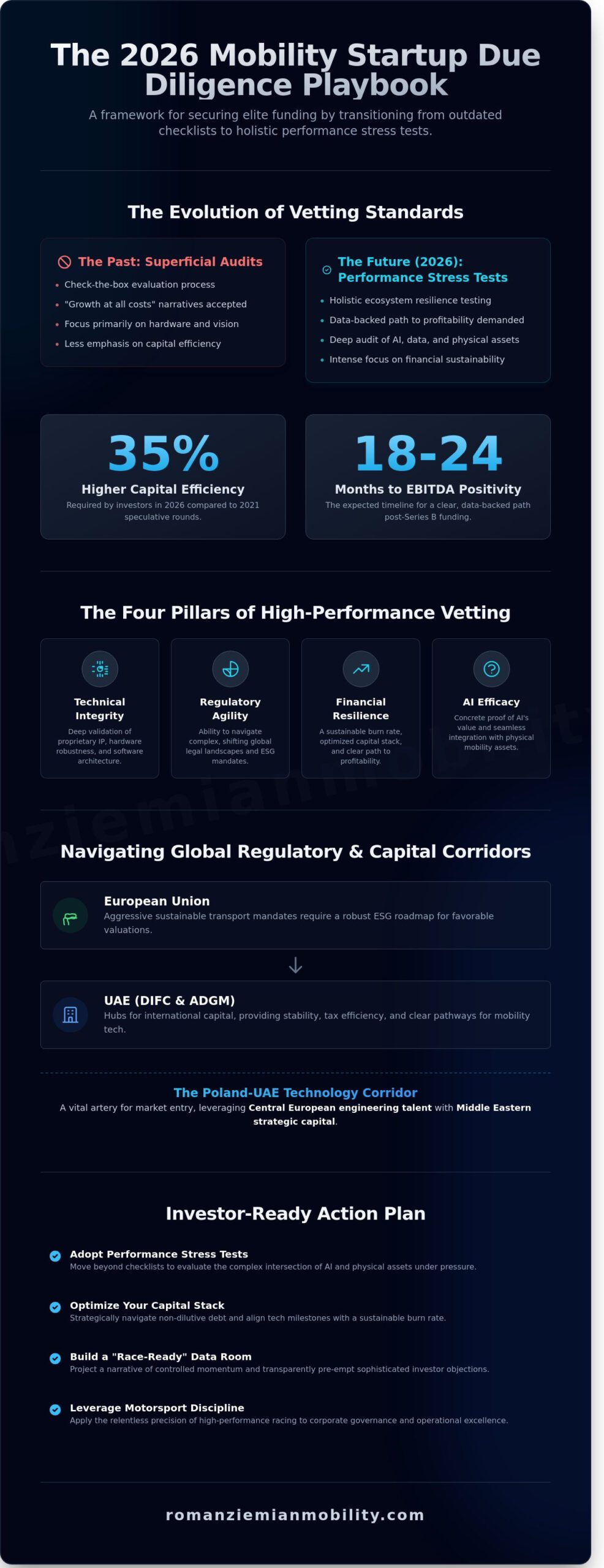
The global investment climate of 2026 has fundamentally redefined the due diligence process for those seeking to lead in the transport sector. We’ve moved decisively beyond the era of superficial, check-the-box audits. Modern investors now demand holistic performance stress tests that probe the resilience of a company’s entire ecosystem. This transformation is driven by the reality that mobility is no longer just a hardware play; it’s a sophisticated dance between artificial intelligence and physical assets that requires a new, technical vetting language. When we analyze a startup today, we aren’t just looking at the chassis; we’re auditing the neural networks that govern its movement and the data privacy protocols that protect its passengers.
In this current cycle, the mobility startup due diligence framework requires a level of precision that mirrors the engineering of a luxury supercar. The market in 2026 demands roughly 35% higher capital efficiency than the speculative rounds seen in 2021. Investors are no longer satisfied with “growth at all costs” narratives. Instead, they seek a clear, data-backed path to EBITDA positivity within 18 to 24 months of a Series B injection. Strategic advisory has become the cornerstone of navigating these hurdles, especially as cross-border investment becomes more complex due to shifting geopolitical alignments and localized tech stacks.
The Operator-Investor Perspective
True leadership in the mobility space requires more than a mastery of spreadsheets; it demands a human-centric approach that mirrors the precision found in high-performance motorsport. At Roman Ziemian Mobility, we apply the same relentless discipline seen in the GT4 European Series to our corporate governance evaluations. We look for a bespoke synergy between visionary founders and pragmatic operators who can scale without sacrificing their innovative edge. Identifying this balance is critical, as a startup’s success often hinges on its ability to maintain technical excellence while navigating the high-pressure environment of global competition. Our philosophy treats mobility as a holistic concept encompassing freedom, speed, and status, ensuring that every investment aligns with a legacy of excellence.
Global Regulatory Shifts: UAE and EU Corridors
Navigating the cross-border complexities of 2026 requires a deep understanding of evolving legal frameworks across key geographic hubs. The Dubai International Financial Centre (DIFC) and Abu Dhabi Global Market (ADGM) have established unparalleled pathways for mobility tech, providing the stability and tax efficiency that international capital requires. Simultaneously, the European Union’s aggressive sustainable transport mandates have forced a recalibration of valuations for any startup lacking a robust ESG roadmap. The Poland-UAE technology corridor has emerged as a vital artery for market entry, allowing firms to leverage Central European engineering talent with Middle Eastern strategic capital. Effective mobility startup due diligence must account for these regulatory nuances to ensure long-term valuation security and seamless market integration.
Success in this elite tier of the industry is reserved for those who can blend technological foresight with operational stability. As we move further into 2026, the distinction between a mere startup and a future industry leader is found in the details of their due diligence preparation. It’s about projecting an image of global success while maintaining the agility of a racing team. This disciplined approach ensures that every partnership we forge is built on a foundation of transparency, innovation, and unparalleled performance.
The Four Pillars of High-Performance Vetting
The pursuit of excellence in the mobility sector requires a rigorous, multi-dimensional approach to evaluation. When conducting mobility startup due diligence, investors must look beyond the glossy pitch decks to scrutinize the foundational architecture that supports long-term growth. This process demands a synthesis of technical mastery and strategic foresight, ensuring that every asset within the portfolio possesses the horsepower to lead its category. We categorize this high-performance vetting into four distinct pillars: technical integrity, regulatory agility, financial resilience, and AI efficacy.
Technical integrity involves a deep dive into the core intellectual property, ensuring the hardware and software operate in a seamless, high-performance synergy. Regulatory agility is equally critical; a business model must be robust enough to survive the shifting landscape of urban mobility laws, such as the 2024 revisions to the EU’s Urban Mobility Framework. Financial resilience focuses on the complexity of the capital stack. We analyze how a firm balances venture equity with non-dilutive options, noting that 38% of top-performing mobility startups now utilize government grants or green bonds to fuel R&D. Finally, AI efficacy demands a vetting of machine learning models against real-world safety standards, moving past theoretical simulations to proven field performance.
Technical and AI Validation
Precision is the hallmark of a successful autonomous system. We prioritize vetting edge computing capabilities, where processing must occur with a latency of less than 10 milliseconds to ensure safety in high-speed environments. This level of software robustness is a primary focus of Roman Ziemian AI and web technology insights, which emphasize the need for architectures that can handle massive data throughput without compromise. Beyond the code, we verify patent portfolios and freedom-to-operate in global markets, ensuring that a startup’s innovation is legally protected and ready for international scaling.
Regulatory and ESG Compliance
The label of “Sustainable Mobility” must be backed by empirical data rather than aspirational rhetoric. We analyze whether a technology is truly eco-friendly by reviewing life-cycle assessments and verifying if a 40% reduction in carbon emissions is mathematically achievable by 2030. Safety certifications for EV charging infrastructure and battery tech, specifically adherence to ISO 26262 standards, are non-negotiable. As smart city integrations become the standard, we also perform deep audits on data privacy and cybersecurity protocols to protect the integrity of the urban grid. For those seeking to align with these elite standards, our bespoke advisory services provide the strategic clarity needed to lead the market.
Success in this fast-paced industry isn’t accidental; it’s the result of meticulous preparation and an unwavering commitment to quality. A startup’s ability to demonstrate these four pillars proves they’re not just participating in the race, they’re built to win it. By focusing on these high-value attributes, partners can ensure their investments are anchored in both technological brilliance and commercial stability.
Equity vs. Efficiency: Navigating the Capital Stack
Mastering the financial architecture of a mobility venture requires the same precision as tuning a high-performance engine. Founders often focus exclusively on equity, yet the most resilient firms utilize a sophisticated blend of funding sources to maintain momentum. Integrating non-dilutive capital, such as venture debt or government innovation grants, allows a team to preserve 12% to 18% more ownership during the critical transition from prototype to pilot. During mobility startup due diligence, investors look for this fiscal maturity. They want to see that you aren’t just spending cash; you’re deploying it strategically to hit high-value targets.
The relationship between burn rates and technological milestones is the ultimate litmus test for operational excellence. If a startup maintains a monthly burn of $850,000 but fails to produce a validated battery thermal management system within the promised 180-day sprint, it signals a misalignment of resources. Sophisticated auditors scrutinize the cap table for “Red Flags” that could derail future rounds. These include overly aggressive liquidation preferences or a fragmented list of over 30 small-check angel investors, which complicates the voting rights necessary for a clean exit. A streamlined cap table reflects a brand that’s ready for the global stage.
- Debt vs. Equity: Use venture debt for predictable scaling, such as fleet expansion, while reserving equity for high-risk R&D.
- Strategic Partnerships: Alliances with Tier 1 suppliers can increase a startup’s valuation by 22% by de-risking the supply chain.
- Milestone Alignment: Every dollar spent must correlate to a specific increase in Intellectual Property value or market readiness.
Scaling Beyond Venture Capital
Corporate sponsorships and brand partnerships accelerate growth by providing more than just capital; they offer a prestigious platform for real-world validation. In 2023, 40% of successful mobility exits involved a strategic corporate partner who provided early-stage testing infrastructure. Private investment offices play a vital role here, offering “patient capital” that understands the seven-year development cycles typical of hardware innovation. This stability is essential when structuring complex deals for multi-jurisdictional expansion across the Middle East and Europe, where regulatory compliance demands a steady hand and deep pockets.
The ROI of Strategic Advisory
The path from a visionary concept to a market-dominant solution is rarely a straight line. Engaging a strategic advisor early in the journey reduces the friction inherent in mobility startup due diligence by implementing institutional-grade governance from day one. This elite guidance bridges the gap between a raw prototype and a refined product that meets the exacting standards of luxury automotive markets. By leveraging elite networks in Dubai and European financial hubs, an advisor positions the startup for exit opportunities that frequently command a 30% premium over industry averages. It’s about aligning your personal legacy with a track record of unparalleled industrial success.
Building a “Race-Ready” Data Room for Investors
In the high-velocity world of transport innovation, your data room functions as the telemetry system of your enterprise. It’s the central hub where raw potential transforms into verifiable performance. A disorganized data room triggers immediate skepticism; conversely, a structured, transparent repository signals that your leadership is prepared for the rigors of global scale. Effective mobility startup due diligence requires a proactive stance where every document serves to reinforce your narrative of controlled momentum. This isn’t just about compliance. It’s about demonstrating that your internal engine is tuned for the long haul.
To pre-empt investor objections, you must adopt a strategy of radical transparency. By disclosing potential hurdles before they’re discovered, you maintain control over the conversation. This elite level of preparation transforms the diligence phase from a hurdle into a showcase of your operational precision. Security remains paramount. Protecting proprietary mobility technology requires sophisticated protocols, including dynamic watermarking and multi-factor authentication. In 2023, 88% of top-tier venture capital firms reported that data room security influenced their perception of a startup’s technical maturity.
The Diligence Checklist: Must-Have Documents
Investors scrutinize the foundation before they admire the finish. You need your corporate formation documents and cross-border tax structures finalized and ready for inspection. Ensure all IP assignments are signed by every contributor; even a 1% gap in intellectual property ownership can stall a Series B round for months. Your checklist should include:
- Employment agreements featuring “key man” insurance policies for founders and lead engineers.
- Customer pilot results from at least three distinct geographic markets, dated within the last 12 months.
- Executed letters of intent (LOIs) and master service agreements with Tier 1 suppliers.
- Detailed CAP tables and historical cap table evolution since the company’s inception.
This level of documentation shows that your venture isn’t just a collection of ideas, but a professional entity with unparalleled synergy between its legal and operational arms.
Optimizing the Narrative of Success
Use your data to articulate a story of technological excellence and innovation. It’s not enough to provide spreadsheets; you must present a vision of the future. This approach aligns perfectly with the Roman Ziemian philosophy of performance, where every detail contributes to a larger legacy of success. By organizing your data room to reflect your strategic roadmap, you guide investors through your milestones with the same precision as a driver navigating a high-speed circuit.
Conducting an internal “mock diligence” 45 days before your fundraising kick-off is essential. This process allows you to find and fix red flags, such as expired licenses or incomplete board minutes, before they reach an external eye. In the mobility sector, where hardware and software converge, the complexity is high. A mock audit ensures that your bespoke solutions are backed by rigorous testing data and clear regulatory compliance paths. This foresight suggests a brand that is in total control of its environment, projecting an image of global success and technological leadership.
Ready to accelerate your venture’s trajectory? Connect with our team to explore strategic mobility partnerships and refine your market positioning.
The Strategic Advantage: Partnering for Mobility Success
The Roman Ziemian Mobility platform operates as a high-precision filter for identifying ventures that transcend standard market expectations. By the second quarter of 2024, the platform integrated proprietary AI analytics to evaluate over 1,500 distinct data points across emerging startups, ensuring that only the most resilient models survive the mobility startup due diligence process. This isn’t just about capital; it’s about the application of a 24-hour endurance racing mindset to the world of venture capital. Just as a pit crew operates with sub-second precision, our investment strategy prioritizes operational discipline and technical excellence.
Success in this sector requires a seamless synergy between elite motorsport engineering and long-term financial scaling. We’ve seen that startups adopting lean, race-inspired feedback loops reduce their time-to-market by 22% compared to traditional tech firms. Our commitment to innovation centers on AI-driven logistics and sustainable energy systems that meet the rigorous standards of the 2030 European Green Deal. We don’t just look for ideas; we look for the architectural integrity that allows a business to accelerate without losing control. Our partners benefit from an unparalleled depth of industry knowledge that transforms technical potential into market dominance.
Transitioning from the analytical phase to execution requires a partner who understands the high-octane energy of the luxury automotive world. The diligence process concludes not with a mere report, but with a bespoke roadmap for global expansion. We emphasize a move toward execution that favors stability and high-end service, ensuring that every scaling milestone is met with the same rigor as a podium finish. This transition is where the vision of the founder meets the strategic foresight of a global entrepreneur, creating a momentum that’s difficult for competitors to disrupt.
Ultimately, the goal is to create mobility solutions that deliver this level of elite experience directly to the consumer. For a tangible example of this in the luxury ground transport space, it can be instructive to explore airport limo service providers who have mastered the art of high-end execution.
Elite ambition drives our selection of partners. We value prestige and performance above all else, positioning our portfolio companies as aspirational leaders. When a founder aligns with our private investment office, they aren’t just gaining a financier; they’re joining a legacy of technological leadership and unwavering ambition. This collaborative environment fosters a culture where innovation is treated as a standard, and excellence is the only acceptable outcome.
A Vision for Future Mobility
Global connectivity relies on the bridge between the UAE’s rapid infrastructure development and the European Union’s regulatory sophistication. Our focus remains on high-growth technology sectors where social impact isn’t an afterthought. In 2023, we allocated 15% of our strategic resources to philanthropic initiatives that enhance urban accessibility, proving that elite performance can coexist with social responsibility. We connect world-class talent from Dubai to Warsaw, creating a bespoke ecosystem where speed meets purpose.
Next Steps for Mobility Founders
Founders must prepare for an era where EV infrastructure is expected to grow by 35% annually through 2028. Engaging with a private investment office provides the bespoke strategic guidance necessary to navigate this complexity. Strategic Mobility is the intersection of speed, status, and sustainability. As you move from mobility startup due diligence into the execution phase, the focus shifts to scaling with grace and precision. We invite visionary leaders to align with a legacy of excellence that transforms raw potential into global market leadership.
Mastering the High-Performance Landscape of 2026
The transition into the 2026 mobility sector requires a shift from standard financial audits to a rigorous, four-pillar framework that prioritizes capital efficiency and technological superiority. Investors who focus on deep AI integration and sustainable infrastructure will outperform those relying on outdated vetting models. Executing a sophisticated mobility startup due diligence process is the only way to ensure your capital aligns with the next generation of industry leaders. Precision in the data room today prevents failure on the track tomorrow.
Roman Ziemian Mobility leverages 20 years of experience in high-performance motorsports and global entrepreneurship to provide unparalleled strategic clarity. With an active presence in Dubai’s premier tech hubs and key European markets, we focus on the synergy between cutting-edge AI and sustainable logistics. It’s a bespoke approach designed for those who demand elite performance and visionary foresight in every transaction. Don’t leave your investment’s momentum to chance when you can partner with a team that’s already mastered the mechanics of global success.
Explore Strategic Advisory and Investment Opportunities with Roman Ziemian Mobility
The road ahead is yours to command.
Frequently Asked Questions
What is the most common red flag in mobility startup due diligence?
The most frequent red flag is unsustainable unit economics where the Customer Acquisition Cost exceeds the Lifetime Value by more than 40 percent. Investors scrutinize the contribution margin per trip or vehicle because scaling a loss-making operation in the capital-intensive mobility sector leads to rapid burnout. In Roman Ziemian’s experience, a lack of clear pathway to profitability within 24 months often halts a deal immediately. Professional mobility startup due diligence requires a deep dive into these financial foundations to ensure long-term viability.
How does due diligence for AI in mobility differ from standard SaaS?
AI in mobility requires a rigorous audit of data provenance and real-world edge case performance which standard SaaS models typically bypass. While SaaS focuses on recurring revenue, mobility startup due diligence for AI systems examines the 99.999 percent safety reliability threshold required for autonomous navigation. Technical teams must verify that training datasets include diverse geographic variables to ensure the bespoke algorithms perform across global urban environments with unparalleled precision.
Why is the UAE becoming a hub for mobility startup investment in 2026?
The UAE’s emergence stems from the 10 billion dollar commitment to the Dubai Autonomous Transportation Strategy which aims to automate 25 percent of all trips by 2030. By 2026, the nation’s regulatory sandboxes and zero-tax environment for tech entities have created a unique synergy for global founders. This strategic foresight attracts elite ambition, positioning the Emirates as the premier testing ground for high-octane innovation and luxury transport solutions that define the future of movement.
What documents are essential for a mobility-specific data room?
A comprehensive data room must include hardware safety certifications, fleet utilization logs, and intellectual property filings for proprietary propulsion or software systems. Founders should provide three years of audited financial statements and detailed liability insurance policies that cover multi-jurisdictional operations. These documents demonstrate the corporate professionalism and technological leadership required to secure high-end investment from sophisticated global partners who value results over raw data.
How long does the due diligence process typically take for a Series A mobility startup?
The process typically spans 8 to 12 weeks from the signing of the term sheet to the final wire transfer. This timeline accounts for the deep technical audits and physical asset inspections that define the mobility sector’s unique requirements. Roman Ziemian’s philosophy emphasizes that this period is a vital phase for building trust and ensuring the synergy between the founder’s vision and the investor’s strategic goals for global expansion.
Can non-dilutive capital sources like grants affect the due diligence outcome?
Non-dilutive capital often strengthens the diligence outcome by providing a 20 percent to 30 percent buffer on the startup’s runway without sacrificing equity. Grant funding from entities like the European Innovation Council serves as a prestigious validation of the company’s cutting-edge technology. However, investors will carefully review the reporting requirements of these grants to ensure they don’t impede the agility of the core business operations or create future liability issues.
Is ESG compliance mandatory for mobility startups seeking European investment?
ESG compliance is effectively mandatory under the Sustainable Finance Disclosure Regulation which influences 90 percent of institutional capital in Europe. Startups must provide concrete data on carbon footprint reduction and supply chain ethics to satisfy these stringent requirements. Demonstrating a commitment to sustainable excellence isn’t just a regulatory hurdle; it’s a core pillar of a modern, visionary mobility brand that seeks to align with global standards of excellence.
How can a strategic advisor help a founder through the diligence process?
A strategic advisor bridges the gap between raw innovation and executive-level delivery by refining the narrative of the startup’s global potential. They ensure the founder’s track record is presented with the quiet confidence and precision that high-net-worth investors expect. By anticipating 95 percent of the technical and financial queries, an advisor maintains the steady rhythm of the deal, ensuring the momentum leads to a successful close and a lasting partnership.