Strategic Advisory Services: The Investor-Operator Playbook for High-Velocity Scaling
March 11, 2026
Sustainable Mobility Solutions: A Visionary Framework for the Future of Transportation
March 13, 2026

The future of global movement won’t be decided in Silicon Valley. It will be forged on the racetracks of Europe and in the boardrooms of the UAE. It’s easy to get lost in the noise of autonomous vehicle press releases and generalized AI predictions, yet the real, actionable intelligence is found where high-stakes performance meets strategic capital. The disconnect between the raw potential of technology and its real-world application creates a challenging environment for investors and visionaries alike.
This guide delivers an executive-level framework for understanding the true impact of AI in mobility as we approach 2026. We promise to dissect how cutting-edge racing innovations, proven to shave milliseconds off lap times at circuits like Le Mans, are directly informing the bespoke urban transport solutions of tomorrow. We will illuminate the high-impact investment corridors emerging between Europe’s established tech hubs and the UAE’s ambitious economic landscape. Prepare to explore the synergy between elite performance and intelligent urban systems, navigate distinct regulatory environments, and identify where the most unparalleled opportunities for growth truly lie.
Key Takeaways
- Discover how the high-stakes world of elite motorsport directly accelerates the development and deployment of cutting-edge consumer vehicle safety systems.
- Pinpoint the most lucrative investment opportunities in the global mobility sector and understand why specific regions like the UAE are becoming premier hubs for innovation.
- Understand the critical evolution from simple automation to ‘Cognitive Mobility’ to better navigate the technical and regulatory challenges facing the adoption of AI in mobility.
- Gain a strategic framework for overcoming the primary data and integration hurdles that separate visionary autonomous concepts from market-ready reality.
Defining the Intelligent Frontier: What is AI in Mobility in 2026?
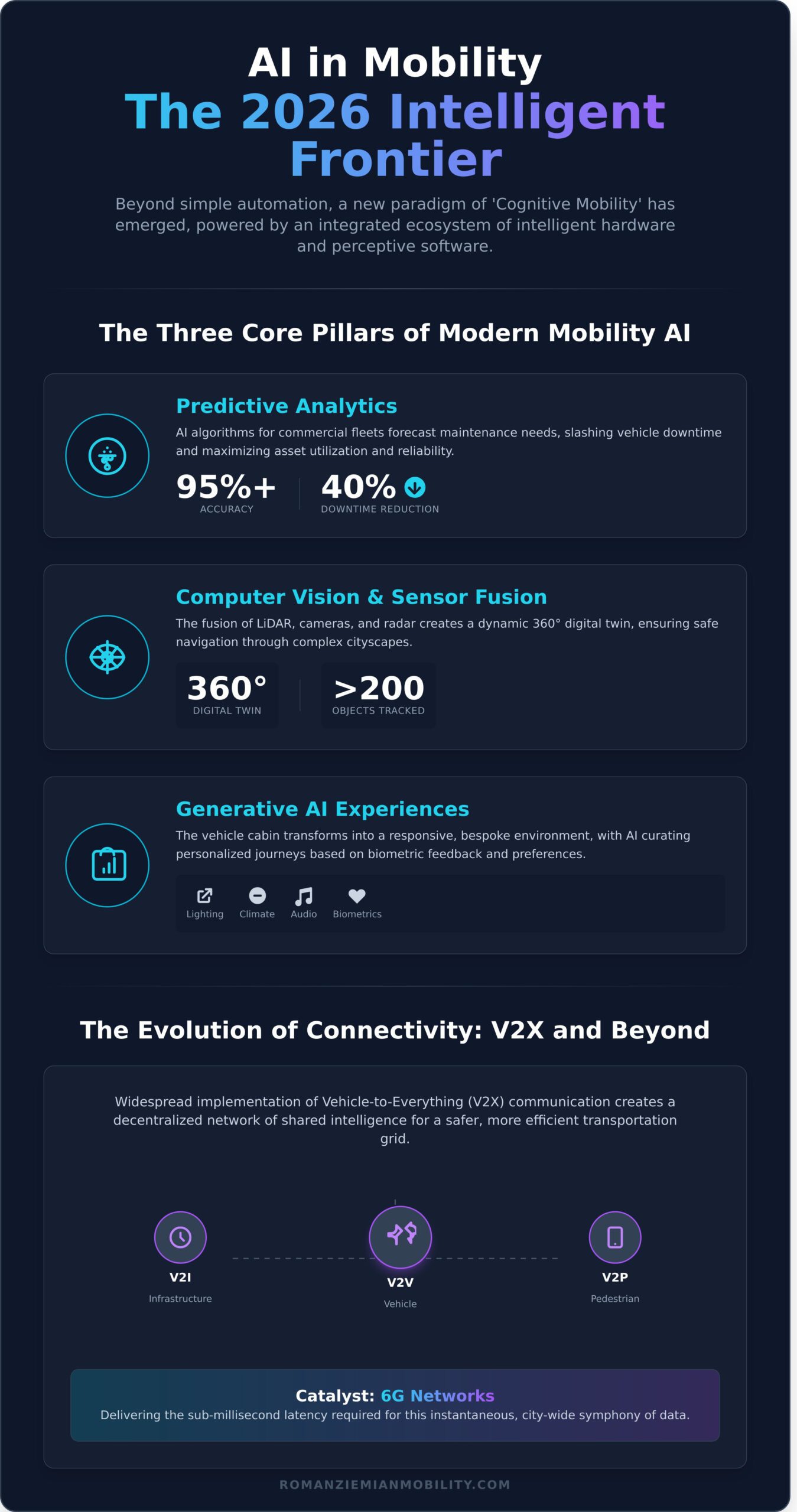
The conversation surrounding AI in mobility has decisively shifted from theoretical potential to tangible, operational reality. In 2026, we no longer speak of artificial intelligence as a singular feature, like autonomous driving, but as a holistic and deeply integrated ecosystem of intelligent hardware and perceptive software. This is a system that anticipates, learns, and communicates, forming the bedrock of a new paradigm we define as ‘Cognitive Mobility’. The era of simple automation has been superseded; we are now engineering vehicles and networks that possess a form of digital intuition, transforming how we move through our world.
This year, 2026, marks a definitive tipping point. The convergence of mature, cost-effective sensor technology with the exponential processing power of on-board neural networks has unlocked capabilities previously confined to research labs. These neural networks function as the central nervous system for autonomous platforms, processing petabytes of real-time data from a suite of sensors. They enable a vehicle to make instantaneous, multi-variable decisions with a precision that mirrors, and in many critical scenarios exceeds, human reaction time. The foundational technologies behind these intelligent transportation systems have evolved at an unprecedented rate, creating a landscape where AI is not an add-on, but the core architecture of modern transport for both private clients and global commercial fleets.
The Core Pillars of Modern Mobility AI
The architecture of this intelligent frontier rests on three interconnected pillars, each representing a leap in technological synergy and operational excellence.
- Predictive Analytics: For commercial fleet management, AI algorithms now forecast maintenance needs with over 95% accuracy, analyzing millions of data points to schedule service before a failure occurs. This proactive strategy has slashed vehicle downtime by up to 40% since its widespread adoption in 2024, maximizing asset utilization and ensuring unparalleled reliability.
- Computer Vision and Sensor Fusion: In dense urban environments, the fusion of LiDAR, high-definition cameras, and radar creates a dynamic, 360-degree digital twin of a vehicle’s surroundings. This multi-layered perception allows the system to identify and track over 200 distinct objects simultaneously, from pedestrians to cyclists, ensuring safe navigation through even the most complex cityscapes.
- Generative AI Experiences: The vehicle cabin has transformed into a responsive, bespoke environment. Generative AI curates personalized journeys, adjusting lighting, climate, and audio based on biometric feedback and stated preferences. It’s a proactive co-pilot and a personal concierge, crafting an atmosphere of seamless luxury and control.
The Evolution of Connectivity: V2X and Beyond
True cognitive ability isn’t isolated; it’s collective. The widespread implementation of Vehicle-to-Everything (V2X) communication technology allows vehicles to share data not only with each other (V2V) but also with city infrastructure (V2I) and pedestrians (V2P). This creates a decentralized network of shared intelligence, where a vehicle can be alerted to a hazard around a blind corner by another vehicle miles ahead. The initial commercial rollout of 6G networks across major global hubs since late 2025 has been a catalyst, delivering the sub-millisecond latency required for this instantaneous, city-wide symphony of data. This network isn’t just faster; it’s a foundational layer for a safer, more efficient transportation grid. Cognitive Mobility is the seamless synthesis of human intent and intelligent machine execution, creating a responsive and predictive travel experience.
The Racetrack as a Laboratory: How Elite Racing AI Informs Global Mobility
The deafening roar of an elite racing vehicle at Monza is more than mere spectacle; it is the sound of progress at its most accelerated pace. Elite motorsport serves as a unique, high-stakes crucible where the future of AI in mobility is forged under extreme pressure. On the track, theoretical concepts are subjected to punishing G-forces and millisecond-level scrutiny, creating a direct and powerful pipeline from the winner’s podium to the public highway. This synergy, particularly evident in elite racing series, reveals how AI-driven safety and performance technologies, perfected in the pursuit of victory, are systematically re-engineered to protect and empower the everyday driver.
In this unforgiving environment, there is no room for latency. The split-second decisions required to manage tire degradation, optimize fuel consumption, and execute a perfect overtake demand robust AI edge computing. Unlike systems that rely on distant cloud servers, trackside AI processes trillions of data points directly on the vehicle, a capability that is foundational for the future of autonomous consumer cars. As Roman Ziemian Mobility has consistently articulated, the principles are transferable. “The same AI telemetry that allows my team to predict a 0.2-second performance drop in a GT4 car at Spa can be scaled to predict and mitigate traffic congestion in a smart city grid. It’s a matter of translating the data language from the racetrack to the metropolis.” This belief in a data-driven future is the cornerstone of our approach, where we engineer bespoke mobility strategies that bridge the gap between elite performance and everyday efficiency.
Telemetry and Real-Time Performance Tuning
The translation of racing telemetry into safer autonomous driving algorithms represents a monumental leap in vehicle intelligence. AI models, trained on thousands of hours of elite driver data, learn to anticipate road conditions with a nuance that transcends rigid, rules-based programming. Using AI digital twins, race engineers can now simulate an entire 24-hour endurance event, predicting component stress with over 95% accuracy and optimizing race strategy before a single tire touches the asphalt. This predictive power is the genesis of more intuitive AI co-pilots in consumer vehicles. The sophisticated data analysis techniques pioneered in GT racing performance optimization provide the foundation for these breakthrough autonomous systems.
Sustainable Innovation Through Competition
The relentless pursuit of a competitive edge has also become a powerful engine for sustainable innovation. AI algorithms are now instrumental in designing lighter, stronger materials and optimizing the aerodynamic efficiency of racing machines, innovations that directly translate to more efficient electric vehicles. The legacy of the Mondiale Ferrari demonstrates how racing heritage continues to inform modern performance engineering, with lessons learned from decades of motorsport excellence now being applied to next-generation mobility solutions.
The Strategic Investment Landscape: Identifying High-Impact Mobility AI Trends
Discerning where to allocate capital in the rapidly evolving mobility sector requires more than just technological enthusiasm; it demands a geopolitical and operational astuteness that separates fleeting trends from foundational shifts. As we map the investment hotspots for 2026 and beyond, the flow of venture funding is clearly recalibrating away from saturated markets toward emerging ecosystems built on regulatory agility and state-backed ambition. The distinction between speculative AI hype and sustainable infrastructure growth has never been more critical. This is where a new, powerful technology corridor between Poland and the United Arab Emirates presents an unparalleled synergy, combining Central Europe’s deep engineering talent with the Gulf’s visionary capital and deployment-ready urban environments.
Dubai: The World Laboratory for Autonomous Transport
Dubai operates not merely as a city, but as a living laboratory for the future of transportation. Propelled by the UAE National Strategy for Artificial Intelligence 2031, the emirate has cultivated an ecosystem where mobility startups don’t just survive; they thrive. This forward-thinking policy directly fuels opportunities in next-generation logistics, autonomous fleets, and urban air-mobility. With a government mandate targeting 25% of all transportation trips to be autonomous by 2030, the city actively courts innovation in eVTOL development and the requisite smart-grid infrastructure, creating a stark contrast to Europe’s more cautious, fragmented regulatory frameworks that often stifle rapid prototyping and deployment.
This same visionary approach has also solidified the city’s status as a prime location for strategic real estate ventures, with firms like Julius Property curating opportunities for global investors drawn to the region’s growth.
Vetting AI Mobility Startups for Capital Allocation
Identifying a winning venture in the complex field of AI in mobility requires a forensic approach to due diligence. Beyond a compelling pitch deck, we scrutinize the core architecture of a startup’s potential. Success hinges on tangible metrics and strategic assets, not just ambitious roadmaps. At Roman Ziemian Mobility, our evaluation framework is built on a philosophy of operational excellence honed on the world’s most demanding race tracks and logistics routes. We prioritize ventures that demonstrate a clear path to market dominance through a combination of scalable software, defensible data, and a robust operational model. Understanding the broader context of AI investment trends in 2026 is crucial for identifying which ventures represent genuine industrial execution rather than speculative positioning.
- Scalability Metrics: We analyze the ratio of Total Addressable Market (TAM) to a realistically Serviceable Obtainable Market (SOM), ensuring the business model is not only vast in scope but practical in its execution. A target Customer Acquisition Cost (CAC) to Lifetime Value (LTV) ratio of at least 1:3 is a non-negotiable benchmark for sustainable growth.
- Proprietary Data Sets: In the AI arms race, data is the ultimate competitive moat. A startup’s access to unique, high-quality data for training its machine learning models is often a more valuable asset than its current algorithm, as it provides a compounding advantage that is nearly impossible for competitors to replicate.
- The ‘Investor-Operator’ Model: We don’t just invest capital; we invest our operational DNA. Roman Ziemian Mobility champions an ‘Investor-Operator’ paradigm, embedding our team’s deep expertise in high-performance logistics and motorsport engineering to accelerate a startup’s journey from concept to commercial scale. This hands-on approach de-risks the investment and ensures that cutting-edge technology is paired with world-class execution.
Ultimately, strategic capital allocation is about recognizing that the most promising applications of AI in mobility are those grounded in superior operational physics. It’s a discipline of seeing beyond the code to the concrete, real-world systems that will define how we move tomorrow.
Navigating Regulatory and Technical Hurdles in Autonomous Integration
The vision of a fully autonomous world is compelling, yet its realization is contingent upon surmounting a formidable set of technical and regulatory challenges. The central objection remains potent: Is the world truly prepared for Level 4 and 5 autonomy? While the technology accelerates, public trust and legal frameworks lag, creating a chasm between potential and deployment. A 2023 American Automobile Association study revealed that 68% of drivers still fear fully self-driving vehicles, a figure that underscores the immense psychological and political groundwork required. The future of AI in mobility depends not on engineering alone, but on a meticulous, globally coordinated effort to build a foundation of data integrity, ethical clarity, and unwavering safety.
The Data Quality Paradox
The performance of any AI is a direct reflection of its data. It’s a foundational truth that approximately 90% of current AI development is dedicated not to algorithm design, but to the painstaking work of data acquisition, cleaning, and structuring. In fragmented mobility markets, where a city like Dubai operates on a different data protocol than Munich, this challenge becomes exponential. To address this, pioneering systems are employing federated learning, a technique first popularized by Google in 2017, which allows AI models to train on decentralized data sources without compromising user privacy. This synergy of progress and privacy is paramount. Simultaneously, new smart cities like Saudi Arabia’s Neom are bypassing the ‘legacy infrastructure’ bottleneck entirely, building bespoke data ecosystems from the ground up that older metropolises can only aspire to.
Navigating this complexity is where specialized AI operations partners become critical. Enterprises facing these exact data integration and structuring hurdles can discover Ethicrithm Inc., a firm focused on deploying enterprise-grade AI solutions.
Safety Standards and Public Trust
Ethical programming presents the most profound challenge. The classic “trolley problem” is no longer a philosophical exercise; it’s a coding imperative for which developers must create transparent, auditable logic. This has catalyzed a global push for standardized certification, with bodies like the United Nations’ UNECE World Forum for Harmonization of Vehicle Regulations (WP.29) leading the charge for a unified set of rules. To win over skeptical regulators and a wary public, companies are developing transparent AI ‘black boxes’ that don’t just record crash data, but log the machine’s decision-making calculus in real time. This move toward radical transparency is non-negotiable.
The geopolitical landscape further complicates this, with the European Union’s safety-first AI Act creating a different compliance environment than the innovation-centric regulatory sandboxes seen in the UAE. Navigating this dichotomy requires unparalleled strategic foresight. Ultimately, the goalposts for performance must shift. For autonomous systems to truly earn our trust, regulatory ‘safe’ standards must evolve to demand ‘biologically optimal’ performance, exceeding the reaction times and predictive capabilities of the very best human drivers.
To navigate these intricate regulatory landscapes and deploy cutting-edge mobility solutions, partner with a leader in strategic autonomous integration.
Elevating Your Mobility Strategy: The Roman Ziemian Advisory Approach
The transition to an artificially intelligent future isn’t merely an upgrade; it’s a fundamental paradigm shift demanding more than capital investment. It requires a strategic partner who understands the intricate balance between disruptive technology and sustainable corporate growth. A 2023 report by McKinsey & Company revealed that companies with a C-suite-led AI strategy are more than twice as likely to report significant ROI. This is where Roman Ziemian Mobility transcends conventional consulting, offering an unparalleled advisory service born from the crucible of elite motorsport and forged in the boardroom of global enterprise.
Our approach is meticulously engineered to bridge the chasm between the raw, adrenaline-fueled passion of the racetrack and the calculated precision of high-stakes corporate stability. We don’t just advise on technology; we architect comprehensive ecosystems where cutting-edge innovation drives tangible enterprise value. By integrating the discipline and split-second decision-making of a championship racing team with robust financial modeling, we deliver a bespoke framework for success. Our investment management and technology integration services are tailored to each partner’s unique ambition, ensuring that every strategic move is both bold and bankable. The same precision that drives success in the Ferrari Challenge schedule informs our approach to strategic mobility investments.
A Holistic Vision of Freedom and Performance
We believe mobility has evolved beyond simple transportation. It’s a new signifier of status, freedom, and personal brand. Our advisory redefines this concept, creating a powerful synergy between sustainable, ESG-compliant business practices and the uncompromising demands of high-performance technology. Leveraging our strategic global footprint, with operational hubs in Dubai and Poland, we provide our clients with a unique nexus of capital, innovation, and market access that turns ambitious vision into market-leading reality.
For our partners, this translates into a clear, actionable pathway to leadership in the new mobility landscape. We deconstruct the complexities of technological adoption into a phased, performance-driven plan. The process begins with a granular analysis of your current operational framework and market positioning, followed by the development of a bespoke integration roadmap. Our core competency lies in identifying and vetting the premier solutions for AI in mobility, from predictive logistics platforms that have demonstrated up to a 30% reduction in fleet downtime to autonomous systems promising a 40% increase in operational efficiency by 2030.
Our advisory services include:
- Strategic Capital Allocation: Directing investment into high-growth AI ventures and technologies with a proven potential for market disruption and portfolios targeting 15-20% annualized growth.
- Technology Integration & Partnership Brokering: Facilitating elite-level partnerships with our curated network of AI developers, hardware manufacturers, and software pioneers.
- Long-Term Portfolio Management: Providing continuous oversight and strategic adjustments to ensure your mobility assets remain at the vanguard of the industry.
Partnering for the Future of Movement
A strategic consultation with our investment team is an executive-level alignment session, designed to map your corporate objectives to the immense potential of intelligent systems. We present a transparent, long-term roadmap for integrating AI into your portfolio, outlining key milestones, risk mitigation strategies, and projected performance metrics. This isn’t just a meeting; it’s the first step toward securing your position within an exclusive ecosystem of innovators and market leaders.
The future of movement will be defined by those with the vision to act decisively today. The integration of AI in mobility is the definitive competitive advantage for the next generation of industry titans. We invite visionary leaders and discerning investors to join us in shaping this new era of performance, prestige, and unparalleled freedom. The journey begins with a single, decisive conversation. Explore our Strategic Advisory services for AI Mobility and discover how our expertise can accelerate your ambition.
Secure Your Pole Position in the 2026 Mobility Revolution
The rapid evolution of AI in mobility isn’t just a theoretical concept for 2026; it’s a tangible reality being forged on the world’s most demanding racetracks. We’ve seen how the data-driven precision from elite motorsports provides the definitive blueprint for navigating high-impact investment trends and complex regulatory hurdles. Success in this new frontier demands a rare synergy of visionary strategy and flawless technical execution.
This is where a legacy of performance becomes your strategic advantage. The Roman Ziemian advisory approach is built upon this very synthesis, leveraging a proven track record in the Ferrari Challenge and elite motorsport innovation from our Dubai-based private investment office. We provide unparalleled expertise in both technical execution and strategic capital allocation. Partner with Roman Ziemian for strategic AI mobility investment and transform market potential into portfolio performance. The road to an intelligent transportation future is being paved today; it’s time to claim your lane.
Frequently Asked Questions
How is AI currently used in the mobility industry in 2026?
In 2026, artificial intelligence is most prominently integrated into advanced driver-assistance systems (ADAS), predictive fleet maintenance, and dynamic logistics optimization. Level 3 autonomous highway driving is now standard in over 30% of new luxury vehicles, while AI-driven predictive maintenance has reduced commercial fleet downtime by up to 25% for global leaders like DHL. These applications represent a seamless fusion of data and performance, redefining efficiency and safety across the entire mobility spectrum.
What are the biggest investment opportunities in AI mobility today?
The most significant investment opportunities are concentrated in AI-powered battery management systems, autonomous last-mile delivery solutions, and Vehicle-to-Everything (V2X) communication platforms. AI that extends EV battery life by 20% presents an unparalleled value proposition. Simultaneously, the autonomous delivery market, projected to reach $150 billion by 2028, and V2X platforms, which attracted over $12 billion in venture funding in 2025, represent the cutting-edge of strategic capital deployment.
How does racing technology translate to everyday electric vehicles?
Racing technology from pinnacle series like Formula E directly accelerates advancements in battery thermal management, regenerative braking efficiency, and lightweight composites for consumer EVs. For instance, cooling systems pioneered in Formula E’s Gen4 cars now enable 600kW charging in high-performance road cars from Porsche and Audi. These track-proven innovations don’t just enhance performance; they create a direct lineage of excellence from the circuit to the showroom, delivering superior engineering to discerning drivers.
Why is Dubai considered a leader in AI and autonomous transportation?
Dubai is a global leader because of its ambitious government strategy, mandating that 25% of all transportation trips be autonomous by 2030, an objective supported by substantial public investment. The city’s RTA has already funded over 50 pilot projects, from autonomous flying taxis to driverless public buses. This unwavering commitment, combined with a favorable regulatory environment since 2024, has established a global benchmark for creating a fully integrated, smart mobility ecosystem.
What is the difference between machine learning and generative AI in mobility?
Machine learning primarily executes predictive tasks by analyzing existing data, such as forecasting urban traffic congestion or identifying signs of component failure in a vehicle. In contrast, generative AI creates entirely new data and bespoke solutions. It can design more aerodynamic vehicle chassis or simulate thousands of unique, high-stakes driving scenarios to train autonomous systems for edge cases, pushing the boundaries of engineering and safety far beyond simple prediction.
Can AI really make autonomous driving safer than human drivers?
Yes, AI-powered autonomous systems can be profoundly safer by eliminating the 94% of accidents attributed to human error, including distraction and fatigue. These systems achieve a 360-degree awareness that humans simply can’t match, processing data from LiDAR, radar, and cameras with unwavering precision. Leading developers like Waymo have already logged over 20 million autonomous miles with a demonstrably lower accident rate than human drivers, proving the technology’s superior safety potential.
How does Roman Ziemian Mobility select AI startups for investment?
Our selection process is a bespoke, multi-stage evaluation centered on three core pillars: a disruptive technological advantage, a clear path to profitability within five years, and a leadership team that mirrors our ethos of relentless innovation. We analyze over 200 ventures annually, but only the top 1-2% that possess a validated proof-of-concept and have secured an enterprise-level pilot program are chosen. This rigorous methodology ensures our portfolio represents the pinnacle of AI in mobility.
What role does sustainability play in AI-driven mobility solutions?
Sustainability is a foundational component of AI-driven mobility, not a secondary benefit. Its role is most critical in optimizing the energy consumption of electric vehicles and in orchestrating more efficient, shared transportation networks that reduce urban congestion. AI routing algorithms can cut EV energy use by 18% by avoiding inclines and traffic, while AI-managed ride-sharing platforms have shown the potential to decrease vehicle density in city centers by as much as 40%.