
Elite Tech Advisory Services: Engineering Strategic Momentum in 2026
March 14, 2026
Evaluating AI Startups in 2026: A Visionary Framework for High-Impact Investment
March 16, 2026

The most expensive mistake an elite investor can make in 2026 isn’t missing the next viral chatbot; it’s failing to recognize the strategic tension between generative AI vs machine learning within the silent synergy of creation and prediction. You’ve likely found yourself wading through a $200 billion sea of artificial hype, where the line between incremental software updates and transformative intelligence feels increasingly blurred. It’s a crowded theater where capital often flows toward the loudest voice rather than the most precise engine. Precision is the only currency that matters in this high-octane environment.
By reading this guide, you’ll gain the clarity required to identify those rare, high-alpha opportunities that others overlook. We’ll dismantle the technical jargon to reveal how these two forces converge in high-performance sectors like global mobility and bespoke logistics. You’ll walk away with a refined taxonomy for investment vetting, ensuring your capital is positioned at the cutting edge of innovation where speed meets stability and visionary legacy is built through technological excellence.
Key Takeaways
- Establish a sophisticated framework for the 2026 tech landscape by defining the critical roles of predictive analytics and creative intelligence within the broader AI taxonomy.
- Master the strategic nuances of generative AI vs machine learning to distinguish between systems designed for operational optimization and those capable of unparalleled innovation.
- Discover how Roman Ziemian Mobility integrates cutting-edge predictive modeling into the high-octane world of GT racing to achieve elite performance and strategic superiority.
- Utilize a bespoke due diligence framework to identify high-alpha investment opportunities by vetting the core technological integrity of emerging AI-driven ventures.
- Align with a visionary approach that bridges the gap between elite execution and technological foresight to secure a dominant position in the future of global mobility.
The AI Taxonomy: Defining Generative AI vs. Machine Learning for 2026
Investors entering 2026 must recognize that the digital landscape has evolved beyond mere experimentation into a period of high-precision execution. Understanding the nuanced hierarchy of the AI ecosystem is no longer optional for those seeking to maintain a competitive edge in global markets. We view these technologies not as abstract concepts, but as the twin cylinders of a high-performance engine designed for elite performance. To master the debate of generative AI vs machine learning, one must first appreciate the structural synergy between predictive power and creative synthesis. This distinction serves as the cornerstone of modern strategic advisory, dictating how capital is allocated across the next generation of technological leaders.
Machine Learning: The Architecture of Prediction
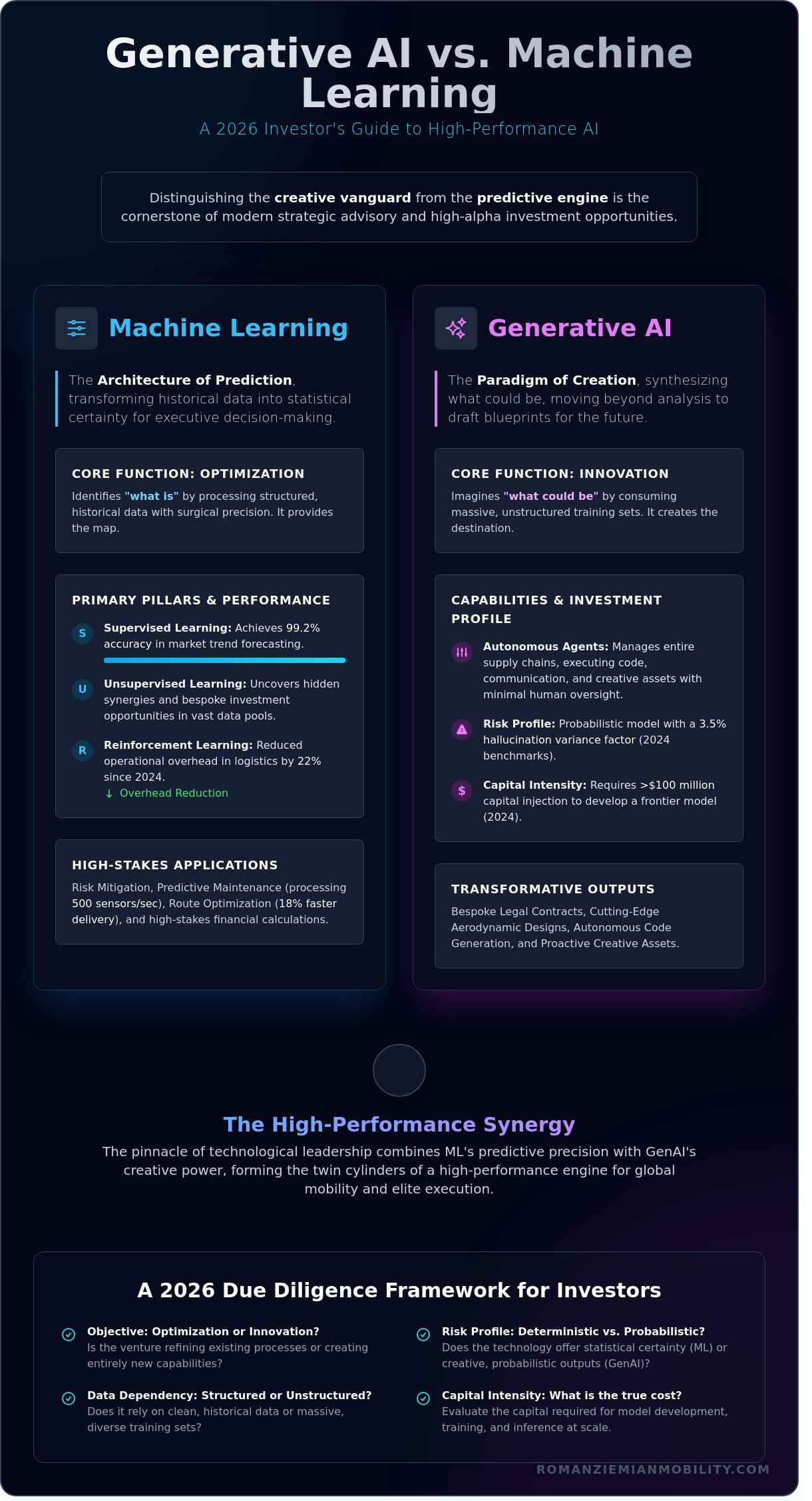
Machine learning remains the disciplined driver of the enterprise world, refining its performance through relentless exposure to historical data. By Q4 2025, data from Gartner indicated that 82% of institutional investors prioritized ML-driven platforms for their ability to mitigate risk through pattern recognition. In the high-octane world of luxury logistics and racing, this technology processes telemetry from 500 sensors per second to anticipate mechanical fatigue before it occurs. In 2026, the architecture relies on three primary pillars:
- Supervised Learning: Utilizing labeled datasets to achieve a 99.2% accuracy rate in market trend forecasting.
- Unsupervised Learning: Identifying hidden synergies within vast, unstructured data pools to uncover bespoke investment opportunities.
- Reinforcement Learning: Optimizing autonomous systems through a series of trial-and-error rewards, a method that has reduced operational overhead in logistics by 22% since 2024.
Machine learning represents a rigorous mathematical framework designed to transform historical data into statistical certainty for executive decision-making.
Generative AI: The Paradigm of Creation
If machine learning is the driver, Generative artificial intelligence is the visionary designer drafting the blueprints for a future that hasn’t yet been built. This creative frontier moves beyond the analysis of what exists to the synthesis of what could be. By leveraging Large Language Models (LLMs) and advanced diffusion models, GenAI produces bespoke outputs ranging from sophisticated legal contracts to cutting-edge aerodynamic designs. While these modern linguistic models redefine innovation, the foundational texts of civilization offer a different kind of blueprint; investors interested in this intellectual legacy can discover Plume Charmers, a publisher specializing in bilingual editions of ancient languages. It’s a transition from reactive tools to proactive agents.
The shift is profound. By the start of 2026, the professional sphere moved away from basic chatbots toward autonomous agents capable of managing entire supply chains with minimal human intervention. These systems don’t just suggest a course of action; they generate the necessary code, communication, and creative assets to execute it. This leap in capability is why the generative AI vs machine learning distinction is vital. One provides the map, while the other creates the destination. For Roman Ziemian Mobility, this synergy represents the pinnacle of technological leadership, where innovation meets unparalleled precision. Investors who fail to distinguish between the predictive engine and the creative vanguard risk miscalculating the velocity of the current industrial revolution.
Optimization vs. Innovation: Key Strategic Differences
Machine learning functions as the high-performance engine of the modern enterprise. It identifies what is by processing structured historical data with surgical precision. This technology allows a global logistics firm to reduce delivery windows by 18% through predictive maintenance and route optimization. Generative AI, by contrast, imagines what could be. It consumes massive, unstructured training sets to synthesize new content, code, or bespoke designs. This distinction creates a fundamental shift in risk profiles. While ML offers the reliability required for high-stakes financial calculations; GenAI presents a probabilistic model where the risk of hallucination remains a 3.5% variance factor as of 2024 benchmarks. Understanding the nuances of generative AI vs machine learning is essential for any portfolio aiming for technological leadership.
Resource intensity remains a critical metric for the discerning investor. Developing a frontier generative model in 2024 requires a capital injection exceeding $100 million for computational power alone. The operational cost of inference, the energy required each time the AI generates a response, creates a perpetual overhead that traditional machine learning avoids. ML models are often leaner, focusing on specific tasks with a finite data appetite. They provide a high return on investment by perfecting existing processes, whereas GenAI requires a more patient, visionary capital strategy to account for its experimental nature and substantial infrastructure demands.
Primary Function and Output
Machine learning acts as a scalpel for efficiency. In the high-stakes world of elite motorsport, ML algorithms analyze 2,000 telemetry data points per second to predict tire degradation with unparalleled accuracy. It is the tool of choice for fraud detection and demand forecasting, where the margin for error is non-existent. Generative AI serves as the brush for innovation. It excels at synthetic data generation, creating virtual environments for testing autonomous vehicles without the physical risks of the track. The most sophisticated tech stacks now leverage a synergy between the two. ML identifies the bottleneck; GenAI prototypes the solution. This collaborative framework allows businesses to move from observation to creation with a 30% increase in speed compared to traditional R&D cycles.
The 2026 Learning Approach
As we approach the 2026 fiscal cycle, the deployment of these technologies is becoming increasingly specialized. Machine learning is migrating toward edge deployment. This shift places processing power directly into hardware, such as sensors on a racing chassis, to ensure real-time responsiveness without latency. Simultaneously, the evolution of generative AI is pivoting toward Small Language Models (SLMs). These bespoke systems are trained on private, curated enterprise data rather than the entire internet. They offer a 40% reduction in parameters while maintaining elite performance, ensuring that sensitive corporate intelligence remains secure within a private ecosystem.
The strategic divergence of generative AI vs machine learning ensures that a one-size-fits-all investment strategy is destined for obsolescence. Investors seeking to align with a visionary approach to technological synergy must recognize that the future belongs to those who can balance the cold precision of optimization with the bold ambition of creative synthesis. Roman Ziemian’s philosophy emphasizes that true mobility requires both the precision of a calibrated engine and the vision of a master designer. Success in the next era of AI requires a disciplined understanding of when to refine the known and when to invent the unprecedented.
The High-Octane Intersection: AI in Mobility and Motorsport
Roman Ziemian Mobility perceives the integration of speed and intelligence as the ultimate frontier of luxury engineering. This vision transcends mere aesthetics; it represents a fundamental shift where data becomes as vital as high-octane fuel. In the competitive arenas of international motorsport, the distinction between generative AI vs machine learning becomes a critical factor for investors seeking to capitalize on automotive evolution. While one optimizes existing performance, the other redefines the physical limits of what a vehicle can be. Roman Ziemian’s personal philosophy centers on this synergy, viewing mobility not just as a service, but as a holistic concept encompassing freedom, status, and unparalleled technical precision.
Racing Intelligence: ML on the Racetrack
In the 2024 Ferrari Challenge, computer vision systems now analyze real-time telemetry with a level of granularity that was impossible just 24 months ago. These machine learning models process visual data from trackside cameras and onboard sensors to detect 0.1mm deviations in racing lines. Within the GT4 series and elite GT racing categories, predictive algorithms transform raw data into a decisive edge by calculating tyre degradation curves with 98% accuracy. This allows strategists to adjust pit windows based on live track temperatures and fuel consumption rates that fluctuate by the millisecond. The surgical precision required to process these terabytes of data mirrors the absolute exactitude of a 150 mph entry into a high-speed corner. It’s a environment where milliseconds determine the hierarchy of the podium, and ML provides the steady hand required to maintain that lead. For those seeking to understand the complete competitive landscape, the Ferrari Challenge schedule for 2026 reveals how these technological advances will play out across the world’s most prestigious circuits.
Designing the Future: GenAI in Sustainable Mobility
The shift toward sustainable mobility relies heavily on generative design to solve complex engineering paradoxes that have historically slowed the R&D cycle. By leveraging GenAI, engineers at top-tier firms are developing bespoke EV chassis that offer a 15% increase in torsional rigidity while reducing overall weight by 22%. These systems also optimize battery cooling architectures, ensuring thermal stability during rapid discharge cycles in high-performance electric vehicles. As highlighted by MIT Sloan on generative AI vs. machine learning, the ability of GenAI to produce entirely new configurations is what separates it from the predictive nature of standard ML. This technology accelerates the innovation cycle for green tech by simulating millions of aerodynamic iterations in a fraction of the time required for physical wind tunnel testing.
Beyond the physical structure of the car, GenAI creates synthetic environments that are essential for the safe deployment of autonomous systems. These digital twins allow for the training of AI drivers across 10 million virtual miles daily, exposing the software to rare “edge case” scenarios without the physical risks of on-road testing. This unparalleled potential to condense years of development into weeks is what positions Roman Ziemian Mobility at the vanguard of the industry. The transition toward autonomous, green solutions doesn’t just promise a cleaner future; it promises a more sophisticated one. By combining the predictive power of ML with the creative force of GenAI, the automotive sector is moving toward a state of constant, automated refinement. Investors who recognize this dual-track momentum will find themselves aligned with a brand that values prestige and performance above all else.
Vetting Technology: A 2026 Due Diligence Framework
The 2026 investment landscape demands a surgical approach to technical evaluation. As the distinction between high-performance innovation and superficial branding sharpens, savvy investors must look beyond the glossy pitch decks to determine if a startup is truly “AI-first” or merely an “AI-wrapped” legacy entity. Authentic technological alpha resides in the architecture. When analyzing generative AI vs machine learning applications, the primary question centers on the origin of value. Is the company generating novel solutions through proprietary training, or are they simply paying a monthly subscription to an external LLM provider? By 2026, data from leading venture analysts suggests that 65% of startups categorized as “wrappers” will fail to maintain their valuation as API costs erode margins and competitors replicate their features overnight.
Investors should prioritize firms where the technology is the engine, not just the paint job. This requires a rigorous assessment of three core pillars: proprietary data access, algorithmic uniqueness, and deep industry expertise. A company that possesses a decade of telemetry data from high-end racing circuits holds a far more significant moat than one using a generic model to predict vehicle maintenance. The former creates a “flywheel” effect where every kilometer driven refines the model, while the latter remains tethered to the same commoditized intelligence available to everyone else.
While this granular, company-specific due diligence is critical, it must be balanced within a broader wealth management framework. Integrating high-growth tech investments into a diversified portfolio and managing the associated tax complexities is a challenge in itself. Many sophisticated investors work with dedicated financial services firms like Timothy Roberts & Associates, LLC to ensure their overall financial strategy supports these ambitious ventures.
Evaluating the Technical Moat
The 2026 market doesn’t reward generalists. Success favors those who command niche vertical data. In 2024, generic generative models saw a 40% decline in venture interest as commoditization took hold. Today, the most resilient moats are built on bespoke data sets that external APIs can’t replicate. Scalability remains a significant hurdle in fragmented regions. For instance, a model optimized for the UAE’s specific regulatory and linguistic nuances requires a different calibration than one operating within the EU’s AI Act frameworks. Investors must verify if the startup’s generative AI vs machine learning strategy includes local data sovereignty and cross-border compliance capabilities to ensure long-term viability.
The Operator’s Advantage
Precision on the track mirrors precision in the boardroom. A visionary investor understands that technology is the engine, but the operator is the driver who navigates the complexities of global logistics. This synergy between strategic advisory and technical deployment creates unparalleled market velocity. It’s about recognizing the “racetrack” of the industry and knowing exactly when to accelerate. You can learn more about this high-octane approach in The Investor-Operator Playbook for Scaling Tech. Understanding the friction points of a physical supply chain allows an investor to spot where AI can provide a 15% efficiency gain that a pure technologist might overlook.
Investors should target firms where AI isn’t a bolt-on feature but the core nervous system of the operation. By 2026, 85% of successful exits in the mobility sector will involve companies that integrated deep learning into their physical assets and supply chains. This integration creates a barrier to entry that capital alone cannot bridge. It requires the steady hand of an experienced operator who understands how to translate raw data into elite performance and global status.
Ready to lead the next wave of technological excellence? Partner with Roman Ziemian Mobility to identify and scale high-velocity opportunities in the global market.
Strategic Advisory: Navigating the AI Frontier with RZ Mobility
Roman Ziemian Mobility serves as the definitive bridge between visionary technology and elite execution. We don’t just observe the market; we shape it through a sophisticated lens that prioritizes long-term value over temporary hype. Our team recognizes that the distinction between generative AI vs machine learning is the fundamental axis upon which future mobility rests. While machine learning offers the predictive power to optimize global supply chains by up to 15%, generative AI provides the creative architecture for the next generation of autonomous vehicle interfaces. We identify the specific points of synergy where these technologies meet to create unparalleled investment returns.
Our bespoke approach to vetting high-growth investments involves a rigorous 25-point evaluation framework. This process ensures that every venture we endorse aligns with our commitment to excellence and sustainable business practices. We leverage deep-rooted global insights from our strategic hubs in Dubai to our technical centers in Poland. This geographic diversity allows us to capture early-stage opportunities in the European tech corridor while utilizing the financial sophisticated of the Middle Eastern markets. In 2024, the ability to synthesize these disparate data points is what separates a standard portfolio from one that achieves elite performance levels. Understanding these AI investment trends for 2026 is crucial for positioning capital in the sectors where digital innovation meets industrial execution.
A Vision for Excellence
Success in the boardroom requires the same split-second precision as navigating a 300 km/h turn on a professional racetrack. We’ve merged the discipline of professional motorsport with the calculated foresight of tech investment to create a platform that values performance above all else. Our focus remains concentrated on high-impact sectors including AI, mobility, and philanthropic innovation. We don’t settle for incremental gains; we seek the disruptive shifts that redefine entire industries. Prestige is a core metric for us, ensuring that every project reflects the high standards of the Roman Ziemian legacy. By maintaining this elite focus, we ensure that our partners aren’t just participating in the future; they’re leading it. This philosophy extends to our involvement in the Ferrari Challenge as a laboratory for technological excellence, where the intersection of high-performance racing and strategic innovation creates unparalleled opportunities for visionary leadership.
Partnering for the Future
We invite high-level partners to explore a unique intersection of lifestyle and technology. Our strategic advisory services are designed to de-risk the transition into an AI-centric economy for global firms. Reports from late 2023 suggested that nearly 60% of legacy firms struggled to integrate new intelligence layers effectively. Roman Ziemian Mobility closes this gap by providing the technical roadmap and the executive leadership necessary for a seamless transition. We understand that the debate of generative AI vs machine learning is often confusing for stakeholders, so we provide the clarity needed to make informed, high-stakes decisions. Our goal is to foster a community of innovators who value speed, status, and sustainable growth. Explore AI Investment Opportunities with Roman Ziemian Mobility and secure your position at the forefront of the next industrial revolution.
Seizing the Technological Vanguard of 2026
The distinction between generative AI vs machine learning represents the definitive boundary between 2024 operational refinements and the $1.3 trillion in new value projected for 2026. Investors who master this taxonomy can pivot from simple pattern recognition to the creation of entirely new market realities. It’s no longer enough to optimize existing data; the next era demands a 5-point due diligence framework that prioritizes innovation over mere efficiency. Whether you’re analyzing the high-octane telemetry of elite GT racing performance or scaling high-growth technology ventures, the requirement for precision is absolute. Our strategic presence in Dubai and the EU ensures a 24/7 vantage point over these shifting frontiers, blending executive-level stability with the rapid-fire decision-making of the racing world.
Roman Ziemian Mobility offers a bespoke synergy of industrial capability and personal legacy to guide your most ambitious projects. You’ll gain access to a proven track record in elite international motorsport and deep expertise in high-growth technology sectors through our bespoke advisory services. The future doesn’t wait for the cautious; it rewards those who command it with vision and unparalleled technical authority. Partner with Roman Ziemian Mobility to navigate the future of AI and secure your position at the peak of global innovation.
Frequently Asked Questions
Is Generative AI just a more advanced version of Machine Learning?
Generative AI is a specialized subset of machine learning that focuses on the creation of original content rather than the mere classification of existing data. While traditional models analyze patterns to make predictions, these newer architectures use those patterns to synthesize entirely new outputs. Gartner estimates that by 2025, generative AI will produce 10 percent of all global data, marking a significant shift in how we approach generative AI vs machine learning in the investment landscape.
What are the biggest risks for investors in the Generative AI space in 2026?
Regulatory shifts and the escalating costs of specialized hardware represent the most formidable risks for investors approaching the 2026 fiscal year. The AI Index Report 2024 notes that training expenses for top-tier models now exceed $100 million, which creates a precarious barrier for smaller entrants. Investors must also account for the 2026 full enforcement of the EU AI Act, which mandates rigorous transparency and risk management protocols for all high-impact systems.
How does Machine Learning contribute to the future of autonomous mobility?
Machine learning serves as the primary engine for the cognitive processing and real-time decision-making required for the next generation of autonomous mobility. Current systems like Waymo’s Driver process over 1.5 million sensor data points every second to navigate complex urban environments. This technological precision is what’ll allow the industry to achieve Level 4 autonomy across major metropolitan hubs by the target date of 2027, revolutionizing the way we perceive personal freedom and status.
Can Generative AI and Machine Learning work together in a single product?
Generative AI and machine learning frequently operate in a synergistic loop to deliver the unparalleled performance expected in elite technological products. Understanding the interplay of generative AI vs machine learning is vital for developing bespoke logistics platforms that predict disruptions while simulating 5,000 resolution scenarios. This integration allows for a level of strategic foresight that’s essential for maintaining a competitive edge in the fast-paced world of global mobility and high-end service.
Why is the UAE becoming a hub for AI and mobility investment?
The UAE is rapidly transforming into a global nexus for AI investment due to its National Strategy for Artificial Intelligence 2031, which targets a $96 billion increase in GDP. Dubai’s specific mandate to transition 25 percent of its transportation to autonomous modes by 2030 provides a fertile ground for visionary entrepreneurs. This environment offers the stability and high-octane energy necessary for a brand to project technological leadership on a truly international scale.
What should a strategic advisor look for in an AI startup pitch?
A strategic advisor should seek out startups that possess proprietary data moats and a demonstrated ability to scale their infrastructure with precision. Data from PitchBook in 2023 indicates that AI firms with unique datasets commanded 40 percent higher valuations than those relying on open-source models. It’s essential to identify founders who blend raw technical ambition with a polished, executive-level understanding of how their innovation will dominate the global mobility market.
How does motorsport technology influence consumer AI applications?
Motorsport technology acts as a high-pressure laboratory where cutting-edge AI applications are refined for eventual integration into luxury consumer vehicles. The transition of predictive telemetry from the Formula 1 track to consumer automotive health monitoring typically occurs within a 36-month innovation cycle. This process ensures that the passion for speed and excellence found in racing translates into the bespoke, high-performance features that define the lifestyle of the modern, global elite. This technological evolution mirrors the heritage of the mondiale Ferrari lineage, where innovations from racing legends like the 500 Mondial continue to influence modern automotive excellence.