Mobility Startup Due Diligence: A High-Performance Framework for 2026
March 19, 2026
A Thesis for Investing in Artificial Intelligence: Performance, Precision, and Mobility in 2026
March 21, 2026

By 2026, the global artificial intelligence market will exceed 300 billion dollars, yet the most sophisticated capital is currently bypassing traditional tech hubs in favor of the precision engineered ecosystem of the United Arab Emirates. You likely recognize that the sheer volume of government press releases regarding the Dubai Universal Blueprint for Artificial Intelligence, launched in May 2024, often obscures the most lucrative, bespoke AI investment opportunities Dubai has to offer private stakeholders. It’s a common frustration to find yourself buried under optimistic headlines while struggling to identify the specific startups and regulatory pathways that define the next frontier of high-octane growth.
I promise to provide you with an elite strategic framework that filters out the noise, helping you identify high-potential niches within autonomous mobility and predictive logistics. True leadership requires looking beyond the horizon. We will analyze the 2026 regulatory shifts across the DIFC and Dubai Internet City to ensure your capital aligns with the city’s unparalleled vision for technological excellence. From identifying the 100 million dirham opportunities in private equity to understanding the synergy between luxury lifestyle and machine learning, you’ll discover how to share in this momentum and success.
Key Takeaways
- Understand how Dubai’s evolution into a global tech epicenter provides a stable, multi-billion dollar foundation for your next high-performance capital allocation.
- Identify the most lucrative AI investment opportunities Dubai offers within the high-alpha sectors of autonomous luxury mobility and global logistics optimization.
- Learn to navigate the sophisticated regulatory frameworks of DIFC, ADGM, and Hub71 to select the bespoke jurisdiction that best accelerates your venture’s growth.
- Master the strategic due diligence required to distinguish core technological innovation from superficial applications while ensuring absolute compliance with UAE data sovereignty laws.
- Discover how aligning with a visionary, motorsport-inspired investment philosophy can bridge the gap between cutting-edge technology and elite lifestyle execution.
The 2026 AI Landscape: Why Dubai Leads Global Tech Allocation
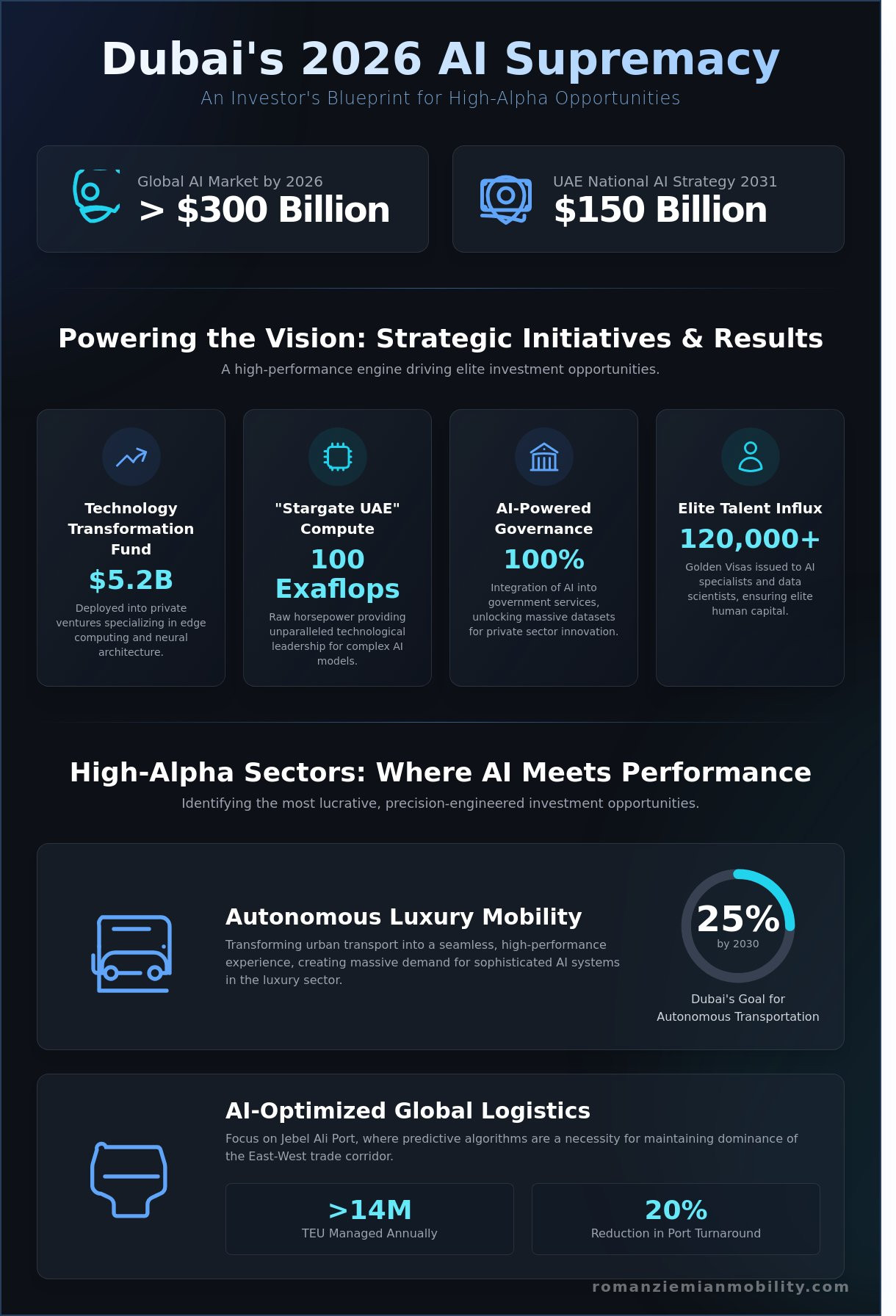
Dubai has secured its position as the definitive nexus for global tech allocation, moving far beyond its reputation as a mere financial hub. By 2026, the city’s transformation transcends basic digital infrastructure. It’s now about the surgical precision of the $150 billion UAE National AI Strategy 2031. This isn’t just a policy document; it’s a high-performance engine driving AI investment opportunities Dubai offers to elite investors who demand both growth and stability. The city’s leadership has masterfully pivoted from building the foundation to fueling sector-specific applications that redefine how capital interacts with code.
The D33 Agenda has effectively retooled the city into a global sandbox for AI-driven commerce and trade. As Dubai’s diversified economy matures, it integrates machine learning into every facet of its logistical and financial DNA. Sovereign wealth funds, including Mubadala and the Abu Dhabi Investment Authority, provide the necessary ballast for private equity. They de-risk the entry of institutional capital into bespoke tech ventures by co-investing in high-stakes projects. This creates a synergy between public ambition and private excellence that is rarely seen in other jurisdictions. It’s a landscape where risk is shared and rewards are amplified by a government that acts as a partner rather than a regulator.
By 2026, the transition from experimental AI to industrial-scale implementation is complete. We see this in the way autonomous logistics and predictive trade finance have become the standard. Investors are no longer betting on the possibility of AI; they’re investing in its proven utility across the city’s most vital sectors. This environment provides a unique vantage point for identifying the most lucrative AI investment opportunities Dubai presents within the mobility and luxury sectors. It’s a world where speed is matched by sophisticated strategy.
The UAE National AI Strategy 2031: A 2026 Status Report
The Technology Transformation Fund has reached a critical milestone, having deployed $5.2 billion into private ventures that specialize in edge computing and neural architecture. By early 2026, the integration of AI into 100% of government services has yielded a commercial fallout of unprecedented scale. This move has opened up massive datasets for private sector innovation while reducing operational friction for businesses. The “Stargate UAE” project has also achieved its target compute capacity of 100 exaflops, providing the raw horsepower required for unparalleled technological leadership.
Regulatory Stability and the Virtual Assets Regulatory Authority (VARA)
Dubai’s legal framework, bolstered by the maturity of the Virtual Assets Regulatory Authority (VARA), offers a sanctuary for high-tech intellectual property. There’s a seamless synergy between AI regulation and digital asset growth that ensures long-term stability for international stakeholders. This clarity protects the elite ambition of founders and investors alike. Furthermore, the issuance of over 120,000 Golden Visas to AI specialists and data scientists by late 2025 has cultivated a workforce of elite caliber. This influx of talent ensures that the human capital matches the city’s technological momentum, creating a self-sustaining ecosystem of innovation and success.
High-Alpha Sectors: Where AI Meets Mobility and Performance
Dubai’s economic landscape for 2026 is defined by a relentless pursuit of speed and precision. High-alpha sectors are emerging where autonomous systems meet luxury performance, creating a unique environment for sophisticated capital deployment. The city’s 2030 goal to transform 25% of total transportation into autonomous modes is driving massive demand for AI investment opportunities Dubai. This evolution centers on the Jebel Ali Port, which manages over 14 million TEU annually. AI optimization here isn’t a luxury; it’s a necessity for maintaining the East-West trade corridor’s dominance. Predictive algorithms now manage container stacking and vessel scheduling with a level of precision that human operators can’t match. These systems reduce port turnaround times by 20%, directly impacting the profitability of international trade routes.
To maximize returns, investors should focus on three primary pillars of AI-mobility synergy:
- Real-time sensor fusion for complex urban navigation in high-density areas.
- Predictive analytics for port logistics and global supply chain fluidity.
- Energy-grid optimization for massive, automated EV fleets.
The Future of Mobility: AI in Autonomous and GT Racing
Elite motorsport remains the premier testbed for technological excellence. The telemetry harvested from the track provides the raw intelligence needed for consumer-grade autonomous systems. High-performance racing generates over 2 terabytes of data per car during a single weekend. This information is vital for perfecting sensor fusion, where data from LIDAR, radar, and cameras must merge in milliseconds. Roman Ziemian AI insights demonstrate how these track-side innovations translate into bespoke mobility solutions for the high-net-worth market. The GT4 European Series serves as a critical data-generation platform for startups focusing on edge computing. These firms are developing hardware capable of processing 100 trillion operations per second. Such processing power is a requirement for navigating Dubai’s complex urban architecture at high speeds without sacrificing safety or the passenger experience.
Smart City Logistics and Sustainable Transport
Dubai’s infrastructure is a canvas for sustainable innovation. The integration of AI into EV charging networks allows for dynamic load balancing, reducing energy waste by 30% across the grid. The CSIS analysis of UAE’s AI ambitions confirms that the nation’s strategy is built on large-scale investment vehicles that prioritize these technological synergies. Last-mile delivery automation is currently a primary focus for Dubai-based startups. Pilot programs using AI-driven drones and ground robots are expected to handle 15% of all parcel deliveries by late 2026. This niche represents a billion-dollar opportunity for those seeking AI investment opportunities Dubai within the intersection of logistics and smart city architecture. Predictive maintenance for these fleets ensures 99% uptime, removing the friction typically associated with traditional transport. Sustainable mobility is no longer a peripheral concern; it’s a core requirement for any sophisticated investment portfolio. You can explore these high-performance investment strategies to align your capital with the future of global movement.
Evaluating Investment Hubs: DIFC vs. ADGM vs. Hub71
Success in the Emirates requires a discerning eye for structural excellence. Selecting the right jurisdiction for your AI venture or investment vehicle represents a foundational decision that dictates your long-term trajectory. While the UAE offers a unified vision for 2026, the granular differences between the Dubai International Financial Centre (DIFC) and Abu Dhabi Global Market (ADGM) create distinct synergies for specific capital strategies. Investors must look beyond the surface to understand how these ecosystems facilitate AI investment opportunities Dubai through bespoke regulatory frameworks and unparalleled access to liquidity.
A localized presence in Dubai is non-negotiable for rigorous AI due diligence. You can’t audit a neural network’s cultural alignment or a team’s execution velocity from a screen in London or New York. Proximity allows private offices to tap into accelerators that filter thousands of pitches into high-conviction deal flows. These accelerators act as the primary engine for discovery, ensuring that only the most resilient technologies reach the desks of elite investors. Both DIFC and ADGM offer 100% foreign ownership and 100% capital repatriation, yet their distinct tax incentives and legal structures, based on English Common Law, provide different levels of protection for intellectual property.
DIFC and the AI & Web3 Campus
The DIFC AI & Web3 Campus stands as the world’s largest cluster for specialized tech companies, targeting over 500 global firms by 2028. This ecosystem isn’t just a workspace; it’s a high-octane environment where innovation meets institutional capital. Investors gain direct access to a 100 million dollar venture capital fund dedicated specifically to fintech and AI startups. Networking with global High-Net-Worth Individuals (HNWIs) within the DIFC ecosystem occurs naturally at elite venues like the Capital Club, where deals are often forged over shared visions of technological leadership. This concentration of wealth and talent ensures that every investment is backed by a sophisticated infrastructure designed for scale.
This elite environment also fosters an appreciation for bespoke craftsmanship, extending from tailored financial instruments to personal luxury. The intricate, handcrafted designs from brands like KaMila Fine Jewellery resonate with a clientele that values precision and unique artistry in all aspects of life, mirroring the bespoke nature of the tech ventures they support.
Hub71: The Gateway to Abu Dhabi’s Sovereign Capital
Hub71 provides a strategic bridge to the massive sovereign wealth managed by Mubadala and ADQ. This Abu Dhabi based ecosystem offers a specialized Digital Assets environment, providing AI engineering teams with incentive packages that cover housing and office space for up to two years. For deep-tech ventures requiring massive compute power and long-term research cycles, the partnership opportunities here are unmatched. The synergy between Hub71 and the Mohamed bin Zayed University of Artificial Intelligence (MBZUAI) ensures a steady pipeline of doctoral-level talent. This makes it an ideal landing zone for firms looking to integrate AI with industrial applications or national-scale infrastructure projects.
Choosing between these hubs depends on your specific appetite for risk and your desired proximity to different types of capital. While DIFC excels in financial integration and high-velocity networking, Hub71 offers a direct path to the heavy-hitting sovereign funds of the capital. Both jurisdictions have eliminated corporate tax on qualified income for free zone entities until at least 2026, provided they meet the necessary economic substance requirements. This fiscal stability creates a secure environment for deploying large-scale capital into the most promising AI investment opportunities Dubai and the wider region have to offer.
- DIFC: Best for fintech-aligned AI and high-velocity venture capital.
- ADGM/Hub71: Ideal for deep-tech, sovereign partnerships, and engineering-heavy teams.
- Commonality: Both offer 100% repatriation and English Common Law courts for dispute resolution.
Elite investors don’t just follow the trend; they position themselves where the infrastructure supports their ambition. The choice of jurisdiction is your first move in a high-stakes game of global innovation. It’s about securing a seat at the table where the future of mobility, finance, and intelligence is being rewritten.
The Strategic Investor’s Playbook: Due Diligence in AI
Discerning excellence in a saturated market requires a shift from speculative enthusiasm to rigorous, technical scrutiny. As the landscape for AI investment opportunities Dubai matures toward 2026, the distinction between “AI-wrapped” products and core architectural innovation has become the primary determinant of long term value. Approximately 68% of current startups utilize basic API wrappers around existing Large Language Models (LLMs). These ventures often lack a defensive moat; they’re susceptible to the rapid platform updates of foundational model providers. Sophisticated capital must instead seek out proprietary neural architectures that demonstrate a 30% or greater efficiency in token processing compared to standard open-source benchmarks.
Data sovereignty represents the second pillar of a robust due diligence process. Compliance with the UAE Data Protection Law, specifically Federal Decree-Law No. 45 of 2021, is a non-negotiable requirement for any scalable enterprise. Investors should prioritize firms that have already secured data residency within the UAE borders. This is particularly critical as 85% of high-value government contracts in the Middle East now mandate local data processing to ensure national security and privacy. Evaluating the scalability of Arabic LLMs is equally vital. The launch of the Jais model in August 2023 set a precedent for linguistic precision. Success in the GCC requires models that understand the nuances of Khaleeji dialects rather than relying on generic translations that fail to capture cultural context.
- Proprietary IP: Verify if the startup owns its training weights or merely leases access.
- Infrastructure Sustainability: Assess the cost of compute; elite firms often leverage the UAE’s $20 billion investment in renewable energy to power data centers.
- Regulatory Alignment: Ensure the venture operates within the Dubai International Financial Centre (DIFC) AI & Web3 Campus frameworks.
Technical Vetting for AI Startups
Technical audits must move beyond the pitch deck to analyze the underlying infrastructure. We look for a 25% reduction in inference costs as a sign of optimized code. Verifying the quality of training data within the UAE regulatory sandbox ensures that the algorithms remain unbiased and legally compliant. Investors should scrutinize the “compute-to-revenue” ratio to ensure the business model remains sustainable as user acquisition scales across the region.
The Human Element: Leadership and Vision
Technology alone does not guarantee market dominance; the pedigree of leadership is the true catalyst for growth. Understanding the track record of the investor-operator Roman Ziemian provides a blueprint for how personal philosophy and global experience merge to drive industrial capability. Founders must possess a deep understanding of GCC cultural nuances to navigate complex local partnerships. Strategic advisory plays a 40% role in post-investment scaling, transforming a technical prototype into a prestigious market leader.
Success in this elite sector demands a partner who understands the intersection of high-speed innovation and executive stability. To explore how bespoke strategies can elevate your portfolio, connect with Roman Ziemian Mobility today.
Partnering for Success: The Roman Ziemian Mobility Vision
The intersection of high-performance racing and sophisticated capital allocation creates a unique vantage point for the modern investor. Roman Ziemian Mobility bridges this gap by applying the rigorous precision of the racetrack to the fast-moving world of technology. Identifying the premier AI investment opportunities Dubai offers requires a perspective that values both rapid acceleration and long-term stability. Our approach isn’t merely about funding; it’s about engineering a bespoke path for capital that fuels sustainable mobility and intelligent systems. We’ve seen how the 100 billion AED Dubai Economic Agenda D33 transforms the city into a global testbed, and our vision aligns with this 2026 horizon to ensure every partnership achieves maximum velocity.
Our methodology draws on a global perspective that links the technical prowess of Poland’s emerging tech hubs with the unparalleled financial infrastructure of the UAE. This synergy allows us to move beyond traditional boundaries, offering a holistic investment legacy that combines philanthropy with cutting-edge innovation. We don’t view mobility as a simple logistics category. Instead, we see it as a comprehensive ecosystem where AI, human ambition, and environmental stewardship converge to create a more efficient world.
A Legacy of Speed and Innovation
The transition from the high-stakes environment of the Ferrari Challenge to the complex dynamics of the boardroom isn’t as vast as it seems. Both arenas demand an obsession with detail and a refusal to accept second place. As Roman Ziemian inspires global change through motorsport and humanity, the RZ Mobility team translates those lessons into strategic excellence. We apply the same split-second decision-making skills found on the track to the evaluation of 2026 market trends. This commitment to excellence ensures that our partners aren’t just participating in the market; they’re leading it. 2026 stands as the definitive year for entry because the Dubai Universal Blueprint for Artificial Intelligence (DUB-AI) will have reached its critical mass by then, providing a mature regulatory framework for bold investors.
Strategic Advisory for the Next Generation
Mentoring high-growth mobility startups requires more than capital; it demands a roadmap for scalability. We focus on identifying founders who possess the technical depth to navigate the AI era and the grit to survive its rapid evolution. Our advisory services emphasize a diversified portfolio that balances high-risk disruptive tech with stable, sustainable infrastructure; for many, this includes options to explore real estate as a tangible asset. This strategy mitigates volatility while capturing the upside of Dubai’s 2026 vision for autonomous transport and smart city logistics. We utilize data-driven insights to ensure our partners’ assets are positioned at the forefront of the 1.9 billion dollar AI market growth projected for the region.
- Precision Mentorship: We provide 100% hands-on strategic guidance for startups integrating AI into logistics.
- Global Connectivity: Our network spans from Warsaw to Dubai, offering a unique corridor for talent and capital.
- Sustainable Focus: We prioritize investments that target a 50% reduction in carbon footprints through intelligent routing.
The future of mobility is being written in the code of neural networks and the blueprints of smart cities. It’s a journey that requires a partner who understands the mechanics of success and the soul of innovation. If you’re ready to explore the most prestigious AI investment opportunities Dubai has to offer, the RZ Mobility team is prepared to guide your entry into this elite sector. Contact our specialists today to discuss how we can align your investment goals with the visionary landscape of 2026.
Accelerating Toward the 2026 AI Frontier
Dubai’s strategic roadmap for 2026 transforms the city into a global laboratory where the AI investment opportunities Dubai offers are anchored by the robust frameworks of the DIFC and ADGM. This evolution isn’t merely about software; it’s about the seamless integration of intelligence into the physical world. By focusing on high-alpha sectors like autonomous logistics and bespoke mobility, you’re positioning your capital at the center of a technological revolution that values precision above all else.
Roman Ziemian Mobility stands at this intersection, merging the high-octane discipline of the Ferrari Challenge and GT4 European Series with a sophisticated global investment portfolio across Poland and the UAE. Our commitment to sustainable innovation ensures that every strategic move reflects a vision of excellence and technological leadership. It’s time to align with a partner who understands that speed is nothing without a calculated direction and a proven track record of success.
Explore AI Investment Opportunities with RZ Mobility
The journey toward 2026 is moving at a record pace, and the most rewarding path is the one we build together.
Frequently Asked Questions
What is the most promising AI sector in Dubai for 2026?
Autonomous transportation and smart logistics represent the most lucrative AI sector in Dubai for 2026. The Dubai Autonomous Transportation Strategy mandates that 25% of all transportation trips become driverless by 2030. This shift creates unprecedented AI investment opportunities Dubai offers to those focusing on sensor fusion and real-time navigation. Investors who align with this 2030 target find a market hungry for bespoke software solutions that bridge the gap between legacy infrastructure and futuristic mobility.
How does the Dubai AI National Strategy 2031 affect private investors?
The Dubai AI National Strategy 2031 creates a high-growth environment for private investors by integrating AI into 100% of government services and high-priority sectors. This strategy aims to generate AED 335 billion in economic returns by its completion date. Private capital benefits from streamlined regulations and direct access to state-backed pilot programs. It’s a structured roadmap that ensures your capital works in synergy with national objectives, providing a stable foundation for elite technological expansion.
Can I get a Golden Visa through AI investment in Dubai?
You can secure a 10-year Golden Visa by making a minimum investment of AED 2 million in a UAE-accredited AI startup or an investment fund. This residency program targets high-net-worth individuals and specialized talent who contribute to the nation’s digital transformation goals. The 2022 updates to the visa regulations allow for greater flexibility, ensuring that visionary leaders can maintain a long-term presence. This stability is essential for overseeing complex technological portfolios and fostering deep industry connections within the region.
What is the difference between investing in DIFC vs. Hub71 for AI?
DIFC specializes in the intersection of AI and financial services, while Hub71 focuses on accelerating early-stage tech startups through a global ecosystem. The DIFC AI and Web3 Campus aims to house 500 firms by 2028, offering a sophisticated regulatory environment for fintech innovation. Hub71 provides a different synergy, offering incentives like subsidized housing and office space for startups. Choosing between them depends on whether your strategy favors regulated financial excellence or rapid, high-octane growth in the broader tech landscape.
How does Dubai regulate AI and data privacy for international firms?
Dubai regulates AI through the Dubai Data Law and the DIFC Data Protection Law No. 5 of 2020, which mirrors the rigorous standards of the European GDPR. These frameworks ensure that international firms can operate with confidence, knowing their intellectual property and consumer data are protected by world-class legal structures. The Dubai AI Ethics Board provides additional oversight, ensuring that 100% of AI deployments remain transparent and accountable. This commitment to precision fosters an environment where innovation thrives without compromising security.
What role does AI play in the future of mobility in the UAE?
AI is the foundational engine for the UAE’s future mobility, powering everything from predictive logistics to the autonomous air taxi fleet scheduled for 2026. The Roads and Transport Authority utilizes AI algorithms to reduce traffic congestion by 20% in key urban corridors. This integration of smart technology into the physical world reflects a passion for speed and efficiency. It transforms mobility from a simple service into a sophisticated, data-driven experience that defines the modern urban landscape.
Is there a minimum investment required for AI startups in Dubai?
A minimum capital investment of approximately AED 50,000 is generally required to secure an AI-related trade license in specialized free zones like DKP or DTEC. This initial outlay covers the essential administrative and legal foundations for your enterprise. Beyond licensing, AI investment opportunities Dubai provides often require larger commitments to scale operations effectively. Most successful ventures in our network start with seed rounds exceeding AED 1 million to ensure they have the technological momentum necessary for global success.
How can I partner with Roman Ziemian Mobility for tech investments?
Partnering with Roman Ziemian Mobility requires an alignment with our core values of excellence and visionary innovation within the high-performance tech sector. Our bespoke investment structures allow partners to share in a legacy defined by precision and elite ambition. We’re currently targeting a 15% improvement in logistics efficiency through our proprietary AI initiatives by 2027. Interested parties should engage with our executive team to explore how their capital can accelerate the next generation of global mobility solutions.