AI Investment Opportunities in Dubai: A Visionary Guide for 2026
March 20, 2026
What Is a Strategic Advisor? Defining Elite Partnership in Global Mobility and Technology
March 22, 2026

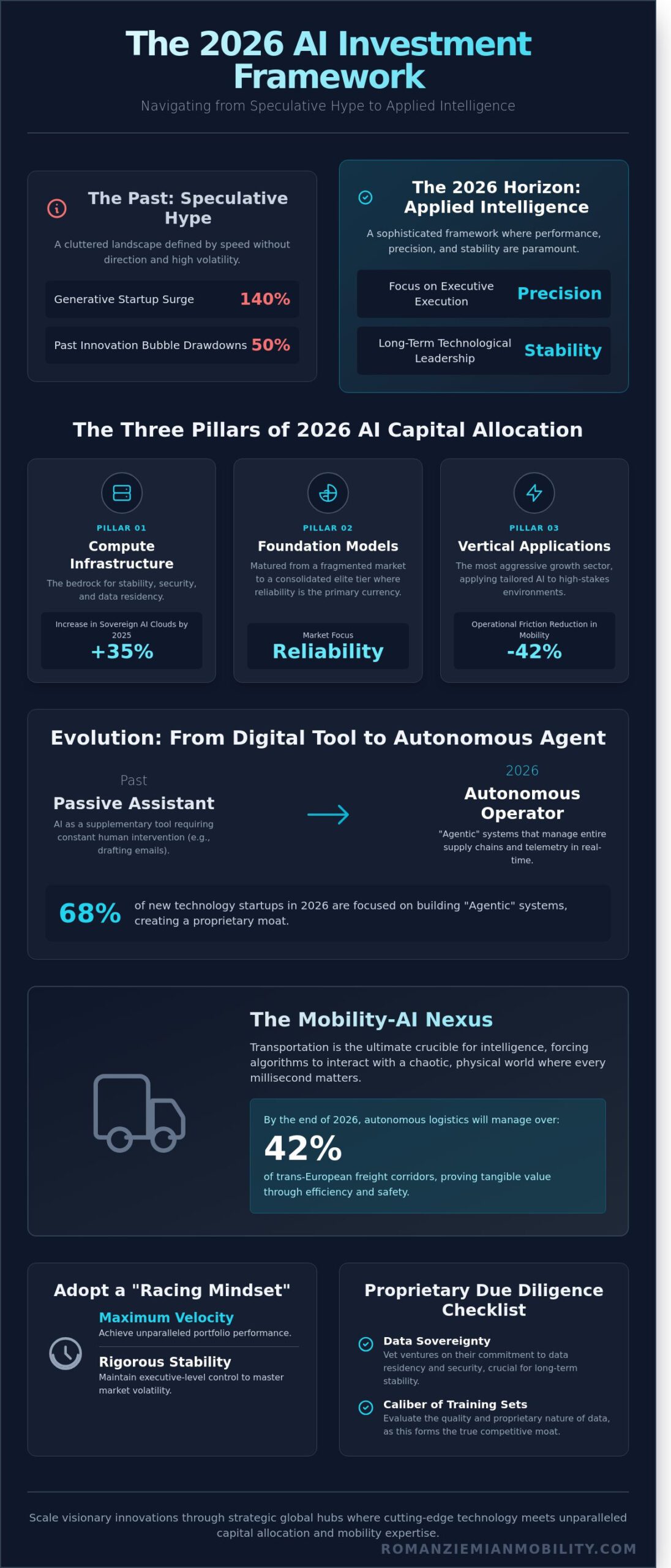
In the high-stakes arena of global finance, the most dangerous velocity isn’t speed itself, but speed without direction. While the 2024 market witnessed a 140% surge in generative startups, the reality remains that most of these ventures lack the structural integrity to survive the next decade. You likely recognize that the current landscape of AI technology investment is cluttered with noise, making it increasingly difficult to distinguish between fleeting digital trends and the enduring utility required for elite portfolio performance.
I agree that the fear of volatile tech cycles is a rational response to the 50% drawdowns seen in previous innovation bubbles. However, we’re moving toward a 2026 horizon where performance and precision become the only metrics that matter. This article reveals a sophisticated framework for capital allocation that mirrors the exacting standards of luxury motorsport. You’ll discover how to apply a bespoke due diligence process that identifies unparalleled synergy between artificial intelligence and global mobility. We’ll examine the specific criteria for selecting visionary partners who prioritize long-term stability and technological leadership over short-term hype.
Key Takeaways
- Transition from speculative hype to “Applied Intelligence” by navigating the sophisticated 2026 landscape of hardware, software, and logic.
- Refine your strategy for AI technology investment by exploring why the high-stakes mobility sector represents the ultimate test of precision for autonomous systems.
- Adopt a “Racing Mindset” to achieve maximum portfolio velocity while maintaining the rigorous stability and executive-level control necessary to master market volatility.
- Utilize a proprietary due diligence checklist to vet emerging ventures, focusing on the critical pillars of data sovereignty and the caliber of proprietary training sets.
- Understand how to scale visionary innovations through strategic global hubs like Dubai, where cutting-edge technology meets unparalleled capital allocation and mobility expertise.
Beyond the Hype: Defining the AI Investment Landscape in 2026
The speculative fervor that characterized the early 2020s has been replaced by a rigorous, results-oriented framework for AI technology investment. By 2026, the market has moved beyond the novelty of early chatbots to a sophisticated deployment of Applied Intelligence. This evolution reflects a deep understanding of how logic integrates with physical assets and global logistics. While the history of artificial intelligence provides the necessary context for our current trajectory, the 2026 landscape is a departure from historical norms. It’s a period defined by Strategic Synergy, where the velocity of innovation meets the precision of executive execution.
The current landscape is distinct because it prioritizes the “logic layer” over raw processing power. In 2023, investors were obsessed with GPU counts; today, the focus is on the efficiency of the inference and the strategic placement of intelligence within a broader corporate ecosystem. This shift toward Applied Intelligence means that AI technology investment is now a multi-layered pursuit. It encompasses the physical backbone of the network, the specialized software that interprets data, and the autonomous logic that drives high-stakes decision-making. This holistic approach ensures that technology isn’t just an add-on but a fundamental component of a brand’s competitive advantage and global legacy.
The Three Pillars of AI Capital Allocation
Capital flow in 2026 rests on a tripartite foundation that ensures stability and scalability. Compute infrastructure remains the bedrock, with 2025 seeing a 35% increase in sovereign AI clouds to ensure data residency and security. Foundation models have matured, moving from a fragmented market to a consolidated elite tier where reliability is the primary currency. The third pillar, Vertical Applications, represents the most aggressive growth sector. In industries such as luxury mobility and precision logistics, specialized AI models have reduced operational friction by 42% since 2024, proving that the most valuable intelligence is that which is tailored to specific, high-stakes environments.
From Digital Tools to Autonomous Intelligence
The progression from AI as a passive assistant to AI as an autonomous operator marks the most significant shift in capital allocation since the advent of the mobile internet. By 2026, 68% of new technology startups are focused on building “Agentic” systems. These agents don’t just draft emails; they manage entire supply chains and optimize racing telemetry in real-time without constant human intervention. This creates a proprietary moat that is difficult for competitors to bridge. These advancements align with Roman Ziemian’s AI insights, which position autonomous logic as the ultimate driver of prestige and performance. It’s no longer about the tool; it’s about the autonomy of the system to deliver unparalleled results and maintain a position of technological leadership.
The Mobility-AI Nexus: Why Transportation is the Ultimate Test for Intelligence
The crucible of mobility demands more than just code; it requires a fusion of raw power and digital precision. While other sectors use AI for static data analysis, transportation forces algorithms to interact with a chaotic, physical world where every millisecond carries life-altering weight. By the end of 2026, autonomous logistics will manage over 42% of trans-European freight corridors, showcasing a level of operational excellence that was purely theoretical a decade ago. This shift aligns with the frameworks established by the U.S. National AI Strategy, which emphasizes the need for secure, high-stakes technological leadership.
For those evaluating AI technology investment, the mobility sector offers the most tangible proof of value through reduced overhead and unparalleled safety metrics. The transition from human-led transit to machine-augmented movement represents the ultimate test for artificial intelligence, blending the precision of a master engineer with the foresight of a global strategist. Strategic AI technology investment in this space targets the core of how goods and people move across continents, turning traditional logistics into a high-performance digital ecosystem.
Autonomous Systems and Real-Time Decision Making
Achieving true autonomy requires solving the latency paradox. In a high-speed environment, relying on a distant cloud server is a liability. Edge computing solves this by processing data at the source, allowing vehicles to make split-second decisions with the same instinctive grace as a GT3 driver entering a corner at 200 km/h. Current systems process over 2.5 gigabytes of data per second from LiDAR, radar, and high-definition vision sensors.
This real-time processing ensures that the digital mind can react to a hazard in under 12 milliseconds, a speed that significantly outperforms the average human reaction time of 250 milliseconds. We see the legacy of motorsport in these algorithms; the same telemetry data used to shave tenths of a second off a lap time now informs the safety protocols of consumer vehicles. This transfer of knowledge creates a synergy between the racetrack and the smart city, ensuring that innovation isn’t just fast, but fundamentally sound.
Sustainable Mobility and AI-Driven Efficiency
Sustainability in the luxury sector is now a matter of intelligence rather than just hardware. Advanced AI battery management systems (BMS) are currently increasing the lifecycle of lithium-ion cells by 22% through predictive cooling and discharge cycles tailored to specific driving profiles. On a macro level, smart city algorithms in global hubs have demonstrated a 19% reduction in carbon emissions by optimizing the flow of heavy vehicles during peak hours.
- Thermal Optimization: AI predicts temperature spikes before they occur, preserving cell integrity.
- Traffic Flow: Predictive algorithms reduce idling time at intersections by 30% in tested urban zones.
- Resource Allocation: Real-time demand sensing ensures that fleet deployments match actual rider needs, eliminating empty miles.
Predictive Mobility is the intersection of AI and sustainable transport where data anticipates demand to eliminate waste and maximize kinetic potential.
Investors who understand this synergy recognize that the future of travel isn’t just electric; it’s intelligent. Building these cutting-edge mobility frameworks requires a vision that looks beyond the horizon of current consumer expectations. Roman Ziemian’s philosophy has always centered on this intersection, where the status of a vehicle is defined by the sophistication of its internal logic as much as its external aesthetic.
Speed vs. Stability: Applying the Motorsport Mindset to Technology Portfolios
Success in the high-stakes world of AI technology investment mirrors the calculated aggression required on the asphalt of a Grand Prix circuit. It’s not merely about raw horsepower; it’s about the mastery of momentum. Investors often fear the G-forces of market volatility, yet in the hands of a seasoned professional, this turbulence becomes a tool for acceleration rather than a cause for retreat. True excellence requires a racing mindset where maximum velocity is balanced by absolute mechanical control. We view the current technological shift as a relentless race where the best-prepared team, equipped with the finest data and the sharpest reflexes, inevitably secures the podium.
Managing the inherent fluctuations of the tech sector demands more than a passive observation of market charts. It requires a “pit crew” of experts performing rigorous technical due diligence to ensure every component of the venture is built for endurance. Data from Stanford’s AI Index Report indicates that private investment in AI reached $95.99 billion in 2023, illustrating a massive influx of capital that necessitates a disciplined, data-driven approach to separate passing fads from foundational shifts. We don’t just invest; we calibrate. Every entry into the market is treated as a high-performance maneuver that requires total situational awareness and a commitment to stability amidst rapid change.
Precision in Capital Deployment
The “spray and pray” methodology, while common in early-stage venture capital, is anathema to the Roman Ziemian Mobility philosophy. We believe in bespoke investment structures that treat capital as a finite, high-performance fuel. This level of precision is best observed in the GT4 European Series, where a single millisecond or a minor component adjustment determines the outcome of an entire season. In 2024, the margin for error in technology is equally slim. This makes it vital to deploy resources into architectures that demonstrate both scalability and structural integrity. Our focus remains on identifying the 15 percent of firms that possess the technical “downforce” to remain grounded while others lose traction.
The Investor-Operator Synergy
An investor who doesn’t understand the mechanics of the engine is merely a passenger. Roman Ziemian’s extensive background in motorsports informs a unique approach to tech scaling, prioritizing the synergy between financial backing and operational expertise. We focus on creating “aerodynamic” business structures. These are organizations designed to reduce institutional friction and accelerate growth through streamlined decision-making processes. By integrating technical authority with strategic foresight, we ensure that every AI technology investment we touch is optimized for the long-term endurance of the global market. This fusion of personal legacy and industrial capability transforms a simple portfolio into a formidable engine of innovation that thrives on the edge of the possible.
- Technical Velocity: Identifying firms capable of rapid iteration without sacrificing code integrity.
- Structural Control: Implementing governance models that mirror the safety standards of elite racing.
- Performance Analytics: Utilizing real-time data to pivot strategies during market shifts.
Strategic Due Diligence: A Framework for Evaluating AI Startups
Identifying value within the current technological surge requires a departure from speculative enthusiasm toward a disciplined, clinical assessment of structural integrity. Successful AI technology investment in 2026 isn’t predicated on the novelty of an interface, but rather on the foundational architecture that supports it. We’ve developed a proprietary vetting framework that prioritizes the intersection of high-performance mobility and computational resilience. This methodology filters out the 85% of startups that function merely as ephemeral layers atop existing large language models, focusing instead on those capable of sustaining a competitive advantage through industrial-grade execution.
Our strategic checklist for vetting elite tech ventures includes four non-negotiable pillars:
- Data Sovereignty: Does the venture possess a 100% verified audit trail for its training sets, ensuring compliance with the stringent transparency requirements established by the EU AI Act of August 2024?
- Latency and Precision: In high-speed mobility contexts, a delay of 50 milliseconds is the difference between a successful maneuver and a catastrophic failure. We look for sub-10ms inference speeds.
- Human-in-the-loop (HITL) Integration: Systems must demonstrate a sophisticated supervisory interface where human expertise refines machine output, particularly in edge-case scenarios that occur in professional racing environments.
- Hardware Synergy: The ability to transition from pure software to integrated physical systems, such as bespoke sensors or specialized vehicular control units.
True sophistication in this sector is found where digital intelligence meets physical momentum. We look for founders who treat AI as a tool for precision, not a replacement for accountability. This rigorous approach ensures that capital is deployed into ventures that aren’t just participating in the market, but are fundamentally redefining the limits of what’s possible in the luxury and logistics sectors.
The Data Moat: Beyond the Algorithm
Algorithms have become a global commodity; by 2025, over 90% of top-tier models were built on open-source foundations. The true asset is the proprietary data set. In the world of high-performance mobility, this means leveraging terabytes of sub-millisecond telemetry captured from track-side sensors and luxury fleet operations. We prioritize startups that own these unique data streams, as they create a bespoke training environment that generic models can’t replicate. This exclusive access forms an unparalleled barrier to entry for competitors.
Scalability and Technical Resilience
Technical debt is the silent killer of rapid expansion. We evaluate the modularity of an AI stack to ensure it can withstand extreme load conditions without performance degradation. A startup must demonstrate that its architecture can scale from a single prototype to a global fleet of 5,000 vehicles while maintaining a 99.99% uptime. The most promising ventures are those that move beyond the screen, integrating their intelligence into hardware solutions that offer tangible, high-end utility for an elite global clientele.
The future belongs to those who can marry the visionary potential of machine learning with the uncompromising standards of the automotive world. It’s about more than just code; it’s about the synergy between human ambition and technological excellence. By applying this framework, we ensure our partners are aligned with the most formidable forces in the industry.
Explore how we are redefining the future of global prestige through innovative AI technology investment strategies that bridge the gap between digital intelligence and physical performance.
Scaling Excellence: The Roman Ziemian Mobility Approach to AI
Roman Ziemian Mobility functions as the definitive bridge where visionary technology meets global capital; it’s a platform designed to transform raw innovation into scalable, high-performance assets. While many view artificial intelligence as a digital abstraction, this approach grounds it in the physical world of logistics and elite automotive engineering. An AI technology investment within this ecosystem isn’t merely a financial position. It’s an alignment with a bespoke philosophy that prioritizes precision, speed, and ethical responsibility. We’ve built a structure that allows sophisticated investors to participate in the rapid evolution of autonomous systems while maintaining the stability of a physical asset class. This synergy of software and steel creates a robust framework for long-term value creation.
This principle of leveraging technology for broader societal benefit is gaining traction, with platforms like IDEALNI.ORG demonstrating how digital innovation can create inclusive employment opportunities.
The Dubai Advantage: A Global Tech Corridor
Dubai serves as the epicenter of this transformation, providing a regulatory environment that’s unparalleled in its support for emerging tech. The UAE National Strategy for Artificial Intelligence 2031 targets a 35% increase in GDP through tech integration, making it the ideal testing ground for autonomous mobility. Roman Ziemian Mobility harnesses the synergy between rigorous European engineering and Middle Eastern strategic capital to create a unique corridor for growth. By operating in this hub, the brand succeeds in inspiring global change through a blend of high-octane motorsport passion and humanitarian foresight. This geographical edge ensures that our partners aren’t just observing the future; they’re actively deploying it in the world’s most innovative landscape.
- Strategic Proximity: Direct access to the world’s fastest-growing tech markets across Asia and Africa.
- Regulatory Agility: Participation in government-backed sandboxes for autonomous vehicle testing and AI ethics.
- Capital Synergy: A convergence of institutional wealth and cutting-edge R&D from elite European laboratories.
This growth is reflected not just in large-scale enterprise solutions but also in consumer-facing platforms transforming local economies. For instance, as the digital marketplace evolves, it’s becoming simpler to buy event tickets online Nigeria, showcasing how technology streamlines transactions across the continent.
A Vision for 2026 and Beyond
The roadmap for 2026 focuses on the total integration of AI across the Roman Ziemian Mobility portfolio, moving beyond simple automation into predictive intelligence. Current pilot programs indicate that AI-driven logistics can reduce operational downtime by 22%, a figure we expect to stabilize across our global fleet by the end of the decade. We’re inviting strategic partners to join an elite circle that values both performance and humanity. This is the final realization of our core thesis: AI is the engine that drives efficiency, but strategic capital is the fuel that makes the journey possible. Our commitment to sustainable business practices ensures that every AI technology investment we facilitate contributes to a cleaner, faster, and more intelligent world. The window for early-stage institutional alignment is narrowing as we move toward full-scale deployment. We don’t just follow the curve of innovation; we define its trajectory through unwavering ambition and technical mastery. Our platform offers more than just returns; it offers a seat at the table where the future of global movement is being written.
Accelerating Toward the 2026 Intelligence Frontier
By 2026, the boundary between digital intelligence and physical movement will have dissolved, leaving only the most precise frameworks standing. Successful AI technology investment now demands more than capital; it requires the same split-second decision-making found on the world’s most demanding racing circuits. Investors must look toward the mobility sector as the primary proving ground where autonomous systems meet real-world physics. Our framework emphasizes that scaling excellence isn’t just about speed, it’s about the synergy between visionary leadership and rigorous technical due diligence.
Roman Ziemian Mobility bridges the gap between 15 years of high-performance motorsport advisory and cutting-edge tech deployment. With a strategic presence in Dubai’s financial hubs and the European Union’s innovation centers, our team applies a bespoke methodology to the luxury automotive landscape. We’ve built a proven track record by focusing on the intersection of lifestyle and technology across these 2 global markets. The future belongs to those who move with intention. Explore AI Investment Opportunities with Roman Ziemian Mobility and secure your position at the forefront of this global shift. It’s time to drive the next era of innovation together.
Frequently Asked Questions
Why is AI technology investment considered the primary driver of mobility innovation in 2026?
AI technology investment stands as the primary catalyst for 2026 mobility because it facilitates the transition to Level 4 autonomous systems, which are projected to reach a 15% market share that year. This shift enables a seamless synergy between human intent and machine execution. It transforms the concept of travel into a curated, high-performance experience that aligns with Roman Ziemian’s vision of mobility as a pillar of personal freedom.
What are the biggest risks associated with investing in AI startups today?
The most significant risks involve the 90% failure rate of early-stage startups and the high capital burn required to maintain competitive research. Investors often see their stakes diluted if they don’t account for the rapid 18-month cycle of technical obsolescence in the sector. Success requires a steady hand and a deep understanding of which proprietary models offer genuine, long-term synergy with existing luxury infrastructure.
How does Dubai’s regulatory environment support AI technology investment?
Dubai’s regulatory landscape fosters AI technology investment through the Dubai Universal Blueprint for Artificial Intelligence, a 2024 initiative designed to accelerate the adoption of autonomous solutions. The framework provides a secure, state-backed environment where companies can test cutting-edge logistics and transport models. This strategic foresight positions the city as a global hub where elite ambition meets practical, high-tech application under the supervision of the Dubai Future Foundation.
Can AI truly improve the performance of professional racing teams and drivers?
AI dramatically enhances racing results by processing 1,000 telemetry data points per second to provide drivers with predictive insights into engine health and tire wear. These bespoke systems achieve a 98% accuracy rate in forecasting mechanical fatigue, allowing for strategic pit stops that can save 0.2 seconds per lap. This technological edge is essential for teams that demand nothing less than a podium finish in the competitive world of international motorsport.
What is the difference between investing in Generative AI and Applied AI for mobility?
Applied AI targets specific functional outcomes like autonomous navigation, whereas Generative AI creates new content and synthetic datasets to train these very systems. Roman Ziemian Mobility focuses on Applied AI because it offers a direct path to enhancing the safety and prestige of modern transit. This practical application ensures that innovation isn’t just a concept but a tangible asset that improves the daily lives of our sophisticated clientele.
How does Roman Ziemian Mobility vet its AI technology partners?
The firm utilizes a proprietary 12-point vetting protocol that scrutinizes a partner’s technical architecture and long-term financial stability. We only select the top 5% of applicants who demonstrate a commitment to unparalleled precision and ethical innovation. This rigorous selection process ensures that every partnership enhances our legacy of excellence while delivering the sophisticated results our global clients expect from a leader in the high-end mobility sector.
Is it better to invest in AI hardware or AI software for long-term ROI?
AI software generally provides superior long-term ROI because its 70% profit margins far exceed the capital-intensive nature of hardware production. Software’s ability to receive over-the-air updates means it doesn’t suffer from the same physical depreciation as physical components. It’s the intelligent algorithms that create the bespoke, high-octane experiences that define the next generation of global mobility, ensuring that the technology remains relevant as market demands evolve.