What Is a Strategic Advisor? Defining Elite Partnership in Global Mobility and Technology
March 22, 2026
Ferrari Challenge Sponsorship: A Strategic Guide to Elite Motorsport Partnerships in 2026
March 24, 2026
Could the roar of a high-performance engine serve as the definitive heartbeat of a carbon-neutral future? For years, discerning observers viewed the intersection of motorsport and sustainability through a lens of skepticism, often dismissing it as a superficial branding exercise rather than a legitimate industrial shift. You likely understand that while the passion for speed is timeless, the traditional mechanics of racing face an existential mandate to evolve. This leaves many to wonder if the sport can truly transcend its carbon-heavy legacy to become a genuine pillar of global environmental progress.
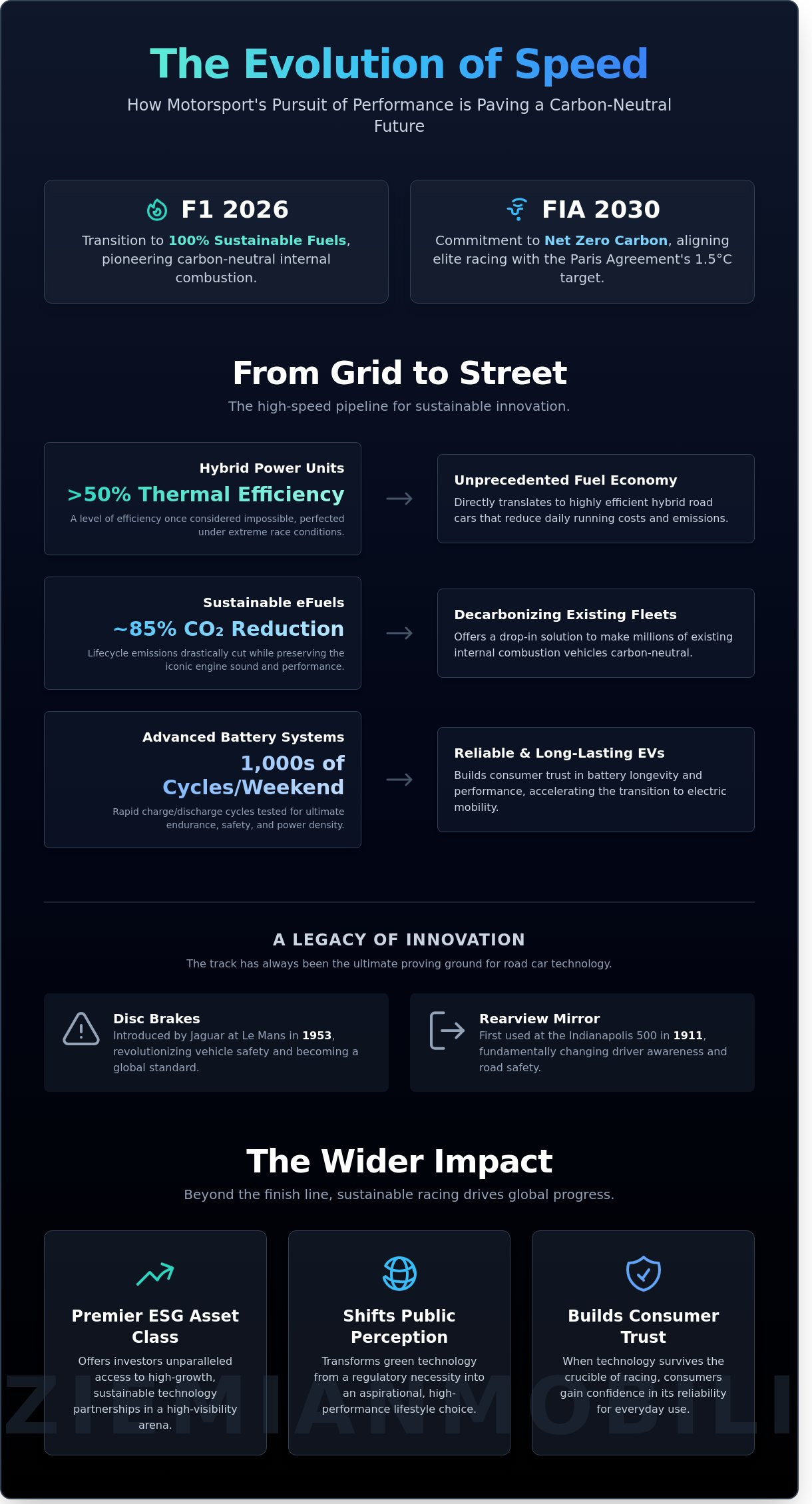
By the 2026 season, when Formula 1 transitions to 100% sustainable fuels, this high-speed laboratory will emerge as the premier frontier for bespoke technological investment. You’ll discover how the elite world of racing drives the next generation of mobility, offering a clear validation of the track-to-road pipeline as a cornerstone of modern ESG strategies. We’ll analyze the complex synergy between eFuels and electric powertrains while providing direct insight into how visionaries like Roman Ziemian orchestrate this transition to ensure that performance and prestige remain synonymous with environmental stewardship.
Key Takeaways
- Understand the paradigm shift toward “Sustainable Performance,” where the pursuit of elite speed is redefined through the lens of uncompromising efficiency and technological synergy.
- Explore the sophisticated mechanisms of tech transfer that allow motorsport and sustainability to converge, accelerating the journey of lightweight materials from the racetrack to global consumer markets.
- Identify why sustainable racing has emerged as a premier ESG-aligned asset class, offering investors an unparalleled opportunity to participate in high-growth innovation partnerships.
- Gain strategic foresight into the 2026 technical regulations and the pivotal role of the Middle East as a visionary testing ground for the future of global mobility.
- Discover the bespoke philosophy of Roman Ziemian, where a legacy of professional racing excellence informs a strategic commitment to driving humanity forward through high-octane innovation.
The Evolution of Speed: Why Motorsport and Sustainability are No Longer Contradictory
The narrative of elite racing is undergoing a profound transformation. We’re witnessing the birth of “Sustainable Performance,” a philosophy where velocity is no longer measured solely by raw power. Instead, it’s defined by the surgical precision of resource management and bespoke engineering. For decades, the paddock prioritized performance at any cost. Today, the metric for victory has shifted toward performance through efficiency. This isn’t a compromise; it’s the ultimate engineering challenge. The FIA has codified this shift with its commitment to achieving Net Zero Carbon by 2030, aligning the world’s most prestigious racing series with the Paris Agreement’s 1.5°C target. This strategic alignment ensures that the intersection of motorsport and sustainability thrives, allowing Electric motorsport and hybrid competitions to serve as high-speed incubators for the green technologies that will soon define our global infrastructure.
Elite racing acts as a catalyst for public perception. It turns abstract concepts into tangible, exciting realities. When spectators see a vehicle powered by hydrogen or 100% sustainable fuels winning a trophy, the psychological barrier to green tech dissolves. This creates an unparalleled synergy between the track and the showroom. It positions eco-friendly mobility as an aspirational lifestyle choice rather than a regulatory necessity.
The Historical Precedent of Racing Innovation
Historically, the track has functioned as the most rigorous R&D laboratory on the planet. From the 1953 introduction of disc brakes by Jaguar at Le Mans to the 1911 debut of the rearview mirror at the Indianapolis 500, track-tested reliability has always preceded consumer adoption. The current sustainability push represents the most significant pivot since the 1973 oil crisis. That era forced engineers to rethink fuel consumption without sacrificing the thrill of the chase. By proving these systems under extreme thermal and mechanical stress, manufacturers build the consumer trust necessary for mass-market transition. When a hybrid system survives 24 hours at Daytona, the average driver gains confidence in the longevity of their own electrified vehicle.
The link between track success and consumer trust is unbreakable. It’s about more than just marketing; it’s about empirical evidence. If a battery can discharge and recharge 1,000 times in a single race weekend without failure, it’s ready for the driveway. This legacy of innovation ensures that the cutting-edge solutions developed for the podium eventually enhance the safety and efficiency of every commuter on the road.
Addressing the Performance vs. Planet Debate
Critics often argue that green initiatives dilute the soul of the sport. The reality is quite the opposite. The current generation of hybrid power units achieves over 50% thermal efficiency, a feat once considered impossible by traditional internal combustion standards. These machines provide a visceral experience, combining the instant torque of electric motors with the high-revving symphony of advanced engines. To manage these complex systems, we define the circular economy of racing as a closed-loop system for resource management where every component, from carbon fiber chassis to rare-earth magnets, is tracked and repurposed to minimize environmental footprints.
The integration of motorsport and sustainability doesn’t signal the end of the high-octane era. It signals its evolution. High-performance eFuels are already being tested to reduce lifecycle CO2 emissions by up to 85% while maintaining the iconic roar of the engine. This transition reflects a bold, visionary approach to mobility. It’s an era where elite ambition meets global responsibility. We don’t just race for trophies anymore; we race for the future of transport itself.
From the Grid to the Street: How Racing Technology Accelerates Global Mobility
The race track serves as the world’s most unforgiving laboratory; it’s a high-pressure environment where every millisecond of performance is scrutinized and every component is pushed to its absolute limit. This relentless pursuit of speed has evolved into a sophisticated engine for environmental progress. The intersection of motorsport and sustainability isn’t merely a corporate objective; it’s a technical mandate that’s reshaping how we perceive global transit. When a racing team discovers a way to shave 50 grams off a suspension arm or increase the thermal efficiency of a power unit by 2%, those gains don’t stay confined to the paddock. They permeate the supply chains of global manufacturers, eventually manifesting in the vehicles parked in suburban driveways.
Lightweighting represents one of the most significant contributions from the track to the street. By utilizing advanced carbon-fiber composites and 3D-printed titanium alloys, engineers can reduce a vehicle’s total mass by up to 15%. In the context of electric vehicles, this mass reduction is transformative. A lighter chassis requires less energy to move, effectively extending the range of a standard battery pack by approximately 10% without the need for heavier, more expensive cells. This synergy between elite performance and practical utility ensures that the next generation of transport is both exhilarating and efficient.
Thermal management is another critical area where racing insights provide a competitive edge. Formula 1 power units operate under extreme heat that would melt conventional engines. The sophisticated liquid-cooling plates and phase-change materials developed to manage these temperatures are now being integrated into consumer EV battery trays. These systems ensure that batteries remain within their optimal temperature window of 20 to 40 degrees Celsius, doubling their operational lifespan and significantly reducing the environmental impact of battery replacement and disposal. To explore how these innovations can be integrated into your own fleet, you might consider investigating bespoke mobility strategies that prioritize such high-end technical standards.
eFuels and the Future of the Internal Combustion Engine
As the 2026 racing season approaches, the industry is pivoting toward 100% carbon-neutral synthetic fuels. This innovation is vital because it addresses the 1.3 billion internal combustion vehicles currently on the road. Leading manufacturers are spearheading this revolution, with Porsche’s $75 million investment in the Haru Oni plant in Chile proving that eFuels can be produced at scale using wind energy and captured CO2. These drop-in fuels provide a pragmatic bridge to a greener future, allowing existing fleets to contribute to motorsport and sustainability goals without requiring immediate, resource-heavy fleet replacements.
AI and Data-Driven Efficiency
Modern racing is as much about code as it is about combustion. Teams use complex algorithms to optimize energy recovery systems in real-time, capturing kinetic energy during braking with surgical precision. This level of data processing is now moving into urban infrastructure. Track-side telemetry informs the development of smart city traffic management systems, reducing urban congestion by up to 12% through better vehicle-to-everything (V2X) communication. Integrating Roman Ziemian’s AI and technology insights provides a robust framework for understanding how these elite data streams can be synthesized into everyday mobility solutions. By applying racing-grade AI to city grids, we don’t just move faster; we move with unparalleled intelligence and foresight.
The Investor’s Perspective: ESG and the Commercial Value of Sustainable Racing
The global capital markets are recalibrating their approach to high-performance assets, moving away from legacy industrial models toward a future defined by technological agility. Sophisticated investors now recognize that the intersection of motorsport and sustainability represents a premier high-growth asset class. In 2023, global ESG-integrated assets were projected to reach $50 trillion, and the racing industry’s commitment to Net Zero by 2030 provides a transparent, high-octane framework for this capital. Private equity firms aren’t merely looking for entertainment; they’re targeting the intellectual property generated on the track. This racing-born IP serves as a critical hedge against the obsolescence of traditional internal combustion technologies, protecting long-term automotive portfolios from shifting regulatory climates.
Strategic advisory has become the essential bridge between the visceral speed of the circuit and the calculated precision of the boardroom. Navigating the complex mobility tech landscape requires an elite understanding of how trackside breakthroughs translate into commercial scalability. Experts in this field identify the synergies between lightweight composite materials, high-density energy storage, and predictive AI. These advisors ensure that investment isn’t just a injection of capital, but a visionary move into the next era of global transport. It’s a game of foresight where the winners are those who can quantify the future value of today’s engineering prototypes.
The ROI of Green Sponsorship
The era of static logo placement has ended, replaced by a sophisticated model of innovation partnership. A 2022 Nielsen Sports report revealed that 66% of fans feel more positive toward brands that demonstrate a genuine commitment to the environment. This shift allows corporations to boost brand equity through visible, high-performance decarbonization efforts. By aligning with sustainable racing, brands engage Gen Z and Millennial audiences who prioritize values-aligned competition. These partnerships also provide the concrete data points required for modern corporate ESG reporting, turning a marketing expense into a documented contribution to global sustainability goals.
Venture Capital in the Paddock
The paddock has evolved into a high-stakes incubator for the “picks and shovels” of the green revolution. Venture capital funds and family offices are increasingly focused on the startups providing the underlying infrastructure for electrified transport. This investment philosophy is central to the About Roman Ziemian Mobility vision, which emphasizes the integration of personal legacy with industrial capability. These private platforms fund the breakthroughs in solid-state batteries and hydrogen fuel cells that the broader market isn’t yet ready to absorb. With software-defined components now accounting for nearly 20% of a vehicle’s performance value, the race to own these proprietary technologies is the primary driver of modern mobility investment. It’s an elite ecosystem where technical authority meets unwavering ambition, ensuring that the next generation of transport is both sustainable and unparalleled in its performance.
Risk mitigation is the silent engine of this financial evolution. As cities worldwide implement low-emission zones, the commercial value of traditional automotive manufacturing faces significant headwinds. Sustainable racing tech provides a laboratory to stress-test the solutions that will maintain the mobility of the world’s elite. Whether it’s through bespoke engineering or the development of carbon-neutral synthetic fuels, the racing sector offers a roadmap for maintaining the luxury and freedom of movement in a regulated world. Investors who align with this momentum don’t just survive the transition; they lead it, sharing in the prestige of a cleaner, faster future.
This same strategic mindset—identifying high-growth sectors and leveraging specialized data—is also transforming other investment landscapes, such as commercial real estate. For investors looking to apply a similar level of analysis in that domain, you can check out Multifamily Intelligence for dedicated tools and resources.
The Road to 2030: Navigating Regulatory and Tech Shifts in Elite Series
The evolution of elite racing is no longer measured solely in milliseconds; it’s defined by carbon metrics and energy density. As we approach the 2026 FIA technical regulations, the intersection of motorsport and sustainability has reached a critical flashpoint. These upcoming mandates require Formula 1 power units to deliver a 50/50 split between internal combustion and electric power, effectively tripling the electrical output to 350kW. For investors and fans, this represents a shift from experimental novelty to industrial necessity. The synergy between high-octane performance and environmental stewardship is the new benchmark for global success.
Different series offer diverse blueprints for this transition. While Formula E has maintained a net-zero carbon footprint since its 2014 inception, F1 is aggressively pursuing a Net Zero 2030 target through the implementation of 100% sustainable “drop-in” fuels. This creates a fascinating competitive landscape. Regional hubs, particularly Dubai, have emerged as the primary facilitators for this progress. The Poland-UAE tech corridor is a prime example, where Polish engineering precision meets the UAE’s ambitious capital. This geographic partnership accelerates the deployment of hydrogen and synthetic fuel solutions across the global mobility sector.
The Ferrari Challenge and GT4 European Series
Within the Ferrari Challenge ecosystem, sustainability is integrated into the very fabric of the logistics and hospitality infrastructure. This series serves as a bespoke environment where luxury meets responsibility. Similarly, the GT4 European Series overview demonstrates how production-based racing acts as a proving ground for manufacturer-led innovation. These cars utilize sustainable components that are 85% identical to road-going models, ensuring that track-tested efficiencies reach the consumer market with unparalleled speed. It’s a laboratory where precision engineering validates the commercial viability of green tech.
Dubai: The Global Hub for Sustainable Mobility Tech
The UAE’s commitment to the future is backed by the Energy Strategy 2050, which involves a 600 billion dirham investment in clean energy. Dubai has positioned itself as the pulse of this movement, integrating smart city infrastructure with elite automotive events at the Dubai Autodrome. This ecosystem doesn’t just host races; it incubates startups focusing on carbon-neutral logistics and kinetic energy recovery. By blending the high-energy world of racing with sophisticated urban planning, Dubai provides a visionary template for how motorsport and sustainability can drive the next era of human freedom and status.
The vision of Roman Ziemian is rooted in this exact intersection of lifestyle and technology. Success in this new era requires a bold, strategic foresight that recognizes racing as the ultimate catalyst for global transport evolution. We don’t just watch the future happen; we engineer the momentum that carries us there. To see how these innovations are reshaping the industry, you should explore our vision for high-performance logistics and join the vanguard of sustainable motion.
Driving Change: The Visionary Approach of Roman Ziemian Mobility
The evolution of global transport requires more than just incremental adjustments; it demands a radical fusion of high-velocity performance and ethical stewardship. Roman Ziemian Mobility stands at this precise intersection, bridging the gap between a distinguished professional racing career and sophisticated strategic investment. This platform isn’t merely a financial vehicle. It’s a manifestation of a personal philosophy where speed, innovation, and humanity converge to redefine how the world moves. By leveraging the split-second decision-making skills honed on the track, the firm identifies unparalleled opportunities in the mobility sector that traditional venture capital often overlooks.
Success in the boardroom mirrors success on the circuit. Both environments reward those who can anticipate shifts before they happen. Roman Ziemian utilizes this predictive capability to scout for technologies that promise triple-bottom-line results: profit, people, and planet. The synergy between high-performance racing and philanthropic impact is central to this mission. It’s about ensuring that the adrenaline of the race fuels the progress of society. The platform prioritizes projects that demonstrate a clear path to commercial viability while addressing urgent environmental challenges, such as the implementation of 100% synthetic fuels which are slated to become the standard in elite racing by 2026.
The platform’s methodology involves a rigorous assessment of technical architecture and market readiness. When evaluating a new venture, the team looks for specific markers of excellence:
- Scalability: Can the technology transition from a niche racing application to a mass-market solution?
- Efficiency: Does the innovation provide a measurable reduction in energy consumption, such as the 25% improvement in thermal efficiency seen in modern hybrid power units?
- Human-Centric Design: Does the solution enhance the user experience while maintaining the highest safety standards?
A Legacy of Performance and Purpose
The discipline required to manage a racing team translates directly to executive leadership. Every millisecond counts on the track, and every detail matters in a strategic rollout. This commitment to precision is what fuels Roman Ziemian’s inspiration for global change through motorsport. He views the car not just as a machine, but as a catalyst for social welfare. By adopting a holistic approach, the platform ensures that the pursuit of motorsport and sustainability leads to tangible improvements in urban infrastructure and rural accessibility alike.
Partnering for the Future of Mobility
In a sector where the landscape shifts daily, bespoke strategic advisory is the only way to maintain a competitive edge. Roman Ziemian Mobility provides the elite guidance necessary to navigate the complexities of 2026 regulatory changes and beyond. The firm aligns with partners who share a commitment to cutting-edge logistics and carbon-neutral operations. By integrating advanced data analytics from the racing world into supply chain management, partners can achieve a level of precision that was previously impossible. This is the era where the intersection of motorsport and sustainability creates a new blueprint for industrial success. We invite visionaries and industry leaders to join the momentum of sustainable excellence as we accelerate toward a cleaner, faster future.
Steering Toward a Carbon-Neutral Horizon
The synergy between motorsport and sustainability represents a fundamental shift in global transportation, transforming the racetrack into a high-stakes laboratory for the 2030 regulatory landscape. Through rigorous testing in the Ferrari Challenge and the GT4 European Series, racing has proven that elite performance and environmental stewardship coexist with unparalleled precision. These advancements aren’t confined to the paddock; they’re actively reshaping how we perceive urban movement and commercial value. Roman Ziemian Mobility leverages this momentum, bridging the gap between high-octane competition and cutting-edge AI integration across strategic hubs in Dubai and Europe. It’s a bespoke approach to innovation that prioritizes both speed and legacy. By aligning technical mastery with visionary leadership, we’re not just witnessing a transition. We’re architecting the very framework of next-generation travel. The path forward demands a partner who understands the rhythm of the grid and the requirements of the boardroom. Together, we’ll redefine what it means to move with purpose and prestige.
Explore the future of mobility and strategic investment with Roman Ziemian Mobility
Frequently Asked Questions
Is motorsport really becoming sustainable or is it just greenwashing?
Motorsport is undergoing a genuine transformation driven by rigorous engineering standards rather than mere marketing tactics. Formula 1’s commitment to achieving Net Zero Carbon by 2030 serves as a definitive benchmark for the industry. This shift is validated by Formula E becoming the first global sport to be certified net-zero carbon since its inception in 2020. Such milestones prove that motorsport and sustainability are now inextricably linked through measurable technical advancement and transparent reporting.
What is the role of eFuels in the future of sustainable motorsport?
eFuels represent a critical bridge for maintaining the high-performance soul of internal combustion engines while eliminating their carbon footprint. Porsche’s pilot plant in Chile already targets a production capacity of 550 million liters annually by 2027. These synthetic fuels utilize captured carbon and renewable hydrogen to create a drop-in solution for existing vehicle fleets. It’s a bespoke approach that ensures the legacy of the engine remains compatible with a carbon-neutral future without requiring massive mechanical overhauls.
How does racing technology actually help the average car owner?
Racing technology directly enhances everyday vehicles through the rapid refinement of efficiency systems like regenerative braking and advanced thermal management. Formula E development has already led to software updates that increase commercial EV range by up to 40% in urban environments. Every lap on the track serves as a high-speed laboratory for the batteries and power electronics found in luxury road cars. This unparalleled synergy between the track and the street accelerates the global transition to cleaner mobility for everyone.
Which racing series is currently the leader in sustainability?
Formula E currently holds the mantle as the leader in sustainable racing through its pioneering use of electric drivetrains and recycled materials. The series utilizes 100% renewable energy and has reduced its carbon footprint by 24% compared to its season five baseline. Meanwhile, Extreme E uses hydrogen fuel cells to charge its fleet in remote locations; this proves that even the most demanding environments can host zero-emission competitions. These series set the pace for the entire automotive sector through relentless innovation.
Can an investor actually see an ROI from motorsport sustainability initiatives?
Investors capture significant value by backing the intellectual property and green tech patents born in the heat of competition. The global green technology and sustainability market is expected to hit $62 billion by 2028; this offers a fertile ground for those who align with elite racing teams. Roman Ziemian emphasizes that the intersection of high-speed performance and environmental stewardship creates a unique asset class. It’s an opportunity to secure a high-yield return while driving global technological progress within the realm of motorsport and sustainability.
What happens to the sound and excitement of racing with sustainable tech?
The sensory experience of racing is evolving into a more nuanced and futuristic display of power rather than disappearing entirely. Modern electric racers like the Gen3 car reach top speeds of 320 km/h while producing a distinctive 80-decibel whine that reflects the high-frequency efficiency of the motor. It’s a different kind of adrenaline that appeals to a new generation of enthusiasts who value precision and technological sophistication. The excitement remains rooted in the skill of the driver and the cutting-edge limits of the machine.
How does Roman Ziemian Mobility integrate racing with tech investment?
Roman Ziemian Mobility fuses the exhilarating world of motorsport with strategic capital to foster a new era of elite transport solutions. By leveraging Roman Ziemian’s 20 years of cross-industry expertise, the brand creates a bespoke ecosystem where racing innovations are funneled into scalable investment opportunities. This vision treats mobility as a holistic concept of freedom and status; it ensures that every technological breakthrough on the track translates into a premium experience for partners and clients alike.
Why is Dubai becoming a hub for sustainable mobility and motorsport?
Dubai is cementing its status as a global mobility hub through aggressive infrastructure projects and a clear vision for the future of transport. The Dubai 2040 Urban Master Plan prioritizes sustainable growth, while the city aims for 25% of all transportation to be autonomous by 2030. This environment provides the perfect backdrop for Roman Ziemian Mobility to showcase the synergy between luxury lifestyle and environmental responsibility. It’s a region where ambition meets the resources necessary to redefine the global racing landscape.