Sustainable Mobility Investment Thesis: Performance, Precision, and the 2026 Capital Shift
April 23, 2026
Roman Ziemian: Ferrari Challenge Driver Profile & Motorsport Achievements
May 20, 2026

The era of chasing venture capital on the back of speculative hype has officially ended; by 2026, the only currency that matters in the high-stakes world of transport is disciplined operational excellence. You’ve likely felt the pressure of high upfront costs and those grueling three-year payback periods that can stifle even the most ambitious founders. Mastering how to scale a mobility startup 2026 requires more than just a passion for innovation. It demands a sophisticated synergy between cutting-edge technology and a rigorous approach to capital allocation. As Roman Ziemian has consistently demonstrated through his own global ventures, true success is born from the intersection of high-end lifestyle and uncompromising technological leadership.
This article provides the bespoke strategic framework you need to navigate this transition, moving away from the fragmented software architectures that currently plague 70% of the industry. We’ll guide you through the complexities of international expansion, focusing on high-growth hubs like Dubai, where the 2030 Autonomous Transportation Strategy is already setting a global benchmark. You’ll gain a clear roadmap for allocating resources and integrating intelligence into your core operations. We’re providing the elite insights necessary to transform your mobility venture into an unparalleled leader in performance and prestige.
Key Takeaways
- Master the transition from conceptual experimentation to precision execution by aligning software-defined vehicle architectures with robust physical infrastructure.
- Implement the sophisticated Investor-Operator framework to harmonize strategic capital allocation with high-performance operational oversight for accelerated market penetration.
- Discover how to scale a mobility startup 2026 by integrating AI-driven validation processes and unlocking the unparalleled revenue potential of data monetization.
- Leverage premier global tech hubs like Dubai to utilize regulatory sandboxes that facilitate the seamless, rapid deployment of visionary mobility solutions.
- Cultivate a culture of innovation by applying elite GT racing principles to the boardroom, ensuring your venture maintains the steady momentum required for global leadership.
The 2026 Mobility Landscape: Shifting from Concept to Precision Execution
By January 2026, the era of speculative venture capital has largely evaporated, replaced by a rigorous demand for operational excellence. Founders aren’t just pitching dreams; they’re demonstrating how to scale a mobility startup 2026 through relentless efficiency and technical mastery. This transition marks the end of the 2025 experimentation cycle, where prototypes were enough to secure funding. Now, the market favors those who’ve mastered precision execution, a discipline where hardware reliability meets sophisticated digital architecture. Investors today seek the unparalleled synergy of a proven operator and a visionary technologist, prioritizing startups that can navigate the current economic constraints with bespoke strategies.
The saturation of the electric vehicle (EV) market has forced a pivot toward niche ecosystem players. While 2024 focused on the vehicles themselves, 2026 is the year of the infrastructure and the service layer. Success no longer depends on manufacturing the car; it depends on owning the experience. Strategic advisory has become the cornerstone of this evolution, guiding firms through a landscape where capital is expensive and margins are thin. Leaders who align themselves with elite ambition and global expertise are the ones finding a clear path to profitability in a crowded field.
Beyond the Hype: The Pragmatic Turn in 2026
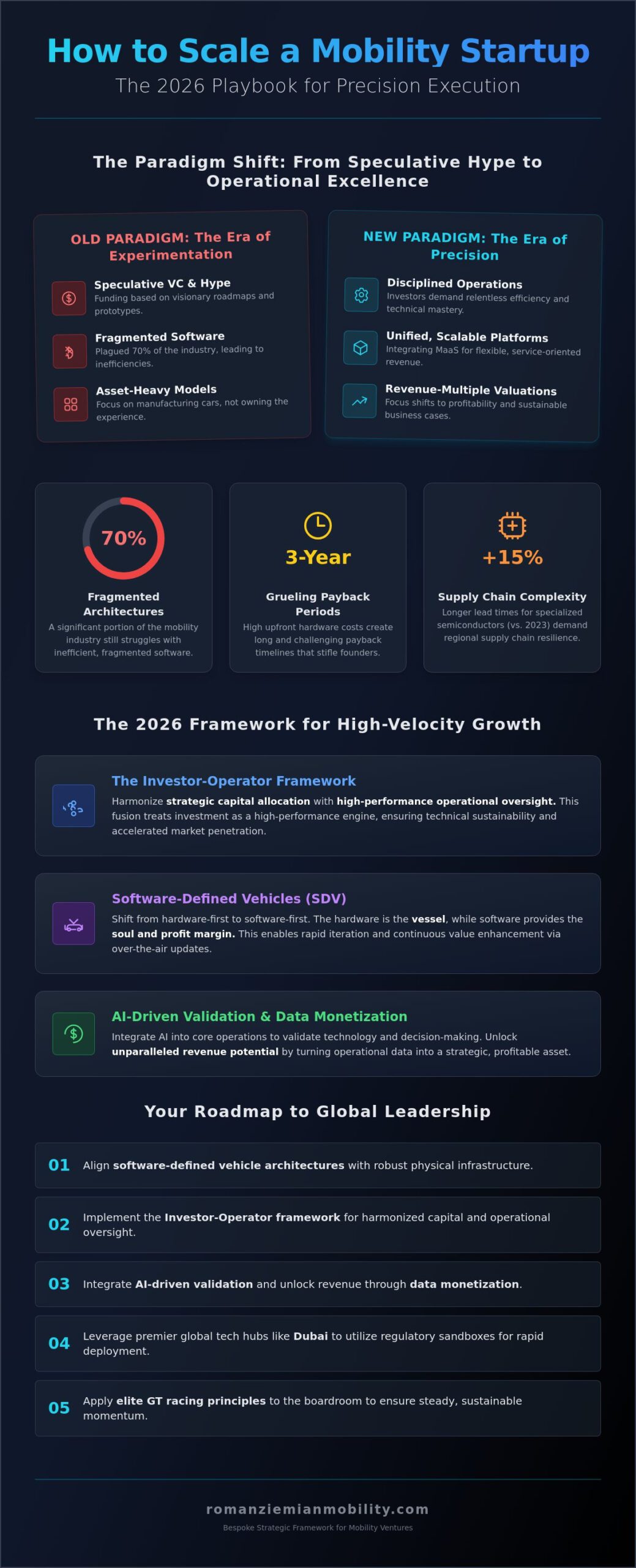
The “Reality Check” phase of 2026 has officially arrived, signaling the end of visionary roadmaps that lack a clear path to production. Supply chains remain complex, with 15% longer lead times for specialized semiconductors compared to 2023, forcing startups to move from fragmented architectures to unified, scalable platforms. The winners are those who integrated Mobility as a Service (MaaS) frameworks early, allowing them to shift from asset-heavy models to flexible, service-oriented revenue streams. This pragmatic turn ensures that every technological leap is backed by a sustainable business case, reflecting the high-octane energy of a brand that values results over raw data.
- Transition from prototype-led funding to revenue-multiple valuations.
- Emphasis on regional supply chain resilience to mitigate global logistics volatility.
- Focus on “Last-Mile” profitability rather than total market share.
The Role of Software-Defined Mobility
Software-Defined Vehicles (SDV) are fundamentally reshaping the relationship between original equipment manufacturers (OEMs) and their suppliers. In 2026, the hardware has become the vessel, while the software provides the soul and the profit margin. This shift from hardware-first to software-first development cycles allows for rapid iteration and over-the-air updates that keep fleets relevant for years. To truly understand this shift, one must look at Roman Ziemian’s insights on AI and web technology, which highlight the intersection of digital intelligence and physical movement. Software-defined mobility is the fundamental architectural shift where a vehicle’s utility and value are continuously enhanced through code, serving as the primary engine for 2026 scalability. This approach allows companies to learn how to scale a mobility startup 2026 by decoupling the pace of digital innovation from the slower cycles of physical manufacturing.
The Investor-Operator Framework: Structuring Capital for High-Velocity Growth
Scaling a venture in the hardware-intensive transport sector requires more than just a liquid balance sheet; it demands a fusion of capital allocation and operational mastery. While traditional venture capital models often prioritize rapid user acquisition over technical sustainability, the Investor-Operator model provides the structural integrity needed to survive the transition from prototype to mass production. This framework treats investment as a high-performance engine, where every dollar is tuned for maximum efficiency. Success in knowing how to scale a mobility startup 2026 depends on this synergy, ensuring that capital doesn’t just fuel growth but builds a resilient foundation for global expansion.
Rigorous mobility startup due diligence has become the primary filter for elite investors in 2026. They no longer accept vague projections; they require proof of supply chain robustness and regulatory alignment. By utilizing bespoke advisory, founders can navigate the “capital-intensive” trap that claimed 42% of mobility ventures between 2021 and 2024. This specialized oversight ensures that every technical milestone aligns with market demand, particularly as analysts identify new 2026 urban mobility growth opportunities in the last-mile and autonomous logistics sectors.
Structuring Large Funding Rounds Effectively
Managing investor expectations in 2026 requires a focus on high-execution environments. With central bank interest rates projected to stabilize around 3.5% to 4%, capital isn’t free, and efficiency is the ultimate currency. Effective rounds now blend equity with non-dilutive funding, such as government green-tech incentives which are expected to reach $150 billion globally by mid-2026. This balanced approach prevents overengineering and ensures that production facilities remain lean and responsive to real-time data. It’s about maintaining a tight grip on the burn rate while accelerating toward commercial viability.
Strategic Advisory as a Scaling Catalyst
Elite strategic advisory services act as the bridge between a founder’s vision and a successful exit. An operator’s perspective at the board level provides a level of technical depth that pure financiers cannot replicate. This involvement accelerates momentum through professional network expansion, connecting startups with Tier-1 suppliers and global distribution partners. It’s about engineering a trajectory that mirrors the precision of a world-class racing team. To explore how these high-performance strategies can redefine your growth path, you should consider the unparalleled expertise available through our specialized consulting framework.
Integrating AI and Sustainable Technology for Unparalleled Scalability
By 2026, the architecture of a successful venture relies on the seamless fusion of computational intelligence and environmental stewardship. Founders who understand how to scale a mobility startup 2026 recognize that technology is no longer an additive feature; it’s the very foundation of the enterprise. We’ve transitioned from the era of experimental algorithms to a period of industrial-grade execution where AI serves as the primary engine for vehicle validation and quality assurance. This shift ensures that every asset in a fleet meets the rigorous standards of performance and safety required in the luxury and high-performance sectors.
AI-Driven Development and the Vehicle Lifecycle
The acceleration of development cycles in 2026 is breathtaking. Traditional engineering timelines that once spanned years are now compressed into months through sophisticated AI simulation and digital twin technologies. These tools allow operators to predict wear and tear with 98% accuracy before a vehicle even touches the tarmac. Real-time driver feedback loops have evolved into a scaling asset, capturing granular telemetry that informs immediate mechanical adjustments. This isn’t “Hype AI” designed for investor slide decks. It’s applied intelligence that optimizes fleet management, reducing downtime by up to 30% compared to 2023 benchmarks. For a deeper look at these advancements, explore our insights on AI in mobility and its impact on the intelligent transportation landscape.
Data monetization represents the next frontier for startups seeking exponential growth. In 2026, the value of a mobility company isn’t just in the physical transit it provides but in the high-fidelity data it harvests. By anonymizing and packaging urban movement patterns, startups can create secondary revenue streams that command high margins. This provides the capital necessary to fuel global expansion without diluting equity, turning every kilometer driven into a financial asset.
Sustainable Mobility as a Competitive Advantage
True scalability requires a commitment to sustainable mobility solutions that extend far beyond simple electrification. In 2026, the elite operators are those who integrate circular economy principles directly into their hardware scaling strategies. This involves designing components for 100% recyclability and establishing “closed-loop” supply chains that mitigate the volatility of raw material costs.
- Verifiable ESG Metrics: Attracting “green capital” is no longer about vague promises. Investors now demand real-time dashboard access to carbon offset data and resource efficiency ratios.
- Bespoke Engineering: Utilizing modular platforms allows for hardware upgrades without replacing the entire chassis, effectively doubling the lifespan of the initial investment.
- Energy Synergy: Leveraging vehicle-to-grid (V2G) technology turns idle fleets into decentralized power plants during peak demand, creating a resilient and profitable infrastructure.
When you master these elements, you’re not just growing a business. You’re orchestrating a sophisticated ecosystem that defines the future of movement. Learning how to scale a mobility startup 2026 means embracing this synergy of speed, prestige, and planetary responsibility. It’s a journey that requires unwavering ambition and the strategic foresight to see technology as a bridge to a cleaner, faster world.
Global Market Entry: Leveraging Hubs like Dubai for Strategic Momentum
Scaling a startup requires more than just capital; it demands an environment where the regulatory velocity matches the speed of the technology. By 2026, the blueprint for how to scale a mobility startup 2026 shifts its focus from traditional Western corridors to the high-performance ecosystems of the Middle East. Dubai has established itself as the preeminent launchpad for visionary operators, offering a synergy of world-class infrastructure and a tax-neutral environment that remains unparalleled in the global market. It’s not just a city; it’s a living laboratory for the future of movement.
Dubai: The Epicentre of 2026 Mobility Innovation
The integration of artificial intelligence into urban transit is no longer a concept but an operational reality in the UAE. Forward-thinking operators are increasingly looking at AI investment opportunities in Dubai to fuel their autonomous fleet management systems and predictive maintenance algorithms. The Dubai Future Foundation acts as a vital catalyst, providing startups with access to the Dubai Future Accelerators program, which has facilitated over 300 partnerships between government entities and private innovators since its inception. From this geographic nexus, a company can reach 60% of the world’s population within an eight-hour flight, making it the strategic bridge between Asian manufacturing powerhouses and European consumer markets.
Navigating International Regulatory Frameworks
Success in the 2026 mobility sector depends on “Glocal” strategies that harmonize local operational excellence with international standards. The Poland-UAE technology corridor has emerged as a vital pipeline, allowing European engineering talent to deploy software-defined vehicle (SDV) solutions within the UAE’s frictionless regulatory sandboxes. These sandboxes permit real-world testing of Level 4 autonomous systems without the multi-year bureaucratic delays seen in other jurisdictions. Dubai’s regulatory environment outpaces traditional Western hubs in 2026 by offering a unified licensing framework for multi-modal transport that integrates air, sea, and land mobility into a single digital ledger. This bespoke approach to governance ensures that innovation isn’t stifled by outdated legal codes.
The infrastructure benefits of a Middle Eastern headquarters extend beyond simple logistics. Consider these strategic advantages for 2026 scaling:
- Tax Efficiency: Access to 0% personal income tax and competitive corporate tax structures for companies operating within specialized free zones like the DMCC.
- Autonomous Vision: Alignment with the Dubai Autonomous Transportation Strategy, which aims to transform 25% of all transportation trips to autonomous modes by 2030.
- Digital Backbone: Deployment of state-of-the-art 6G connectivity and edge computing nodes across major transit arteries, ensuring low-latency communication for vehicle-to-everything (V2X) systems.
Establishing a presence in these hubs allows founders to demonstrate a track record of success in a high-stakes, high-visibility environment. It’s about building a legacy of performance that resonates with global investors. To master the technical requirements of this expansion, explore Roman Ziemian’s insights on AI and web technology to understand the digital architecture required for global mobility success.
Engineering Sustainable Momentum: The Roman Ziemian Approach to Scaling
Scaling a mobility venture in the mid-2020s requires more than just venture capital; it demands the mechanical precision found in elite GT racing. Roman Ziemian’s philosophy bridges the gap between high-speed performance and corporate growth, emphasizing that momentum is a product of meticulous design rather than chance. This track-to-boardroom approach fosters a culture where innovation isn’t a buzzword but a daily operational requirement. To understand how to scale a mobility startup 2026, leaders must look at how Roman Ziemian inspires global change by blending technological investment with the discipline of motorsport. Success in this sector requires a bespoke synergy between capital, engineering, and strategic foresight. It’s not enough to have a cutting-edge product. You need the organizational stamina to maintain peak performance across global markets. This involves treating every department like a high-performance engine where every component is optimized for maximum output and minimal friction.
The Motorsport Mindset in Corporate Strategy
Lessons from the GT4 European Series provide a blueprint for rapid adaptation. On the track, conditions change in milliseconds. Mobility startups in 2026 must mirror this by applying pit-stop efficiency to their workflows. This means reducing internal friction to ensure the company remains agile. This mindset is essential for those learning how to scale a mobility startup 2026 amidst shifting global regulations. When a team executes a strategic pivot with the speed of a tire change, they gain an unparalleled competitive advantage in execution. High-performance teams thrive when every member knows their role with absolute clarity, ensuring that the scaling process remains stable even at high velocities.
Building a high-performance team is the final piece of the scaling puzzle. In elite racing, every technician and strategist understands that their individual contribution affects the overall lap time. Scaling a startup requires this same level of specialization and trust. When you combine top-tier talent with a shared vision of technological leadership, the resulting momentum becomes difficult for competitors to disrupt. This isn’t just about raw speed; it’s about the stability that comes from rigorous training and clear, executive-level communication. It is this marriage of human talent and technological capability that defines the most successful ventures in the modern era.
The Visionary Conclusion
The journey toward 2026 success requires a sophisticated blend of capital, technology, and strategic foresight. Founders who embrace this elite mindset will lead the global mobility transformation. It’s a path defined by passion, precision, and an unwavering commitment to excellence. By integrating these principles, you don’t just grow; you dominate the landscape with quiet confidence. To secure your position at the top tier of the industry, partner with Roman Ziemian Mobility for elite strategic advisory. It’s time to accelerate your momentum and define the future of movement. The future moves fast, and it’s your responsibility to set the pace.
Mastering the High-Performance Future of Global Mobility
Winning in the next era of transportation requires more than just capital; it demands the surgical precision of an operator who understands the mechanical nuances of high-velocity growth. By aligning the Investor-Operator framework with the strategic advantages of hubs like Dubai, founders can transform visionary concepts into dominant market forces. Success hinges on integrating AI-driven logistics with sustainable energy solutions to build a resilient, global infrastructure that thrives under pressure. You’ve seen that the shift from concept to execution is where the most ambitious ventures either stall or accelerate into industry leadership.
Mastering how to scale a mobility startup 2026 involves leveraging the same discipline found in the Ferrari Challenge and GT4 European Series. Roman Ziemian’s track record in these elite racing circuits, combined with a proven history of AI and sustainable technology investments across European tech hubs, provides the blueprint for unparalleled scalability. You’re not just building a company; you’re engineering a legacy of performance and prestige. Elevate your venture with elite Strategic Advisory from Roman Ziemian Mobility. The road ahead is paved with opportunity for those ready to lead with unwavering ambition and strategic foresight.
Frequently Asked Questions
What are the primary challenges for mobility startups scaling in 2026?
The primary obstacles involve navigating the 2026 implementation of the EU Data Act and managing the 4.5% average cost of capital that persists in global markets. Startups face a landscape where hardware margins remain under 12%, necessitating a shift toward subscription-based revenue models. Success requires balancing these thin margins with the high cost of maintaining a fleet across diverse regulatory zones; it’s a test of operational precision.
Why is Dubai considered a leading hub for mobility innovation in 2026?
Dubai leads mobility innovation because the 2030 Autonomous Transportation Strategy mandates that 25% of all trips must be driverless by the end of the decade. The city’s Road and Transport Authority provides a sandbox for testing Level 4 autonomy, supported by a 0% corporate tax rate for qualified innovation hubs. This ecosystem offers an unparalleled synergy between government mandate and private capital, creating a prestigious environment for global expansion.
How does the Investor-Operator model differ from traditional venture capital?
The Investor-Operator model differs by integrating 15 years of hands-on technical expertise directly into the startup’s daily workflow; traditional venture capital focuses primarily on quarterly financial metrics. This bespoke approach ensures that leaders like Roman Ziemian provide strategic foresight and industrial capability rather than just capital. It’s a partnership where the investor’s track record in motorsport and logistics actively accelerates the firm’s operational maturity and elite market positioning.
What role does AI play in scaling Software-Defined Vehicles?
AI serves as the central nervous system for Software-Defined Vehicles by processing 2.5 gigabytes of sensor data per hour to optimize battery performance and safety. In 2026, machine learning algorithms allow for real-time over-the-air updates that reduce maintenance downtime by 30%. This technological foundation is essential when learning how to scale a mobility startup 2026 effectively within the luxury automotive sector, ensuring that performance remains at its peak.
How can mobility startups secure non-dilutive funding in 2026?
Startups secure non-dilutive funding by accessing the 95.5 billion EUR Horizon Europe fund or the UAE’s Ghadan 21 accelerator grants. These programs provide capital without sacrificing equity, allowing founders to maintain control while funding high-cost R&D projects. Leveraging these specific government-backed initiatives ensures that the startup remains financially robust while pursuing ambitious technological milestones. It’s a strategic move for any founder who values long-term control and brand equity.
What is the “Poland-UAE technology corridor” and how does it benefit startups?
The Poland-UAE technology corridor connects Poland’s 15,000 annual engineering graduates with the UAE’s sophisticated capital markets to create a seamless pipeline for mobility innovation. This strategic bridge allows startups to leverage European technical precision and Middle Eastern investment power. It’s a synergy that offers a unique competitive advantage for those looking at how to scale a mobility startup 2026 across two distinct, high-growth geographic hubs.
How does motorsport technology influence sustainable transportation scaling?
Motorsport technology influences sustainable transport through the transfer of high-performance energy recovery systems that achieve 90% efficiency in urban environments. Racing serves as a high-octane laboratory for testing lightweight carbon-fiber composites and advanced thermal management systems. These innovations transition from the track to the street, providing the elite performance and durability required for high-end electric vehicle fleets. It’s where cutting-edge speed meets environmental responsibility.
What are the key due diligence factors for mobility investments in 2026?
Key due diligence factors center on a startup’s MSCI ESG rating and the defensibility of its intellectual property portfolio. Investors in 2026 prioritize unit economics that show a clear path to profitability within 24 months of Series A. They scrutinize the synergy between the executive team’s vision and their actual industrial capability, ensuring that the brand’s trajectory is backed by verified data and an unwavering commitment to excellence.