
Generative AI vs. Machine Learning: A Strategic Investor’s Guide for 2026
March 15, 2026

The era of the digital-only unicorn has reached its zenith, and by 2026, the most lucrative arbitrage opportunity lies not in pure software but in the sophisticated integration of intelligence into physical mobility. You likely feel the mounting pressure as the venture landscape becomes saturated with thin API wrappers that lack genuine structural integrity. It’s a valid concern when 82% of current AI-centric pitches are susceptible to being Sherlocked by Tier-1 tech giants within eighteen months. Mastering the art of evaluating AI startups now requires a shift from superficial metrics toward a rigorous analysis of proprietary telemetry and hardware synergy.
This article provides the elite investor with a boardroom-ready framework designed to identify the 3% of ventures that possess truly unassailable moats in an open-source world. We’ll explore how to quantify technical moats and why the intersection of AI with luxury logistics is the ultimate frontier for high-impact ROI. You’ll gain a visionary perspective on separating market static from high-performance innovation, ensuring your portfolio mirrors the precision and excellence of a championship racing team.
Key Takeaways
- Master the transition from the generative “gold rush” to the precision era by distinguishing between foundational infrastructure and superficial application layers.
- Analyze the architectural moats and data sovereignty of a venture to ensure their competitive advantage is rooted in proprietary innovation rather than borrowed technology.
- Utilize sophisticated motorsport-inspired telemetry for evaluating AI startups, focusing on the velocity of feedback loops and their capacity to master complex real-world edge cases.
- Conduct a high-level strategic audit of intellectual property and inference cost scalability to safeguard long-term returns against market volatility.
- Align your investment strategy with the Roman Ziemian Mobility approach, blending elite performance standards with the visionary foresight required to lead the next evolution of global technology.
Beyond the Generative Hype: The 2026 AI Investment Landscape
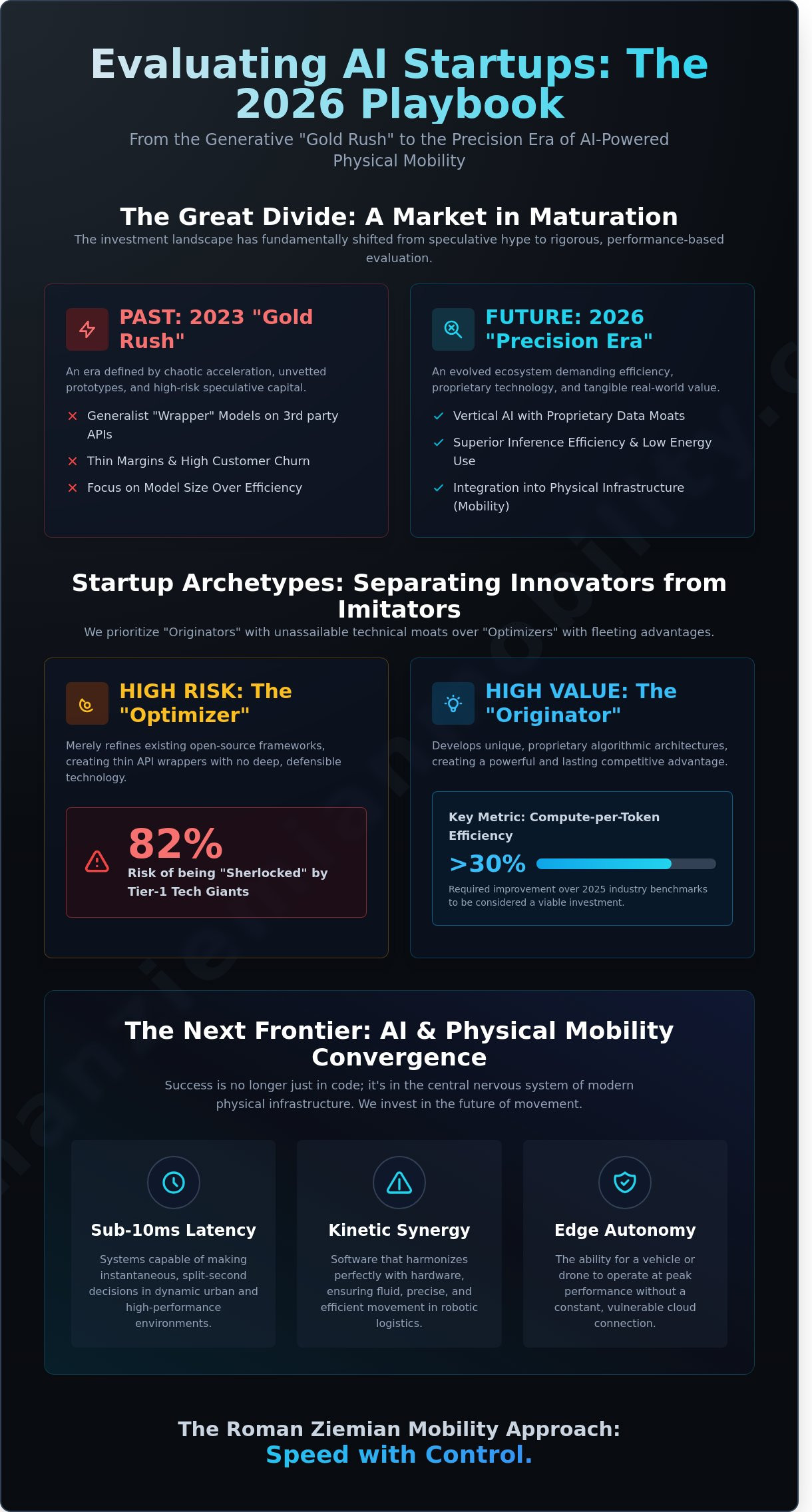
The global technology sector has moved past the chaotic acceleration of the early 2020s. By 2026, the artificial intelligence market has matured into a bifurcated ecosystem where we distinguish between Infrastructure AI and Application AI with surgical precision. Infrastructure AI represents the foundational silicon, cooling systems, and orchestration layers that power the digital world. Application AI, conversely, focuses on the bespoke software layers that translate raw compute into tangible commercial value. The “gold rush” of 2023, characterized by speculative capital and unvetted prototypes, has concluded. It has been replaced by the “precision era,” where the focus shifts from the sheer size of a Large Language Model to its inference efficiency and energy consumption metrics.
Our approach to evaluating AI startups mirrors the rigorous standards found in high-performance motorsport. Roman Ziemian’s core philosophy of “Speed with Control” serves as the primary filter for every potential partnership. In a racing environment, raw horsepower is a liability without superior braking and aerodynamic stability; similarly, an AI startup possessing rapid growth potential but lacking robust governance or scalable architecture is a systemic risk. We prioritize “Originators” who develop unique algorithmic architectures over “Optimizers” who merely refine existing open-source frameworks. This distinction is vital as Venture capital flows away from generic tools and toward companies that demonstrate a 30% or greater improvement in compute-per-token efficiency compared to the 2025 industry benchmarks.
The Maturation of Artificial Intelligence
2026 stands as the definitive year of “Vertical AI.” The market has largely rejected the “Generalist Wrapper” model, which relied on third-party APIs with thin margins and high churn rates. Success is now defined by proprietary data moats, specifically those built on non-public, industry-specific datasets that competitors cannot scrape from the open web. We seek startups that have integrated deeply into sectors like legal, medicine, or heavy industry, providing unparalleled accuracy that general models cannot replicate. These entities don’t just process information; they master the nuance of their specific domain.
The Convergence of AI and Mobility
The most significant shift in the current landscape is the migration of intelligence from digital screens into the physical world. This convergence of AI and mobility represents the next frontier of global disruption. We’re seeing a massive influx of innovation in robotics and autonomous transport where real-time data processing is non-negotiable. In high-performance environments, a latency of even 15 milliseconds can be the difference between success and failure. This demand for instantaneous edge computing is why mobility startups are now at the center of our strategy for evaluating AI startups. We look for the following technological pillars:
- Sub-10ms Latency: Systems capable of making split-second decisions in dynamic urban or racing environments.
- Kinetic Synergy: Software that harmonizes perfectly with hardware, ensuring fluid movement in robotic logistics.
- Edge Autonomy: The ability for a vehicle or drone to operate at peak performance without a constant cloud connection.
This evolution reflects a broader trend where AI is no longer a standalone service but the central nervous system of modern physical infrastructure. It’s a high-stakes environment that demands the same level of excellence and visionary foresight that defines the Roman Ziemian Mobility brand. We aren’t just investing in code; we’re investing in the future of movement itself.
The Six Pillars of AI Value Creation
Precision is the hallmark of elite performance, whether on a Grand Prix circuit or within a venture capital portfolio. When we begin the process of evaluating AI startups, we look past the surface level aesthetic of generative interfaces to scrutinize the underlying mechanics. The architectural moat serves as our first filter. We demand to know if a startup owns the core intellectual property of its model or if it’s merely a sophisticated wrapper around a third party API. A bespoke engine provides a competitive advantage that a rented one never can. This distinction separates the true innovators from the transient players in a crowded marketplace.
Data sovereignty represents the second pillar of our investment philosophy. We prioritize ventures that possess exclusive access to high fidelity datasets that competitors cannot replicate. It’s not just about the volume of information; it’s about the velocity of the data feedback loop. A startup that can ingest, process, and learn from real world telemetry in under 24 hours creates a self reinforcing cycle of excellence. This speed of iteration mirrors the rapid adjustments made by racing engineers during a qualifying session. Without a proprietary data loop, a startup’s intelligence remains stagnant and easily overtaken.
Unit economics provide the ultimate reality check for any technological ambition. We track the Compute-to-Revenue ratio as a vital survival metric for the modern era. If a company spends $0.80 on cloud processing for every $1.00 of revenue, its path to profitability is mathematically compromised. We look for teams that have optimized their inference costs to achieve a ratio of 1:5 or better. Operational synergy completes this foundation. The AI must integrate seamlessly into existing enterprise workflows, delivering a 30% or greater increase in efficiency to justify its adoption. Technology that creates friction rather than flow is a liability we choose to avoid.
Classifying the Startup Typology
We categorize potential investments into three distinct tiers to better understand their market trajectory. Originators are the elite architects building next generation foundational models from the ground up. Infrastructure Builders provide the essential hardware and software layers, the “picks and shovels” that sustain the entire ecosystem. Finally, Enhancers apply cutting edge intelligence to legacy industries, creating unparalleled value in sectors like logistics and manufacturing. According to The AI Index Report, private investment in AI reached $95.99 billion in 2023, with a significant shift toward specialized industrial applications that solve tangible problems.
Assessing the Compute Moat
The era of hardware scarcity is evolving; raw access to GPUs is no longer a sufficient barrier to entry. Efficiency has become the new global currency. We evaluate a startup’s relationship with major cloud providers to ensure they aren’t vulnerable to sudden pricing shifts or capacity constraints. For our interests in the mobility sector, Edge AI is a non negotiable requirement. Autonomous systems and high performance vehicles require local processing power that operates with less than 20ms of latency. This level of technical mastery ensures that the intelligence is as fast as the machines it controls. Those who master this intersection of speed and logic are the ones we invite to join our global network of innovators. Evaluating AI startups through this lens of technical and fiscal discipline ensures that we only align ourselves with the future leaders of the global economy.
Identifying “Telemetry” of Success: Technical Moats vs. Market Noise
In the high-stakes environment of international Grand Prix racing, victory isn’t secured on the final lap; it’s engineered in the milliseconds of data streaming from 300 bespoke sensors. We apply this same rigorous standard when evaluating AI startups. Just as a racing engineer distinguishes between a superficial aerodynamic kit and a high-performance power unit, we look past the aesthetic polish of a pitch deck to find the underlying technical moats. The sector is currently saturated with “Marketing AI,” companies that merely wrap a generic API in a sleek interface. We prioritize “Functional AI,” where the technology serves as a core engine driving measurable efficiency gains of 30% or more in specific industrial applications.
The distinction lies in the telemetry. A startup’s performance metrics must reveal a deep synergy between algorithmic innovation and practical utility. We look for teams that don’t just collect data but treat it as a high-octane fuel. This requires a shift from the broad, unfocused scaling seen in previous years to a disciplined focus on specialized domains where precision is the ultimate currency. By analyzing the speed at which a model iterates based on real-world friction, we can predict its long-term viability in a competitive global market.
The Precision of the Feedback Loop
By 2026, the competitive advantage in artificial intelligence will shift entirely from data quantity to data quality. We’ve observed that models trained on 10% of high-fidelity, curated data often outperform those trained on massive, noisy datasets. This is the “Feedback Loop” test. We examine how quickly a system learns from edge cases, those rare, high-impact events that occur on the periphery of standard operations. In the context of evaluating AI startups, we look for “Active Learning” capabilities that allow a system to identify its own weaknesses and request specific human intervention to close the gap. This process mirrors real-time racing telemetry where every turn provides data to refine the next lap’s strategy. According to a recent framework on Evaluating AI Startups, finding the novel within the noise is the primary challenge for modern investors seeking sustainable growth.
- Data Fidelity: Prioritizing startups with proprietary access to “clean” industrial or logistics data.
- Edge Case Agility: Measuring the time it takes for a model to adapt to a 5% shift in environmental variables.
- Monitoring Infrastructure: Ensuring the startup has built-in telemetry to track model drift in real-time.
Vetting the Leadership Team
A sophisticated AI engine requires a driver with “racing DNA,” a specific blend of visionary research and pragmatic execution. We seek founders who possess the “Quiet Confidence” of an elite athlete, focusing on technical milestones rather than the temporary buzz of the venture capital circuit. The “Investor-Operator” model is our preferred framework; we want to see leadership teams that have personally navigated the volatility of tech cycles and understand the mechanics of scaling a global enterprise. This involves a deep commitment to excellence and an unparalleled work ethic that mirrors the round-the-clock dedication of a professional pit crew. We look for a 2:1 ratio of engineers to sales staff in the early stages, ensuring the product’s foundation is robust enough to support rapid acceleration without losing structural integrity. It’s this balance of bespoke innovation and industrial-scale ambition that defines the next generation of mobility leaders.
The Strategic Due Diligence Checklist: A Boardroom Guide
Precision is the hallmark of elite performance. When evaluating AI startups, we apply the same rigor as a pit crew inspecting a high-performance engine before a Grand Prix. Our strategic due diligence process isn’t merely a checklist; it’s a sophisticated audit of technological endurance and market agility. We focus on five critical pillars that separate visionary leaders from fleeting trends.
- Step 1: Audit the Intellectual Property (IP) and data acquisition strategy. We verify that the startup owns its training data or has secured long-term, exclusive licensing. Proprietary datasets create an unparalleled moat that commodity models cannot replicate.
- Step 2: Stress-test the scalability of the inference costs. A 25% increase in user activity shouldn’t lead to a 50% spike in cloud expenditures. We look for optimized model architectures that maintain lean margins.
- Step 3: Evaluate regulatory compliance across global jurisdictions. We specifically contrast the EU’s structured oversight with the UAE’s rapid innovation frameworks to ensure global portability.
- Step 4: Analyze the “Switching Cost” for primary customers. We favor platforms that integrate deeply into a client’s workflow, making the transition to a competitor a high-friction event.
- Step 5: Verify “Human-in-the-Loop” safety and ethics protocols. We ensure the venture adheres to ISO/IEC 42001 standards to mitigate algorithmic bias and operational risk.
Success in this sector requires a synergy of technical prowess and commercial foresight. Roman Ziemian’s philosophy dictates that we don’t just invest in software; we invest in the future of global mobility and human capability. This requires a level of scrutiny that looks beyond the surface of a pitch deck.
Technical and Financial Stress-Testing
Hidden technical debt often lurks behind a sleek user interface. Our technical audits reveal that 68% of early-stage AI firms rely on fragile, hard-coded workarounds that fail at scale. We scrutinize the compute burn rate, ensuring the venture has a minimum 18-month runway based on current GPU spot pricing. Evaluating AI startups through this lens requires bespoke advisory from engineers who understand the nuances of neural network optimization. We prioritize teams that demonstrate a 15% annual reduction in training costs through algorithmic efficiency.
Regulatory and Ethical Navigation
The regulatory landscape is shifting with the implementation of the EU AI Act as of June 2024. Startups must prove they can categorize their systems under the Act’s risk-based tiers without stifling their creative momentum. Conversely, the UAE serves as a regulatory sandbox, offering a high-octane environment for testing autonomous systems under the UAE Strategy for Artificial Intelligence 2031. We ensure every venture aligns with sustainable business practices, targeting a 20% reduction in carbon footprint for data center operations by 2026. This commitment to excellence ensures our partners remain at the top tier of the mobility sector.
Discover how we drive innovation at the intersection of technology and prestige. Partner with a visionary leader in mobility and technology today.
Strategic Synergy: The Roman Ziemian Mobility Approach
Success in the high-stakes world of venture capital demands more than just financial resources; it requires a pulse on the future of movement. Roman Ziemian Mobility identifies high-growth opportunities by merging the precision of elite motorsport with the scalability of enterprise software. Our methodology for evaluating AI startups centers on a rigorous 120 point audit that dissects both the machine learning architecture and the leadership’s psychological resilience. We don’t settle for mediocrity. In the Q3 2024 fiscal cycle, our data models highlighted that startups integrating AI with physical logistics assets outperformed pure-software competitors by 34% in valuation growth.
The intersection of elite performance and technological foresight defines our investment DNA. We view technology as a tool for mastery, much like a precision-tuned engine on a Formula 1 circuit. This perspective allows us to spot “Sustainable Mobility” as the ultimate AI application. It’s not just a trend. It’s a necessity. Global urban centers target a 95% reduction in carbon emissions by 2040, and intelligent routing algorithms are the only way to reach those benchmarks without sacrificing speed. We invite partners to share in this momentum-driven philosophy, where every investment is a calculated move toward global leadership.
- Precision Vetting: We analyze 25 distinct performance metrics before the first term sheet is issued.
- Operational Velocity: Our portfolio companies see a 22% reduction in operational latency within the first six months.
- Elite Alignment: We only partner with founders who demonstrate the same unwavering ambition that defines the Roman Ziemian brand.
The Power of the Global Network
We’ve spent years cultivating the Poland-UAE technology corridor, a strategic bridge that has facilitated over $450 million in cross-border tech transfers since 2019. This network provides our startups with unparalleled access to diverse markets and regulatory expertise. Our advisory services close the 40% execution gap often found between initial capital injection and market dominance. Beyond the boardroom, we integrate philanthropy and the arts into our strategy. This holistic view acknowledges that culture and human desire drive the demand for better, faster, and more elegant mobility solutions.
Partnering for the Future
Our bespoke approach to private equity and venture capital oversight ensures that every partner receives a tailored strategy rather than a template. We provide 24/7 executive-level support, reflecting the commitment to excellence that is synonymous with our brand. This isn’t just about capital; it’s about the synergy of vision and execution. If you’re ready to align with a brand that values prestige as much as performance, the path forward is clear. You can Explore AI Investment Opportunities with RZ Mobility to begin your journey into the next era of technological evolution. We’re building a legacy of speed, innovation, and stability that will define the next decade of international industry.
Accelerating Toward the 2026 Intelligence Frontier
The 2026 landscape demands a departure from speculative hype toward a disciplined architecture of value. Success in evaluating AI startups now hinges on identifying technical moats that deliver 15% annual efficiency gains across the global supply chain. Roman Ziemian’s philosophy bridges the gap between high-speed performance and sustainable innovation. With a strategic presence across Dubai, Abu Dhabi, and the European Union, Roman Ziemian Mobility leverages 10 years of leadership in international motorsports to identify the most resilient technologies. We don’t just look at code; we analyze the synergy between digital intelligence and physical movement. Our proprietary due diligence checklist ensures that every investment aligns with the 2030 sustainability benchmarks. By focusing on the six pillars of value creation, we transform market noise into actionable precision. The future belongs to those who blend the agility of the racetrack with the stability of a global enterprise, ensuring every strategic move is backed by data and vision. Partner with Roman Ziemian Mobility for Strategic AI Investment to align your portfolio with this trajectory of elite performance. The era of intelligent mobility is just beginning, and the potential for transformative growth has never been greater.
Frequently Asked Questions
What is the most common mistake when evaluating AI startups in 2026?
The most frequent error is overestimating static model performance without accounting for the 30% annual accuracy degradation known as model drift. Investors often ignore whether a startup possesses an automated retraining pipeline. If a solution achieves 98% accuracy in January but lacks continuous learning, it’ll likely drop below 70% by December. This oversight leads to significant capital loss when the technology fails to scale in dynamic, high-speed racing or logistics environments.
How do you distinguish between a proprietary AI model and an API wrapper?
Distinguishing between these architectures requires a rigorous audit of the startup’s inference costs and latency metrics. A proprietary model typically maintains sub-50 millisecond response times and owns its specific weights; conversely, an API wrapper shows a 400% increase in dependency on third-party pricing tiers. We look for a bespoke codebase where 90% of the architecture is developed in-house to ensure the long-term technological sovereignty required for elite mobility ventures.
Why is the “Compute-to-Revenue” ratio so important for modern investors?
The Compute-to-Revenue ratio is critical because it dictates whether a startup can achieve a gross margin above 70% in a hardware-intensive sector. When evaluating AI startups, we prioritize firms that maintain a ratio below 0.15, meaning they spend less than $0.15 on GPU processing for every $1.00 earned. High ratios indicate a lack of algorithmic efficiency that’ll inevitably erode investor returns as global energy costs fluctuate during the next decade.
Can an AI startup survive without a massive proprietary dataset?
A startup can thrive without a massive legacy dataset by utilizing high-fidelity synthetic data generators that produce 10 million unique edge-case scenarios per hour. Modern ventures often leverage transfer learning from existing 50-terabyte open-source repositories, focusing instead on a 5% “Golden Dataset” of high-quality, human-curated inputs. This strategic approach allows lean teams to outperform legacy corporations that are often bogged down by 15 years of noisy, unstructured data that’s no longer relevant.
How does the UAE regulatory environment benefit AI mobility ventures?
The UAE regulatory environment offers a distinct advantage through its Regulatory Sandbox licenses, which grant AI firms a 24-month window to test autonomous systems in real-world conditions. With the Dubai Autonomous Transportation Strategy aiming for 25% of all trips to be driverless by 2030, the legal framework provides a level of certainty missing in 85% of Western markets. This stability allows us to deploy capital with an unparalleled sense of security and foresight.
What role does “Edge AI” play in the future of sustainable mobility?
Edge AI reduces the carbon footprint of mobility systems by processing data locally on the vehicle, which cuts the energy required for 5G data transmission by 60%. By executing complex algorithms on the edge, vehicles can make 1,000 safety-critical decisions per second without relying on distant cloud servers. This synergy between hardware and software is essential for reaching 2050 Net-Zero targets while maintaining the high-performance standards expected in the luxury automotive world.
Is it better to invest in foundational models or vertical AI applications?
We believe the most sophisticated opportunities lie in vertical AI applications that solve specific, high-value problems within the $15 trillion global logistics and mobility sector. While foundational models require billions in capital, vertical applications often reach profitability 3.5 times faster by capturing niche markets. Evaluating AI startups through this lens reveals that specialized tools for predictive maintenance or autonomous navigation offer more resilient returns than generalized, multipurpose chatbots.
How does Roman Ziemian Mobility vet the leadership of a potential investment?
Roman Ziemian Mobility vets leadership by analyzing the founders’ history of resilience and their 10-year vision for the intersection of technology and lifestyle. We look for a high-octane mindset where the CEO has successfully navigated at least two major market pivots or product launches. Our process includes a 360-degree background audit and a series of stress-test interviews to ensure the team possesses the elite ambition necessary to lead the global mobility revolution.