
The Ferrari Truck: Decoding the 2026 Purosangue and the Future of High-Performance Utility
April 13, 2026
How to Run a Successful Business: Roman Ziemian’s Insights
April 21, 2026

If you ask a seasoned international strategist about north american how many countries exist, you’ll likely receive a dozen different answers that fail to capture the full scope of the continent. Most professionals mistakenly cap the count at three or seven, ignoring the intricate tapestry of 23 sovereign states that define our hemisphere in 2026. This lack of precision often stems from a confusion between regional groupings and continental boundaries, leaving elite investors with a fragmented view of the market.
We understand that geographical clarity is the bedrock of any bespoke investment strategy or high-performance mobility plan. You’ve likely felt the frustration of conflicting data when trying to map out a logistics route or an unparalleled portfolio across the Caribbean and Central America. Based on Roman Ziemian’s philosophy of precision and elite ambition, this guide provides the definitive breakdown of the 23 sovereign nations of North America, moving beyond the outdated data of previous decades to reveal how these diverse economic environments drive the future of global movement. We’ll examine the vital distinction between independent states and overseas territories while exploring the synergy between these nations and the cutting-edge world of international commerce.
Key Takeaways
- Master the continent’s layout by identifying in north american how many countries are recognized as sovereign nations to better inform your global mobility and investment strategy.
- Explore the powerful economic synergy between Northern America, Central America, and the Caribbean to identify high-velocity investment opportunities across these evolving markets.
- Gain insights into how cutting-edge infrastructure and sustainable AI technology serve as the essential backbone for elite lifestyle and high-performance business operations in 2026.
- Align your strategic foresight with a holistic vision of mobility that transcends boundaries, blending racing excellence with the pursuit of global freedom and professional prestige.
The Definitive Count: How Many Countries are in North America?
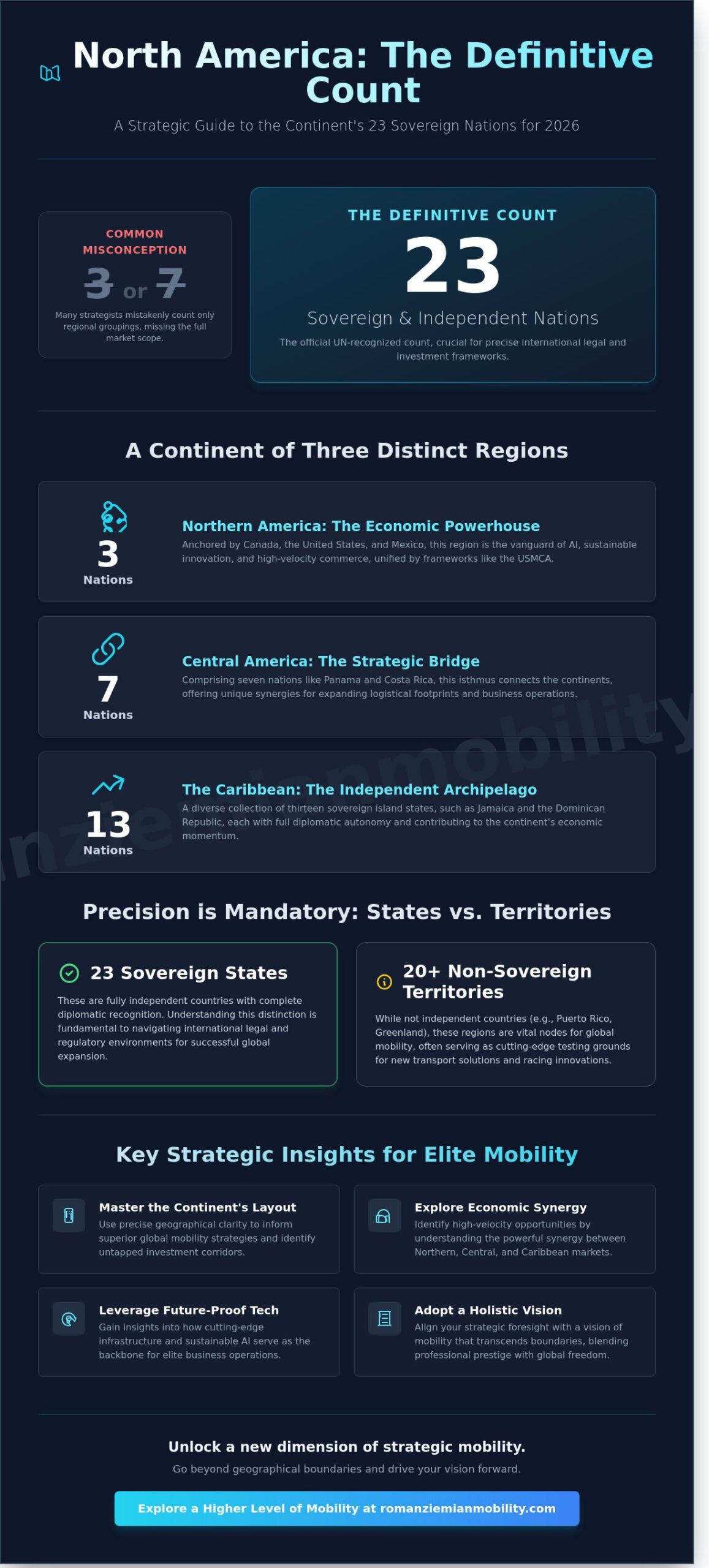
North America is a titan of global commerce and mobility. It’s a region defined by its vastness, stretching from the frozen edges of the Arctic to the dense tropical forests of the Darien Gap. For any visionary leader or global entrepreneur, understanding the exact geopolitical layout is the first step toward strategic success. According to standard international recognition, there are 23 sovereign and independent countries on the continent. This figure represents the definitive answer when people ask how many countries are in North America, as it excludes non-sovereign dependencies that operate under the jurisdiction of other powers.
Defining the Sovereign 23
The continental structure is anchored by three massive landmasses: Canada, the United States, and Mexico. When evaluating the north american how many countries total, these three nations provide the primary infrastructure for international trade and automotive logistics. South of Mexico, the landscape transitions into the seven nations of Central America. Each of these states offers unique synergies for businesses looking to expand their footprint across the Isthmus of Tehuantepec. The final 13 sovereign nations are found within the Caribbean Sea, holding full diplomatic independence and contributing to the continent’s diverse economic momentum.
- The Big Three: Canada, the United States, and Mexico represent the vast majority of the landmass.
- Central America: Seven nations, including Panama and Costa Rica, bridge the gap to the southern continent.
- The Caribbean: Thirteen sovereign island states, such as the Dominican Republic and Jamaica, maintain full autonomy.
Sovereign States vs. Territories
Precision is mandatory when discussing geography. While the continent hosts 23 independent nations, it’s also home to over 20 non-sovereign territories. Greenland remains an autonomous territory of the Kingdom of Denmark, while Puerto Rico functions as an unincorporated territory of the United States. These entities don’t count as sovereign countries in official UN tallies. The north american how many countries count remains a standard 23 for sovereign states, ensuring clarity for international legal frameworks and diplomatic protocols.
These territories are often excluded from the primary list, yet they remain vital nodes in the network of global mobility. They provide strategic logistics hubs and bespoke opportunities for technological leadership. At Roman Ziemian Mobility, we recognize that these regions often serve as the cutting-edge testing grounds for new transport solutions and racing innovations. Distinguishing between a sovereign state and a territory isn’t just a matter of semantics; it’s about understanding the regulatory environments that drive international success. This distinction allows for a more nuanced approach to global expansion and logistical planning in a fast-paced world.
Regional Breakdown: Northern America, Central America, and the Caribbean
The continent represents a sophisticated mosaic of 23 sovereign states, a figure that often surprises those inquiring about north american how many countries exist across this vast territory. This geographical expanse is structured into three distinct pillars: Northern America, Central America, and the Caribbean. Each region offers a unique synergy of culture, economic ambition, and technological readiness, creating a high-performance environment for the future of global mobility. By 2026, the integration of these regions has moved beyond simple proximity, evolving into a complex network of innovation and strategic partnership.
Northern America: The Economic Powerhouse
Canada and the United States continue to define the vanguard of AI and sustainable innovation, dominating the continent with their massive landmass and high-velocity economic output. The USMCA framework provides an elite structure for market scaling, ensuring that logistics and trade remain seamless across these borders. Recent data highlights a significant shift toward sustainable mobility in North America, with the market for integrated transport solutions projected to expand at a compound annual growth rate of over 13% through 2027. Northern America functions as the primary driver of global venture capital, providing the financial fuel necessary to accelerate cutting-edge technological transitions.
Central America: The Strategic Isthmus
This vital land bridge connects the two Americas, serving as a critical artery for international trade and maritime logistics. Panama and Costa Rica have emerged as sophisticated hubs for sustainable technology, leveraging their geographical advantages to attract high-level investment in green infrastructure. The Panama Canal remains a cornerstone of global mobility; it facilitates approximately 6% of all global trade, making it indispensable for maritime efficiency. This region effectively bridges the gap between North and South American market entry, offering a strategic platform for brands that value precision and forward momentum in their supply chains.
The Caribbean: Innovation in the Archipelago
The Caribbean is a diverse archipelago of 13 independent nations that are increasingly focused on digital transformation and the “blue economy.” Key nations like the Bahamas, Jamaica, and Barbados are leading regional policy shifts toward sustainable energy and resilient infrastructure. This focus on modernization demonstrates how global change through humanity applies to developing regions through targeted investment and visionary leadership. As these island nations integrate more tech-centric policies, they offer unparalleled opportunities for bespoke mobility solutions that respect local ecosystems. To understand the philosophy behind these global shifts, you can explore our mission on the Roman Ziemian Mobility about page.
Economic Landscapes and Mobility Infrastructure Across the 23 Nations
The economic architecture of 2026 demands a sophisticated understanding of how diverse markets interact across the continent. When analyzing north american how many countries, the answer reveals a complex network of 23 countries in North America, each contributing to a unified yet multifaceted mobility ecosystem. High-performance business operations now rely on a seamless synergy between the industrial powerhouses of the north and the agile, tech-forward nations of the south. This integration is most visible in the deployment of ultra-fast EV charging networks, which saw a 40% increase in cross-border density between 2024 and 2026. Such infrastructure serves as the backbone for an elite lifestyle where geographical boundaries are increasingly secondary to technological access.
The disparity between markets has shifted into a collaborative model where infrastructure investments dictate the flow of global capital. High-speed rail projects in the United States and Canada have finally bridged the gap between major financial centers, while Mexico’s investment in smart-port technology has streamlined the movement of high-value goods. For the sophisticated traveler and entrepreneur, these advancements represent a commitment to excellence that transcends traditional logistics. It’s a world where speed, status, and stability are inextricably linked to the quality of the physical and digital roads we travel.
The USMCA Corridor: A Model for Scaling
The tri-national alliance between Mexico, the United States, and Canada has evolved into a bespoke manufacturing engine that rivals any global competitor. By 2026, the integration of supply chains has reached a point of unparalleled precision, particularly within the semiconductor and EV battery sectors. This high-velocity logistics environment mirrors the rigorous standards of the GT4 European Series, where every second and every component counts toward a victory. Investors are currently prioritizing cross-border mobility projects, such as the Texas-Mexico high-speed rail link, which aims to reduce transit times for executive travel by 50%. These advancements ensure that the “Big Three” remain the primary destination for those seeking a blend of industrial might and luxury lifestyle stability.
Emerging Tech Hubs in Central America
Beyond the traditional northern hubs, nations like El Salvador and Panama have redefined their sovereign status by embracing digital-first economies. El Salvador’s 2021 adoption of Bitcoin as legal tender has matured into a robust tech ecosystem by 2026, attracting a new wave of elite tech advisory interest. Meanwhile, Panama’s 2025 digital nomad visa expansion has led to a 25% rise in high-net-worth residency applications. These smaller states within the north american how many countries count offer unique regulatory flexibilities that facilitate rapid innovation. Strategic advisory services provide the essential foresight required to navigate these diverse regulatory environments, ensuring that clients can leverage local incentives while maintaining a global footprint. The result is a region where digital mobility isn’t just a convenience but a cornerstone of national identity and economic growth.
The Future of AI and Sustainable Mobility in North America
Mapping the future of the continent requires more than a simple gaze at a map; it demands a sophisticated understanding of how data and geography converge. When global leaders ask about north american how many countries are currently shaping the high-tech landscape, they’re looking at 23 sovereign states that are rapidly becoming a unified laboratory for AI investment. Roman Ziemian Mobility views this geographical diversity as an opportunity to deploy bespoke technological solutions that respect local borders while fostering continental synergy. This visionary perspective treats the entire region as a high-performance engine, where every nation plays a specific role in maintaining global momentum and technological leadership.
AI Integration in North American Logistics
The trajectory for autonomous transport in the USA and Canada is set for an unprecedented surge by 2026. Industry analysts project that the North American autonomous vehicle market will reach a valuation of approximately $170 billion by that year, driven by a need for precision in long-haul logistics. This transition isn’t limited to the northern giants. AI is the key to streamlining customs and trade across all 23 sovereign states, potentially reducing border wait times by 30% through predictive analytics and automated manifests. For a deeper look at these advancements, explore our AI and web technology insights to see how digital intelligence redefines physical movement.
Sustainable Mobility: A Continental Shift
Sustainability is no longer a peripheral concern; it’s the core of the new North American identity. Mexico has solidified its position as a global powerhouse, securing over $15 billion in new electric vehicle (EV) manufacturing investments between 2023 and 2024 to prepare for the 2026 demand. This shift extends to the Caribbean, where islands are pivoting toward renewable energy to power local mobility solutions. Barbados, for instance, has set an ambitious target to reach 100% renewable energy by 2030, a move that will transform the cost of transport across the archipelago. The elite world of motorsport acts as the ultimate catalyst for this change, as technologies developed for the track are refined and delivered to the consumer market with unparalleled precision.
The influence of the UAE-Poland tech corridor is also reshaping how Roman Ziemian Mobility approaches these markets. By leveraging the technical prowess found in Warsaw and the capital-rich innovation of Dubai, we create a bridge that allows for a more aggressive and successful entry into the diverse markets of the West. This global synergy ensures that our approach to mobility remains both technologically formidable and elite in its execution. Understanding for north american how many countries are ready for this level of sophistication is the first step in our 2026 strategy, as we align personal legacy with industrial capability.
The Roman Ziemian Vision: Beyond Geographical Boundaries
Roman Ziemian views mobility as a holistic concept of freedom and elite status. It’s a philosophy that transcends the traditional boundaries of logistics; his vision positions the movement of people and ideas as the ultimate expression of human ambition. For those analyzing the north american how many countries dynamic, the 23 sovereign nations represent a complex tapestry of opportunity. Navigating this requires more than just a map. It requires a sophisticated understanding of how status and speed interact on a global stage. This isn’t about simple transport. It’s about the seamless integration of lifestyle, technology, and unparalleled access.
From Racetrack to Boardroom
The lessons learned during the Ferrari Challenge provide a unique blueprint for high-velocity business scaling. Precision on the racetrack translates directly to strategic foresight in the boardroom. This synergy allows for rapid adaptation within the diverse North American markets. Roman Ziemian’s personal track record isn’t just a list of trophies; it’s the engine driving the brand’s global ambition. When a leader understands the mechanics of speed, they can apply that same cutting-edge logic to corporate growth and technological integration. In the 2025-2026 fiscal cycles, these principles of racing excellence have already informed the expansion strategies for several high-tech ventures across the continent. Success requires the same split-second decision-making found at 200 miles per hour.
Connecting Global Markets
A deep understanding of north american how many countries exist is merely the baseline for any serious operator in 2026. While the count remains at 23, the real challenge lies in synchronizing operations across these distinct jurisdictions. Strategic advisory serves as the primary tool for this navigation, ensuring that every move is calculated and efficient. The Roman Ziemian Mobility platform acts as the essential gateway for this global synergy. It’s where luxury meets logic.
Beyond the technical aspects, Ziemian’s focus on philanthropy and child welfare remains a pillar of his market development strategy. He believes that true excellence is impossible without a commitment to humanity. By supporting educational initiatives and welfare programs, the brand builds a foundation of trust in every market it enters. As we move toward 2026, the future of mobility will be defined by this blend of high-end service, technological prowess, and a relentless pursuit of global harmony. The goal is a world where borders don’t restrict potential, but rather serve as the jumping-off points for the next phase of human achievement.
Charting a New Era of Continental Connectivity
Navigating the 2026 landscape requires more than a simple map; it demands a sophisticated appreciation for the 23 sovereign nations that define the region. While the inquiry regarding north american how many countries finds its answer in these distinct territories, the true value lies in the synergy between Northern, Central, and Caribbean markets. These regions are rapidly evolving through sustainable infrastructure and cutting-edge AI integration, creating an unparalleled framework for international growth. This evolution represents a shift from traditional logistics toward a bespoke era of global movement where precision and speed are paramount.
Roman Ziemian brings the elite performance of the Ferrari Challenge to the world of corporate strategy, serving as a strategic partner in global technology and AI. His visionary leadership ensures that every mobility solution is both technologically formidable and environmentally conscious. By leveraging a proven track record in international motorsport, he crafts pathways for success that transcend geographical boundaries. You’re invited to join this momentum and align with a brand that values prestige and excellence above all else. Explore Strategic Investment Opportunities with Roman Ziemian to secure your place at the forefront of this industrial transformation. The future of mobility is arriving fast, and it’s your time to lead the way.
Frequently Asked Questions
Is Mexico considered part of North America or Central America?
Mexico is officially situated within the geographic boundaries of North America. This positioning is reinforced by the United States-Mexico-Canada Agreement (USMCA), which governs trade across 1.96 million square kilometers of Mexican territory. While cultural ties often link it to Latin America, its physical and economic synergy remains firmly anchored in the northern continental block, facilitating an unparalleled flow of high-value commerce and industrial innovation.
Are there 23 or 24 countries in North America?
There are 23 sovereign countries recognized by the United Nations within the North American continent. Understanding north american how many countries exist is vital for orchestrating complex logistics across the 24.7 million square kilometers of this diverse region. This count encompasses the three mainland giants, seven Central American nations, and 13 independent island states within the Caribbean basin. It’s a framework that demands precision in global mobility planning.
Which is the smallest sovereign country in North America?
Saint Kitts and Nevis represents the smallest sovereign nation in North America, covering a land area of precisely 261 square kilometers. This dual-island state achieved independence from the United Kingdom on September 19, 1983. Its compact size offers a bespoke environment for high-end tourism and boutique financial services, reflecting a unique niche within the broader continental mobility framework that Roman Ziemian Mobility navigates with expert foresight.
Is Greenland a country in North America?
Greenland is geographically a part of North America but functions as an autonomous territory under the Kingdom of Denmark. It spans approximately 2.16 million square kilometers, making it the world’s largest island. While it shares a tectonic plate with Canada, its political and economic structures are deeply integrated with European standards, creating a fascinating intersection of continental identity and cutting-edge arctic governance that challenges traditional logistics models.
What are the three largest countries in North America by land area?
Canada, the United States, and Mexico constitute the three largest nations by land mass on the continent. Canada leads with 9.98 million square kilometers, followed by the United States at 9.83 million and Mexico at 1.96 million. These three powers facilitate an unparalleled flow of goods and talent. They serve as the primary engines for the region’s technological leadership and industrial momentum through high-speed infrastructure and shared economic goals.
Does North America include the Caribbean islands?
The Caribbean islands are definitively included within the geographic definition of the North American continent. This region comprises 13 sovereign nations and over 7,000 individual islands, cays, and reefs. For elite travelers and logistics professionals, these territories represent a vital network of maritime and aerial hubs. They enhance the overall reach of the North American mobility sector, providing strategic points of access for global trade and luxury travel.
How many languages are primarily spoken across the 23 North American countries?
Three primary languages, English, Spanish, and French, serve as the dominant modes of communication across the 23 North American countries. English is spoken by over 370 million people, while Spanish serves 121 million residents in Mexico. French maintains a prestigious presence in Canada’s Quebec province and various Caribbean territories. This multilingual landscape requires a bespoke approach to international relations, ensuring that communication remains as fluid as a high-performance engine.