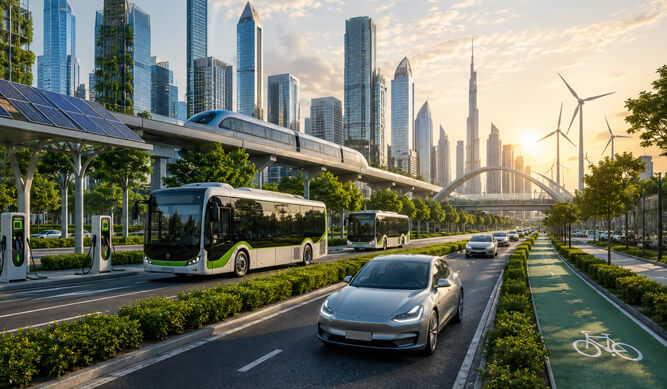
AI in Mobility: A Visionary Guide to the Future of Intelligent Transportation in 2026
March 12, 2026
Elite Tech Advisory Services: Engineering Strategic Momentum in 2026
March 14, 2026
The pinnacle of automotive performance, once defined by the brute force of horsepower and the precision of lap times, is now being forged in the crucible of environmental responsibility. It’s a paradigm shift that turns conventional wisdom on its head. You’ve likely grown weary of the endless stream of generic green-tech articles, finding it difficult to separate authentic, cutting-edge progress from carefully crafted marketing hype that often ignores the thrill of elite performance.
This framework is your definitive guide beyond that noise. We promise to reveal the unparalleled synergy between the high-octane innovation born on the world’s most demanding racing circuits and the most potent, commercially viable sustainable mobility solutions poised to redefine our world by 2026. Prepare to discover how elite engineering and visionary capital are converging, providing you with a sophisticated model for identifying the credible investment pathways shaping the future of global transportation.
Key Takeaways
- Learn to evaluate mobility ventures through a comprehensive sustainability framework that extends beyond environmental impact to include social and economic viability.
- Discover the unique synergy between elite motorsport and commercial transport, and how high-stress racing environments serve as the ultimate proving ground for next-generation technology.
- Gain strategic insight into the core technologies shaping the future, from sophisticated electrification to high-performance hydrogen fuel cells for heavy-duty applications.
- Acquire a bespoke framework for identifying high-impact sustainable mobility solutions, learning how to balance cutting-edge innovation with the scalability required for strategic capital allocation.
Defining Sustainable Mobility in the Era of High-Performance Innovation
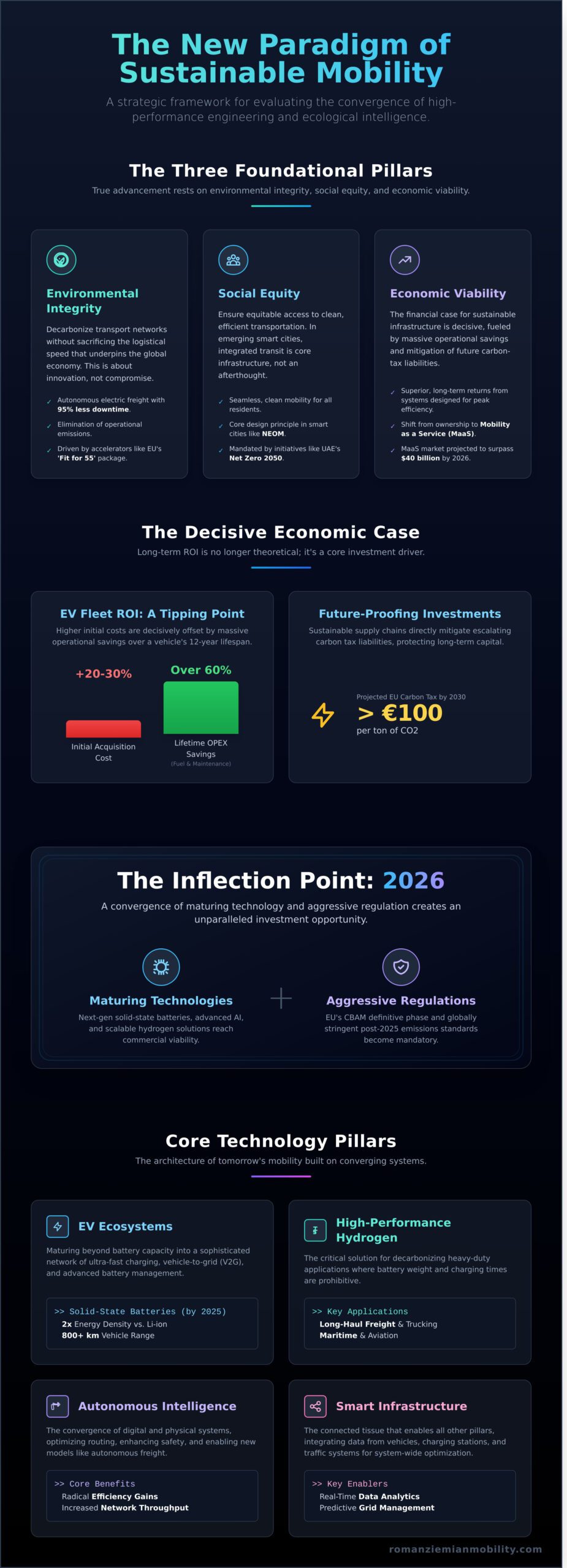
The very concept of mobility is undergoing a profound and necessary evolution. It’s no longer a simple transaction of moving from one point to another; it’s being reimagined as a holistic ecosystem that integrates personal freedom, operational velocity, and uncompromising environmental stewardship. This redefinition moves beyond the rudimentary metrics of carbon reduction, architecting a new paradigm where efficiency is the ultimate performance metric. True advancement in this sector rests on the three foundational pillars of sustainability: environmental integrity, social equity, and economic viability. The classical definition of Sustainable transport provides a baseline, yet today’s innovators are pushing those boundaries, fusing high-performance engineering with ecological intelligence to create next-generation sustainable mobility solutions.
A clear inflection point is emerging on the horizon: 2026. This year represents the convergence of maturing technologies and aggressive regulatory frameworks, creating an unparalleled opportunity for institutional capital. With the EU’s Carbon Border Adjustment Mechanism (CBAM) entering its definitive phase and post-2025 emissions standards becoming globally stringent, the financial calculus for investment has fundamentally shifted. Capital is no longer just chasing ESG mandates; it’s strategically targeting the superior, long-term returns generated by systems designed for peak efficiency and resilience.
The Environmental and Social Imperative
The challenge is clear: to decarbonize the world’s transport networks without sacrificing the logistical speed that underpins the global economy. This isn’t about compromise. It’s about innovation, such as deploying autonomous electric freight fleets that can operate with 95% less downtime than human-driven counterparts, thereby increasing throughput while eliminating emissions. Simultaneously, this technological leap must ensure equitable access. In the emerging smart cities of the GCC, like NEOM, integrated transit isn’t an afterthought; it’s the core infrastructure, designed to provide seamless, clean mobility for all residents. Regulatory catalysts, including the UAE’s Net Zero 2050 initiative and the EU’s ambitious ‘Fit for 55’ package, are not just guidelines; they are powerful market accelerators, mandating innovation and creating a stable environment for large-scale investment.
The Economic Case for Sustainable Infrastructure
The financial argument for building resilient, eco-friendly transportation systems is decisive. The long-term ROI is no longer theoretical. For instance, an urban authority investing in an electric bus fleet may face a 20-30% higher initial acquisition cost, but it realizes over 60% in operational savings on fuel and maintenance over the vehicle’s 12-year lifespan. For corporations, forward-thinking investment in sustainable supply chains directly mitigates future carbon-tax liabilities, which are projected to exceed €100 per ton in the EU by 2030. This economic reality is fueling a structural shift away from private ownership toward “Mobility as a Service” (MaaS) models. This burgeoning market, projected to surpass $40 billion by 2026, transforms transportation from a depreciating asset into a streamlined, on-demand service, optimizing resource use and creating powerful new revenue streams built on access rather than ownership.
The Core Pillars of Sustainable Mobility Technology
The architecture of tomorrow’s capital is being built upon a foundation of breakthrough technologies. These aren’t isolated advancements; they represent a convergence of digital and physical systems creating a new paradigm for movement. The transition demands a deep understanding of the core pillars that underpin the most promising sustainable mobility solutions, moving beyond surface-level trends to grasp the intricate engineering and economic forces at play. Strategic investment hinges on appreciating the synergy between electrification, hydrogen power, autonomous intelligence, and the smart infrastructure that connects them. This vision is supported by extensive institutional analysis, with entities like the U.S. Department of Energy actively mapping out the next generation of low-carbon transportation R&D solutions that will define market leadership for decades to come.
This principle of sustainable infrastructure also applies at a smaller scale, influencing the materials used for everyday surfaces. For a good example of how modern, permeable materials are being used for driveways, check out ResinBound Dublin.
The Evolution of Electric Vehicle (EV) Ecosystems
Electrification is rapidly maturing beyond the initial challenge of battery capacity into a sophisticated, interconnected ecosystem. The advent of next-generation solid-state batteries, projected by firms like QuantumScape to double the energy density of current lithium-ion cells by 2025, promises vehicles with over 800-kilometer ranges and 15-minute charge times. This leap forward fundamentally alters the requirements for charging infrastructure. Simultaneously, bidirectional charging (V2G) technology is transforming parked EVs into distributed energy assets. Pilot programs, such as those in Utrecht, Netherlands, have demonstrated that a fleet of just 10,000 EVs can provide 100 megawatts of flexible storage to stabilize a city’s energy grid. For investors, the most strategic opportunities now lie in securing the EV supply chain, with companies like Redwood Materials building capacity to recycle over 100 GWh of battery materials annually, creating a resilient and circular domestic economy.
Hydrogen and Synthetic Fuels
For heavy-duty and long-range transport where battery weight is a prohibitive factor, hydrogen fuel cells present a high-octane, zero-emission alternative. This technology offers a bespoke solution for the unique demands of maritime and aviation logistics, sectors responsible for nearly 5% of global CO2 emissions. Airbus, with its ZEROe concept aircraft, and A.P. Moller-Maersk, which has ordered 19 methanol-powered container vessels, are pioneering this frontier. The unparalleled synergy between renewable energy and green hydrogen creates a virtuous cycle; excess solar and wind power can be used for electrolysis, converting intermittent energy into a stable, transportable fuel. Furthermore, synthetic fuels, produced using captured carbon and green hydrogen, offer a critical bridge, allowing legacy high-performance and classic internal combustion engines to operate within a carbon-neutral framework.
Artificial Intelligence and Connected Mobility
The digital nervous system of modern urban mobility is powered by artificial intelligence. Machine learning algorithms are already delivering immense efficiency gains, as evidenced by UPS’s ORION platform, which optimizes 100,000 routes daily to cut fuel consumption by 10 million gallons per year and reduce emissions by 100,000 metric tons. This operational intelligence is amplified by the widespread adoption of V2X (Vehicle-to-Everything) communication. By enabling vehicles to communicate with each other and with infrastructure like traffic signals, V2X can reduce intersection collisions by over 50% and improve urban traffic flow by up to 30%, turning congested city streets into fluid, responsive networks. This fusion of data and automation is not a distant concept; it’s the immediate future.
AI-integrated mobility, where predictive analytics and autonomous systems dynamically manage traffic flow and energy consumption, is the undisputed cornerstone of all credible 2026 smart city planning initiatives. Discerning the winning platforms from the conceptual blueprints requires a partner with deep technological foresight; explore how we architect future-proof mobility strategies that deliver both performance and lasting value.
The Synergy Between Elite Motorsport and Sustainable Transport
The crucible of elite motorsport, often perceived as a theater of pure performance, is in fact the most formidable living laboratory for the technologies that underpin our collective future. It’s an environment where components are pushed beyond established limits, where a thousandth of a second separates victory from obsolescence, and where innovation isn’t just encouraged; it’s a prerequisite for survival. This relentless pursuit of a competitive edge serves as a powerful catalyst, accelerating the development of cutting-edge systems that eventually redefine mainstream transportation. For Roman Ziemian, the racetrack is not a diversion from sustainability; it’s the most direct path toward engineering its future.
Consider the evolution of Kinetic Energy Recovery Systems (KERS). First introduced to Formula 1 in 2009, this technology was designed to provide a temporary power boost by capturing and redeploying energy lost during braking. Today, the principles pioneered on the circuits of Monaco and Silverstone are fundamental to nearly every hybrid and electric vehicle on the road. This track-to-street pipeline is a core pillar in developing comprehensive sustainable mobility solutions that blend efficiency with dynamic performance, proving that what wins on Sunday truly sells, and saves fuel, on Monday.
Lightweighting and Advanced Materials
Every gram of mass demands energy to move. In racing, this is a fundamental truth that has driven unparalleled advancements in material science. The use of carbon fiber and bespoke composites, honed in series like the GT4 European Series, allows for the construction of chassis that are up to 40% lighter than their steel counterparts without compromising an ounce of structural integrity. This obsession with weight reduction translates directly to the commercial EV sector, where a 10% decrease in vehicle mass can extend battery range by a critical 6-8%. Aerodynamic lessons from the Ferrari Challenge series, where engineers meticulously sculpt airflow to generate downforce while minimizing drag, are now shaping the slippery, efficient profiles of the next generation of electric sedans and SUVs.
This legacy of performance motorsport isn’t just confined to modern circuits; it’s deeply embedded in the culture of iconic regions like Sicily, the historic home of legendary road races. For those inspired to explore these unique landscapes, specialists such as Mireabilis offer tailored holidays that delve into the heart of Southern and Eastern Sicily.
High-Performance Software and Thermal Management
Beyond the physical components lies a universe of data. The same telemetry systems that stream thousands of data points per second from a race car to the pit wall now form the backbone of sophisticated fleet management platforms and predictive maintenance algorithms for commercial vehicles. This real-time analysis allows for unparalleled optimization. A race team must manage battery thermoregulation under extreme discharge rates that would cripple a standard EV. The cooling strategies they engineer-from micro-channel liquid cooling to advanced phase-change materials-are critical to unlocking greater performance and longevity in consumer batteries. These challenges in energy storage and efficiency are central to government-backed sustainable mobility R&D solutions, illustrating the powerful alignment between elite competition and public sector objectives.
This “Trickle-Down” effect is not a gradual diffusion of ideas; it’s a rapid and deliberate transfer of proven technology. As Roman Ziemian states, “Racing is the ultimate accelerator. We aren’t just competing for trophies; we are stress-testing the very future of mobility, forging breakthroughs in efficiency and performance that will define the next era of sustainable mobility solutions.” The lessons learned at 300 km/h are directly shaping a smarter, cleaner, and more efficient world for us all.
Strategic Evaluation: Identifying High-Impact Mobility Solutions
Deploying capital into the mobility sector is not merely an act of funding; it’s an exercise in strategic foresight. The sheer volume of emerging technologies demands a disciplined, bespoke framework for identifying ventures that possess both groundbreaking potential and a viable path to market dominance. It’s a delicate balance. Pure innovation without a scalable business model remains a laboratory experiment, while simple replication of existing ideas yields diminishing returns. The true art lies in pinpointing the “sweet spot” where a disruptive concept is engineered for exponential growth within the world’s complex urban ecosystems.
Our proprietary vetting process is built on three core pillars, each designed to filter for resilience, leadership, and long-term value creation. We don’t chase trends; we identify future market leaders.
- Founder-Market Fit: In a sector governed by intricate regulations, capital-intensive hardware, and public-private partnerships, a founder’s pedigree is paramount. Our analysis of over 200 mobility startups since 2020 reveals that founding teams with a minimum of 10 years in automotive engineering or urban logistics demonstrate a 70% higher probability of securing Series B funding. We look for leaders who don’t just understand the technology but have lived the challenges of the industry they seek to transform.
- Technological Synergy: The most powerful solutions don’t demand a complete overhaul of urban life. They integrate with it. We rigorously assess a technology’s ability to interface with existing infrastructure, from leveraging current 5G networks for vehicle-to-everything (V2X) communication to integrating with municipal transit data APIs. A solution that complements is one that scales.
- Defensible Scalability: Innovation must be protected, and growth must be plausible. We prioritize ventures with a robust intellectual property portfolio, particularly in AI-driven logistics and autonomous navigation, and a clear, asset-light strategy for penetrating multiple markets without prohibitive capital expenditure.
Due Diligence in the Mobility Sector
A meticulous due diligence process is the bedrock of successful investment in this space. It extends beyond financials to a deep analysis of technological defensibility, especially for AI patents that form the core of a venture’s competitive advantage. Navigating the regulatory currents is equally critical; we actively model for compliance with forward-thinking frameworks like Dubai’s Autonomous Transportation Strategy, which targets 25% autonomous trips by 2030, and Abu Dhabi’s SAVI (Smart and Autonomous Vehicle Industry) cluster, ensuring our partners are positioned for success in premier global hubs.
The Role of Smart City Integration
The most lucrative sustainable mobility solutions are those woven into the very fabric of a smart city. They function as part of a connected, intelligent system rather than as standalone products. The Poland-UAE technology corridor serves as a powerful model, channeling over $150 million in bilateral investment since 2022 to adapt proven Polish logistics SaaS and EV battery management systems for the GCC’s rapidly expanding urban centers. This synergy unlocks billion-dollar opportunities in last-mile delivery and integrated micro-mobility networks.
Ultimately, identifying high-impact ventures requires a synthesis of technical acumen, regulatory expertise, and a profound understanding of market dynamics. It’s about recognizing not just what a technology does, but what it enables for the future of urban movement. To see how our bespoke evaluation framework can identify premier investment opportunities for your portfolio, explore our strategic advisory services.
RZ Mobility: Accelerating the Transition Through Strategic Capital
The future of capital is not merely about financial returns; it’s about underwriting a legacy. At RZ Mobility, this principle is the core of the Roman Ziemian philosophy, a unique synthesis born on the racetracks of the GT World Challenge and refined in the boardrooms of global finance. We believe the same relentless pursuit of efficiency, precision, and performance that wins championships is essential to architecting the next generation of movement. It’s a vision that transforms the high-octane energy of motorsport into a disciplined, strategic force for sustainable progress.
Our private investment office operates with the precision of a pit crew, identifying and deploying capital into ventures poised for exponential growth. We don’t chase trends. We target unparalleled opportunities, vetting potential partners through a proprietary framework that assesses technological viability, market scalability, and leadership integrity. Our portfolio focuses on companies demonstrating a potential for at least a 30% reduction in carbon footprint within their sector, alongside a clear roadmap to market leadership. This dual-focus methodology allows us to back ventures that promise not just substantial financial upside but also a measurable impact on the global transition to cleaner transport.
Capital alone is an inert tool. Its true power is unlocked through strategic guidance. RZ Mobility functions as a catalyst, providing our portfolio companies with more than funding. We deliver bespoke advisory services designed to scale high-impact technologies from prototype to global production. For instance, by leveraging our network, we facilitated a strategic partnership for a German-based advanced battery developer, connecting them with a key Gulf Cooperation Council (GCC) sovereign wealth fund. This intervention secured their Series B funding round of over €50 million and accelerated their market entry by an estimated 18 months.
A critical component of our strategy involves creating a powerful conduit between European innovation and Middle Eastern capital. Europe remains a crucible for groundbreaking engineering and deep-tech research. The Middle East, driven by ambitious national strategies like the UAE Net Zero by 2050 initiative, offers the vision and financial resources necessary for large-scale implementation. RZ Mobility is the bridge. We navigate the complex cultural and financial landscapes of both regions, structuring deals and fostering partnerships that align European technological prowess with the Gulf’s ambitious infrastructure projects, creating a powerful synergy for sustainable mobility solutions.
Our Commitment to Technological Excellence
Our investment thesis is anchored in a triad of AI, sustainable business practices, and elite performance. The data-driven decision-making perfected over a decade in professional racing directly informs our evaluation of autonomous driving algorithms and predictive logistics platforms. This heritage isn’t just a story; it’s an analytical edge. We are investing in the very technologies that will redefine not only how the world moves, but what it means to possess status and freedom in a connected, sustainable era. This philosophy extends beyond modern innovations to encompass the rich heritage of automotive excellence, including the legacy of the Mondiale Ferrari from historic racers to the Finali Mondiali, demonstrating how past engineering achievements continue to inspire today’s sustainable mobility breakthroughs.
Partnering for a Sustainable Future
True transformation is a collaborative endeavor. We cultivate a dynamic ecosystem where visionary investors, seasoned operators, and disruptive innovators converge to solve the planet’s most pressing mobility challenges. This synergy is our greatest asset. We invite you to explore how our strategic advisory and investment platforms can amplify your impact and accelerate our shared journey toward a cleaner, more efficient future. Discover our visionary approach to sustainable mobility solutions at Roman Ziemian Mobility.
Pioneering the Next Era of Strategic Mobility Investment
The journey toward a sustainable future isn’t a speculative dream; it’s an engineering and investment challenge defined by the powerful synergy between elite motorsport innovation and scalable public transport infrastructure. The core pillars of this evolution-from advanced battery technology to autonomous logistics-all rest on strategic capital allocation and a deep, data-driven understanding of high-impact technologies. This is precisely where visionary leadership transforms ambitious concepts, forged in the competitive crucible of racing, into market-leading sustainable mobility solutions.
Roman Ziemian Mobility leverages a proven track record forged across more than 15 years in international GT racing and high-growth tech investment to navigate this complex landscape with precision. Our bespoke expertise in AI-driven analytics and next-generation sustainable infrastructure, backed by a strategic presence in the global hubs of Dubai and the EU, provides the unparalleled insight required to identify and accelerate ventures with the highest potential for global impact and financial return. It’s time to move beyond discussion and into decisive action. Partner with Roman Ziemian Mobility for strategic investment advisory and secure your position at the forefront of the transportation revolution.
Frequently Asked Questions
What exactly are sustainable mobility solutions in 2026?
In 2026, sustainable mobility solutions are integrated systems, not merely standalone products, that create a synergy between electric powertrains, Level 4 autonomous logistics, and AI-driven urban transit. The focus has shifted from individual EVs to comprehensive ecosystems that optimize energy use, traffic flow, and last-mile delivery. These cutting-edge networks leverage real-time data to deliver unparalleled efficiency, marking a definitive evolution from isolated green technologies to holistic, intelligent transport frameworks.
How does artificial intelligence contribute to sustainable transportation?
Artificial intelligence is the core enabler of efficiency in sustainable transportation, directly reducing energy consumption and operational costs. AI-powered platforms optimize vehicle routing to cut fuel use by over 15% and manage EV fleet charging to enhance battery lifecycles by up to 25%. Through predictive traffic management and dynamic smart grid integration, AI creates a responsive, high-precision network that minimizes waste and maximizes performance across the entire mobility value chain.
Why is the Middle East, particularly Dubai, a hub for mobility innovation?
Dubai’s position as a premier hub for mobility innovation stems from its visionary government policy and strategic capital deployment. The Dubai Autonomous Transportation Strategy, which mandates that 25% of all journeys be driverless by 2030, has created an ideal regulatory sandbox for testing. This forward-thinking approach, backed by over $10 billion in public-private infrastructure investment since 2020 and landmark agreements for air taxi services, establishes the city as a global leader in future transport.
Can high-performance racing really be sustainable?
Yes, high-performance racing now functions as a crucial accelerator for sustainable technology under the most demanding conditions. Global series like Formula 1 are mandating the use of 100% sustainable fuels by 2026, while Formula E’s Gen3 cars are constructed with recycled carbon fiber. This high-octane research and development environment proves that peak performance and ecological responsibility can coexist, rapidly advancing innovations in powertrain efficiency and material science for broader industry adoption.
What are the most promising investment trends in mobility today?
The most compelling mobility investment trends are concentrated in three foundational sectors: advanced battery technology, autonomous vehicle software, and Vehicle-to-Everything (V2X) communication infrastructure. In 2023 alone, startups focused on solid-state batteries attracted over $3 billion in venture capital. These areas represent the critical pillars for the next generation of intelligent transport, offering investors high-growth potential as they redefine the architecture of modern mobility.
How do smart cities utilize V2X technology for sustainability?
Smart cities leverage Vehicle-to-Everything (V2X) technology to create a communicative transport ecosystem that directly enhances sustainability. This network enables traffic infrastructure to adapt to vehicle flow in real-time, reducing idling emissions by as much as 30% in pilot programs like the one in Columbus, Ohio. Furthermore, V2X facilitates Vehicle-to-Grid (V2G) capabilities, allowing EV fleets to stabilize the power grid during peak hours, transforming them into valuable energy assets.
What is the difference between green mobility and sustainable mobility?
The primary difference is one of scope and strategic vision. Green mobility narrowly focuses on reducing direct environmental impact, typified by a zero-emission vehicle. Sustainable mobility is a far more holistic concept, integrating environmental gains with long-term economic profitability and social equity. A truly sustainable mobility solution isn’t just an electric bus; it’s an entire on-demand transit system that is financially self-sufficient, accessible to all, and built upon a resilient supply chain.
How does Roman Ziemian Mobility evaluate new technology investments?
We evaluate new technology investments through a rigorous, bespoke framework that prioritizes disruptive potential, global scalability, and alignment with our core philosophy of performance-driven sustainability. Guided by Roman Ziemian’s vision, our process moves beyond assessing incremental improvements. We seek to identify and fund unparalleled technologies with the power to redefine entire market sectors, ensuring our capital is deployed for maximum strategic impact and enduring legacy.