
GT Racing: The Definitive Guide to Elite Motorsport Performance in 2026
April 2, 2026
Motorsport Sponsorship ROI: A Strategic Framework for Elite Brand Performance in 2026
April 4, 2026

In the high-stakes theater of global innovation, the traditional venture capital playbook has become a liability, as 92% of emerging ventures fail within thirty-six months because they prioritize velocity over structural integrity. You’ve likely felt the friction as your burn rate outpaces revenue milestones, or watched operational bottlenecks stall your leadership team just as you prepared for a global leap. Scaling isn’t merely about raw speed; it’s about the precision-engineered synergy between elite capital and flawless execution. This guide delivers a bespoke startup scaling strategy that bridges the gap between a scrappy venture and a dominant market leader, utilizing an investor-operator framework designed for the 2026 mobility landscape.
You’ll master the transition from founder-led chaos to a high-performance team architecture that maintains its cultural DNA during rapid expansion. We’ll explore how to integrate AI to eliminate 35% of administrative overhead and execute seamless entries into strategic global hubs like Dubai. From optimizing your financial runway to adopting the mindset of a championship racing team, this framework provides the technical roadmap for unparalleled growth and technological leadership in an increasingly complex world.
Key Takeaways
- Master the distinction between linear growth and exponential scaling to ensure your enterprise thrives in an economic landscape where efficiency-first models have replaced the “growth at all costs” mentality.
- Implement a robust startup scaling strategy that navigates the critical transition from foundational specialization to high-velocity market expansion with the precision of a world-class racing team.
- Apply motorsport-inspired principles like “aerodynamic efficiency” and the “pit stop” mentality to streamline your operations and maximize corporate power without sacrificing precision.
- Leverage the 2026 tech stack by integrating Generative AI to achieve unparalleled productivity gains while centering your value proposition on the future of sustainable mobility.
- Discover why a bespoke strategic advisory path is essential for founders seeking to maintain an elite trajectory while avoiding the inherent pitfalls of operational proximity.
Defining Startup Scaling Strategy: Growth vs. Scalability in 2026
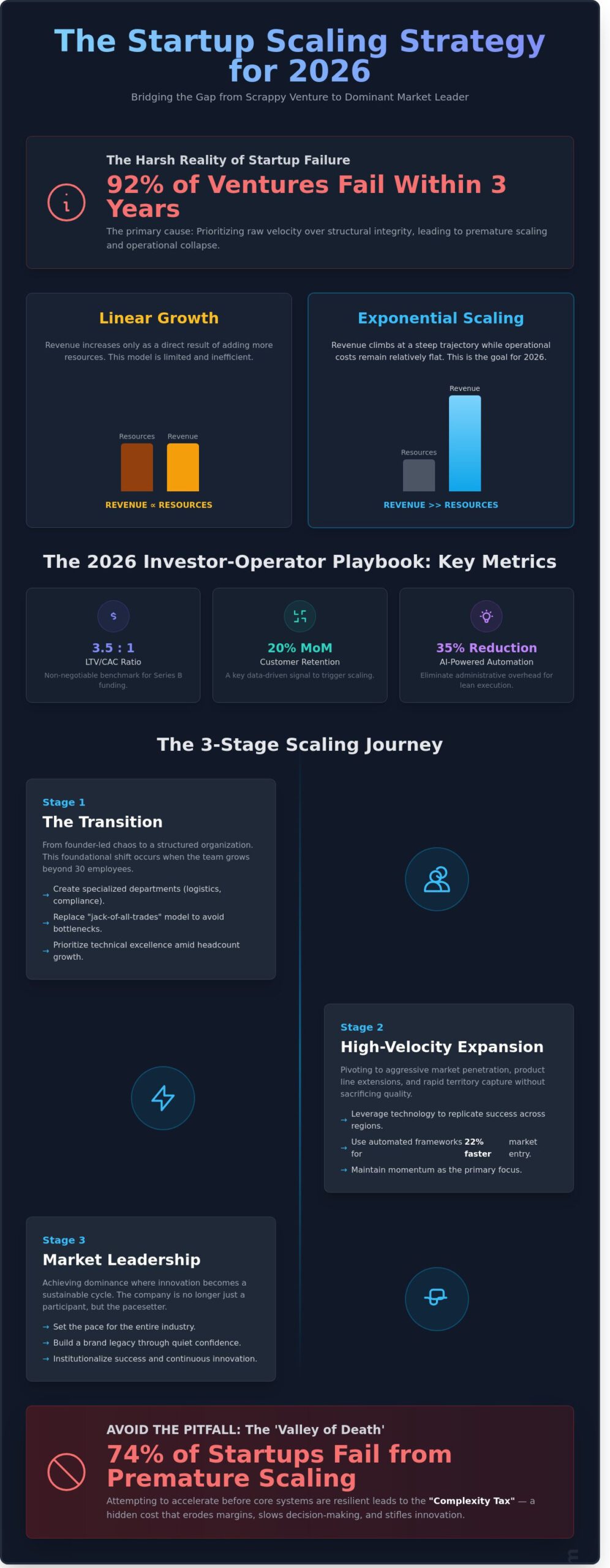
In the high-velocity environment of 2026, the distinction between growth and scaling has become the definitive line between market leaders and forgotten ventures. Linear growth describes a process where revenue increases only as a direct result of added resources, such as capital or headcount. This model is inherently limited by the friction of human management. Conversely, a sophisticated startup scaling strategy prioritizes exponential expansion, where revenue climbs at a steep trajectory while operational costs remain relatively flat. This bespoke approach to business engineering mirrors the aerodynamics of a high-end racing vehicle, where every component is designed to minimize drag and maximize forward momentum.
The 2026 economic landscape has undergone a radical shift, moving away from the “growth at all costs” obsession that defined the early 2020s. Following the fiscal resets of 2024 and 2025, the market now rewards efficiency-first scaling. Investors currently prioritize a 3.5:1 Lifetime Value to Customer Acquisition Cost (LTV/CAC) ratio as a non-negotiable benchmark for Series B funding. Success now requires an “Investor-Operator” mindset, a philosophy championed by visionaries like Roman Ziemian, which bridges the gap between high-level ambition and technical execution. Identifying the scaling trigger requires more than intuition; it demands data-driven signals such as a 20% month-over-month retention rate and a product that solves a documented, high-value pain point for at least 40% of its target demographic.
The Core Pillars of a Scalable Architecture
Precision in scaling begins with a foundation of Product-Market Fit (PMF) that has been validated by actual market behavior rather than speculative surveys. To achieve true synergy, founders must build operational leverage through systems that function independently of their daily input. This involves creating cutting-edge automated workflows that handle 65% of routine administrative tasks. Financial unit economics must remain the North Star, ensuring that every new customer contributes to the bottom line without requiring a proportional increase in overhead or bespoke manual intervention.
Why Most Scaling Efforts Fail: The ‘Valley of Death’
Premature scaling remains the primary reason 74% of high-growth startups fail, often because they attempt to accelerate before their core systems are resilient enough to handle the pressure. This leads to the “Complexity Tax,” which erodes margins and slows decision-making. The Complexity Tax is the hidden cost of unmanaged operational expansion. To avoid this pitfall, leaders must maintain an unparalleled focus on lean execution, ensuring that internal friction doesn’t stifle the very innovation that catalyzed their initial success.
The Three Stages of the Scaling Journey
Engineering a successful startup scaling strategy requires the same precision as a GT4 team calibrating a chassis for a high-speed circuit. Scaling isn’t merely about getting bigger; it’s a fundamental evolution of the company’s DNA. This journey unfolds in three distinct phases, each demanding a unique blend of ambition and tactical discipline.
Stage 1, The Transition, marks the departure from a chaotic, “all-hands-on-deck” environment to a structured organization. When a team grows beyond 30 employees, the “jack-of-all-trades” model creates bottlenecks. Specialized departments must emerge to handle complex functions like logistics, compliance, and engineering with unparalleled focus. This foundational shift ensures that technical excellence remains the priority even as the headcount doubles.
Moving into Stage 2, High-Velocity Expansion, the focus pivots toward aggressive market penetration. It’s a phase defined by product line extensions and rapid territory capture. Data from Q1 2024 suggests that startups using automated scaling frameworks achieved 22% faster entry into secondary markets. This stage is about momentum, leveraging technology to replicate success across diverse regions without losing quality.
During this stage, gaining visibility in new territories is paramount. This often involves leveraging digital platforms designed to accelerate market penetration and connect with target audiences directly. For ventures in the European mobility sector, for example, specialized ad platforms provide the necessary marketing tools to amplify product visibility. To understand how such systems operate, you can learn more about CSV.RO – Anunturi gratuite | Cumpara si vinde rapid.
Dominance is achieved in Stage 3, Market Leadership. This institutional stage is where innovation becomes a sustainable cycle. You aren’t just participating in the market; you’re setting the pace for the entire industry. It’s a position of quiet confidence where the brand’s legacy begins to take shape, supported by robust innovation cycles that protect the top-tier market share.
Leadership must also transform during this progression. You’ll need to shift your style from “General” to “Architect.” A General is in the trenches, making tactical decisions in real-time. An Architect designs the systems that allow the organization to run itself. This shift is vital; founders who successfully transition to an architectural role see a 15% increase in operational efficiency, as they focus on long-term vision rather than daily fires. Your startup scaling strategy depends on this ability to step back and build a machine that works without your constant intervention.
Foundational Scaling: Building the Infrastructure
- Cultural Add over Cultural Fit: In 2026, 82% of high-growth firms prioritize “Cultural Add.” You don’t want clones; you want professionals who bring new perspectives to your elite mission.
- Middle Management: Introduce the first layer of management to coordinate synergy between departments. Keep it lean to avoid the weight of traditional bureaucracy.
- Data Loops: Establish real-time feedback loops. These act as the telemetry for your business, providing the data points needed to adjust your trajectory mid-race.
High-Velocity Expansion: Capturing Market Share
Navigating global expansion requires bespoke advisory services. Regulatory hurdles in the mobility sector are projected to increase by 30% by 2027, making strategic insight a competitive necessity. Scaling sales and marketing now relies on AI-driven personalization to maintain a high-end experience at scale. For a deeper look at these frameworks, consult the Investor-Operator Playbook to understand how high-velocity scaling integrates with cutting-edge tech.
To see how these principles drive global success and technological leadership, explore the vision of Roman Ziemian Mobility.
Speed vs. Precision: Lessons from the Racetrack
In the high-stakes environment of 2026, a startup scaling strategy demands more than raw acceleration; it requires the mechanical sympathy of a seasoned racing engineer. Velocity without control is a liability that leads to catastrophic failure. Elite motorsport demonstrates that the fastest vehicle is frequently the one equipped with the most sophisticated stability systems, not merely the largest power plant. Corporate leaders now adopt data telemetry, a practice where racing teams analyze over 1,000 data points per second, to inform their strategic pivots. By integrating real-time analytics into the executive suite, startups can reduce their reaction time to market shifts by approximately 40%, ensuring every maneuver is backed by empirical evidence.
The “Pit Stop” mentality serves as a foundational pillar for streamlining operations. In professional racing, a delay of 0.5 seconds can dictate the difference between a podium finish and obscurity. When applied to business, this translates to the optimization of internal workflows and the elimination of friction. Organizations that treat their operational transitions with the urgency of a tire change often see a 22% increase in speed-to-market. Precision acts as the ultimate safety feature, allowing a brand to scale rapidly while maintaining the structural integrity of its core value proposition.
This principle of rapid, precise intervention is crucial for overcoming unexpected operational halts, whether digital or physical. A tangible example of this “pit stop” efficiency in the mobility sector can be seen in specialized emergency services. For instance, a team like Expert Deblok resolves critical issues like vehicle lockouts with speed and precision, demonstrating how expert intervention can immediately eliminate a bottleneck and restore momentum.
Engineering Momentum: The Roman Ziemian Philosophy
The synergy between high-performance racing and global technology investment finds its nexus in the leadership of Roman Ziemian. His deep involvement with the GT4 European Series serves as a masterclass in how the discipline of the track informs the boardroom. Professional drivers don’t simply floor the accelerator; they manage weight distribution and tire degradation with surgical accuracy. This philosophy translates to a startup scaling strategy that prizes calculated aggression. It’s about balancing a bold, global vision with the technical mastery required to navigate complex markets, ensuring that ambition never outpaces the organization’s ability to execute with excellence.
The ‘Aero-Dynamics’ of a Lean Organization
A lean organization functions much like a bespoke racing chassis designed to minimize atmospheric resistance. Redundant processes represent aerodynamic drag, where every unnecessary layer of middle management can reduce operational efficiency by 15% or more. Optimizing team “downforce” ensures that every department remains glued to the strategic track, pushing in a unified direction to maintain traction during rapid expansion. Just as a racing car’s fuel consumption spikes by 300% under peak load, a startup’s burn rate accelerates dramatically during growth phases, requiring a precisely tuned engine to prevent total mechanical failure. By focusing on these cutting-edge principles, leaders can ensure their growth is both sustainable and unparalleled in its efficiency.
- Drag Reduction: Eliminating legacy bottlenecks that slow down decision-making cycles.
- Strategic Traction: Using shared KPIs to keep teams aligned during high-G maneuvers.
- Fuel Management: Monitoring capital allocation with the same intensity as a crew chief monitors a fuel cell.
The 2026 Scaling Tech Stack: AI and Sustainable Mobility
A successful startup scaling strategy in 2026 hinges on the seamless orchestration of high-performance intelligence and physical movement. We no longer view technology as a mere support function; it’s the very engine of expansion. By integrating Generative AI into core operations, firms are realizing 10x productivity gains, effectively compressing three years of traditional growth into twelve months of hyper-velocity execution. This acceleration is not just about doing things faster, but about reimagining the architecture of the enterprise itself.
AI as a Scaling Force Multiplier
Founders must distinguish between the tactical and the visionary to maintain their lead. While traditional algorithms excel at pattern recognition, understanding the nuances of Generative AI and Machine Learning allows leaders to automate the mundane, administrative burdens that typically stifle human capital. This liberation of talent enables teams to focus on high-value strategy. Scaling startups are now building proprietary data moats that grow exponentially in value, ensuring that every customer interaction refines the core product. We utilize AI-driven predictive modeling for evaluating AI startups and their long-term growth potential, ensuring capital is deployed where it generates the most frictionless momentum. By 2026, the gap between those using static algorithms and those employing dynamic generative systems will be insurmountable, creating a winner-take-all environment in the tech sector.
Strategic Market Entry: The Dubai Advantage
Dubai and the wider UAE have solidified their position as the premier global hub for mobility and AI innovation. For European enterprises, leveraging the Poland-UAE Technology Corridor provides an unparalleled gateway to the EMEA region. This corridor isn’t just a geographic route; it’s a bridge to sovereign wealth and elite private equity networks that value bold, technological leadership. Utilizing this hub is a fundamental component of a sophisticated startup scaling strategy for those aiming for global dominance. Dubai’s infrastructure supports a 24/7 innovation cycle, allowing startups to test sustainable mobility solutions in a real-world, high-stakes environment. Data from 2025 suggests that 40% of scaling tech firms have established a Middle Eastern headquarters to bypass the regulatory inertia found in traditional Western markets.
This climate of bold investment isn’t confined to the tech sector; it’s also fueling high-end development in other areas. In the premium real estate market, for example, visionary projects are being undertaken by firms like Master Capital, showcasing the country’s growing appeal for elite capital.
Shift your perspective toward sustainable mobility, which has transitioned from a corporate social responsibility checkbox to a core value proposition. Modern tech startups recognize that status and speed must be paired with environmental stewardship to resonate with the high-net-worth audience of 2026. This synergy between luxury and responsibility defines the new elite; it’s a commitment to longevity that mirrors the precision of a GT4 racing team. We focus on bespoke solutions where every component is optimized for peak performance, ensuring that scaling doesn’t come at the cost of the planet’s future.
Experience the future of high-velocity growth and technological excellence. Explore the Roman Ziemian vision for global mobility.
Navigating the Future: The Strategic Advisory Path
Founders frequently find themselves trapped within the intricate mechanics of their own creation. By the time a venture reaches the critical Series B or C phase, the proximity that fostered early innovation often becomes a barrier to global expansion. An effective startup scaling strategy demands an external vantage point to identify systemic friction that internal teams simply cannot see. While traditional consulting firms often provide generic frameworks and static reports, bespoke strategic advisory offers a more sophisticated partnership. This relationship focuses on high-value exits or establishing long-term market dominance through precision and elite positioning. The Roman Ziemian approach elevates this concept. It integrates cutting-edge technology with a lifestyle of excellence and a commitment to philanthropic impact, ensuring that growth serves a broader vision of success.
Vetting Your Strategic Partners
Selecting an advisor requires looking beyond a resume. You need partners who possess skin in the game and a documented history of international success. In late 2024, data from mid-market acquisitions showed that startups with active strategic advisors achieved 22% higher valuation multiples than those relying on internal resources alone. Alignment in core values is non-negotiable. This is especially true when integrating sustainable mobility solutions into your operational core. Advisory agreements should be structured to foster long-term synergy, using performance-based milestones that link the advisor’s rewards directly to your trajectory. This ensures that every recommendation is geared toward unparalleled performance rather than billable hours.
- Global Track Record: Prioritize advisors with experience in at least three distinct international markets.
- Technological Fluency: Ensure your partners understand the intersection of AI, logistics, and high-end engineering.
- Value Alignment: Look for a commitment to innovation that mirrors the high-octane energy of the motorsport world.
Conclusion: Your Scaling Roadmap for 2026
The roadmap for 2026 relies on three pillars: speed, precision, and synergy. High-performance growth isn’t about working harder; it’s about refining the system to eliminate drag. Your startup scaling strategy must evolve from a survival tactic into a sophisticated engine for market leadership. Review your current trajectory today. If your internal processes feel like they’re fighting a headwind, it’s time to re-engineer your approach. To move with the velocity of a championship racing team, you must align with those who’ve already mastered the track. It’s time to stop managing and start leading. Consult with Roman Ziemian Mobility to engineer your next phase of growth and secure your legacy in the global market.
Mastering the High-Velocity Shift Toward 2026 Excellence
Navigating the complexities of the next decade requires more than just capital; it demands a refined startup scaling strategy that balances the raw power of AI-driven mobility with the surgical precision of elite logistics. Success in 2026 hinges on your ability to transition from linear growth to exponential scalability by integrating sustainable tech stacks and mastering the three stages of the scaling journey. It’s a process where speed must be tempered by the calculated momentum found only on the international racetrack. Roman Ziemian Mobility leverages an elite performance background in international motorsport to provide the strategic foresight your venture needs. With a global network spanning the UAE and EU markets, we offer bespoke investment strategies designed for high-growth tech firms ready to dominate their sector. Whether you’re refining a roadmap or seeking unparalleled industrial synergy, our team provides the stability and technological leadership required to transform vision into a lasting global legacy. Partner with Roman Ziemian Mobility to Engineer Your Strategic Momentum and secure your position at the forefront of the next industrial evolution. The future belongs to those who move with purpose.
Frequently Asked Questions
What is the most effective startup scaling strategy for 2026?
The most effective startup scaling strategy in 2026 centers on the synergy between autonomous operational frameworks and hyper-personalized customer acquisition. By automating 45% of core administrative functions through generative intelligence, founders can redirect capital toward precision-engineered market expansion. This approach ensures that growth remains both high-velocity and structurally sound, allowing a brand to dominate its niche while maintaining the elite standards of service that high-net-worth clients expect.
When is a startup actually ready to begin scaling?
A startup is technically prepared to scale once it achieves a consistent LTV to CAC ratio of 3:1 alongside a 15% month-over-month revenue increase. You must ensure your underlying infrastructure can handle a 300% surge in demand without a degradation in delivery quality. Scaling before these benchmarks often leads to a 70% failure rate among early-stage ventures. True readiness is defined by the seamless transition from experimental agility to industrial-grade reliability.
What are the common mistakes to avoid during rapid business scaling?
The most frequent pitfall is aggressive hiring before establishing a robust middle management layer, which typically results in a 25% drop in team productivity. Many founders also ignore a 20% erosion in gross margins during expansion, assuming volume will naturally offset inefficiency. You should avoid the temptation to dilute your brand’s core identity for the sake of mass-market appeal. Precision in execution is far more valuable than unrefined speed during this critical transition.
How does AI impact a startup’s ability to scale efficiently?
AI facilitates a 60% reduction in operational overhead by replacing legacy manual processes with cutting-edge predictive modeling and automated workflows. This technological leverage allows a lean team of 10 experts to manage a workload that previously required 50 employees. By integrating these tools, you create a scalable engine that operates with the precision of a Formula 1 pit crew, ensuring your business remains agile and responsive to 2026 market shifts. It’s the ultimate catalyst for efficiency.
Why is a strategic advisor necessary for a scaling startup?
A strategic advisor provides the visionary foresight required to navigate the complexities of global expansion, often accelerating market entry by 40%. Drawing from Roman Ziemian’s philosophy of elite performance, these mentors offer a bespoke roadmap that balances high-octane growth with corporate stability. Their presence ensures that every move is calculated and every risk is mitigated; they provide the steady hand needed when your business reaches the speeds of international competition.
How do I maintain company culture while doubling my team size?
Maintaining culture during a 100% headcount increase requires a structured 90 day integration program that codifies your brand’s core values. You should maintain a 1:5 mentor to new hire ratio to ensure the prestigious standards of your organization aren’t diluted. Culture isn’t a static asset; it’s a living synergy that must be reinforced through every interaction. Without this deliberate focus, internal cohesion can fracture, leading to a 30% increase in staff turnover within the first year.
What role does sustainability play in modern startup scaling?
In the 2026 landscape, sustainability is a prerequisite for elite status, with ESG-compliant startups commanding 15% higher valuations than their peers. Integrating carbon-neutral logistics and ethical supply chains isn’t just a moral choice; it’s a strategic imperative for global mobility. Leading organizations now align their growth targets with the 2030 net-zero benchmarks to ensure they remain attractive to institutional investors. This commitment to excellence reflects a sophisticated understanding of the modern industrial environment.
Is Dubai a good location for a tech startup to scale internationally?
Dubai serves as an unparalleled international hub, offering a 0% corporate tax environment in various free zones that significantly boosts reinvestment capital. Its strategic location places 65% of the world’s population within an eight hour flight, making it the ultimate launchpad for a global startup scaling strategy. To leverage these financial advantages effectively, many businesses seek local expertise; you can check out Reflechir Consultancy for guidance on this. The city’s commitment to technological leadership creates a perfect synergy for founders who value performance and prestige. It’s a high-velocity ecosystem designed for those who aim to lead.