AI Startup Investment Opportunities: A Visionary Guide to High-Performance Capital in 2026
April 22, 2026
How to Scale a Mobility Startup in 2026: The Investor-Operator Playbook
April 24, 2026

The 2026 regulatory shift represents a definitive finish line for the era of speculative green investing, marking the moment where precision engineering becomes the only viable path to institutional alpha. You’ve likely found that the current deluge of data makes it nearly impossible to distinguish between a startup with a genuine racing pedigree and one that merely wears the aesthetic of innovation. The divergence between the EU’s 2035 combustion ban and the UAE’s bespoke Net Zero 2050 pathways creates a complex friction that many portfolios aren’t prepared to handle. It’s a landscape where the passion for speed must be tempered by executive-level strategic foresight.
This sustainable mobility investment thesis delivers an unparalleled framework for evaluating the synergy between high-performance motorsport technology and the global transition to clean energy. We’ll demonstrate how elite engineering from the world’s most demanding circuits translates into commercial excellence, guiding you through the high-growth corridors that define the future of movement. By aligning your capital with the same rigor found on the track, you’ll identify the technological leaders poised to dominate the next decade of transport.
Key Takeaways
- Understand the 2026 paradigm shift where the synergy of AI and energy hardware renders legacy internal combustion models obsolete for the visionary, long-term investor.
- Navigate the evolving value chain with a comprehensive sustainable mobility investment thesis that identifies unparalleled opportunities across hardware manufacturing and critical software layers.
- Uncover how elite racing series like the Ferrari Challenge act as cutting-edge R&D laboratories, driving high-performance innovation from the track directly into commercial applications.
- Implement a rigorous due diligence framework to de-risk your portfolio by prioritizing founder-product fit and the technical precision required for global automotive engineering.
- Leverage the unique “investor-operator” advantage to bridge the gap between visionary technology and disciplined capital deployment in the high-octane world of luxury mobility.
The 2026 Mobility Paradigm: From Alternative to Essential Asset Class
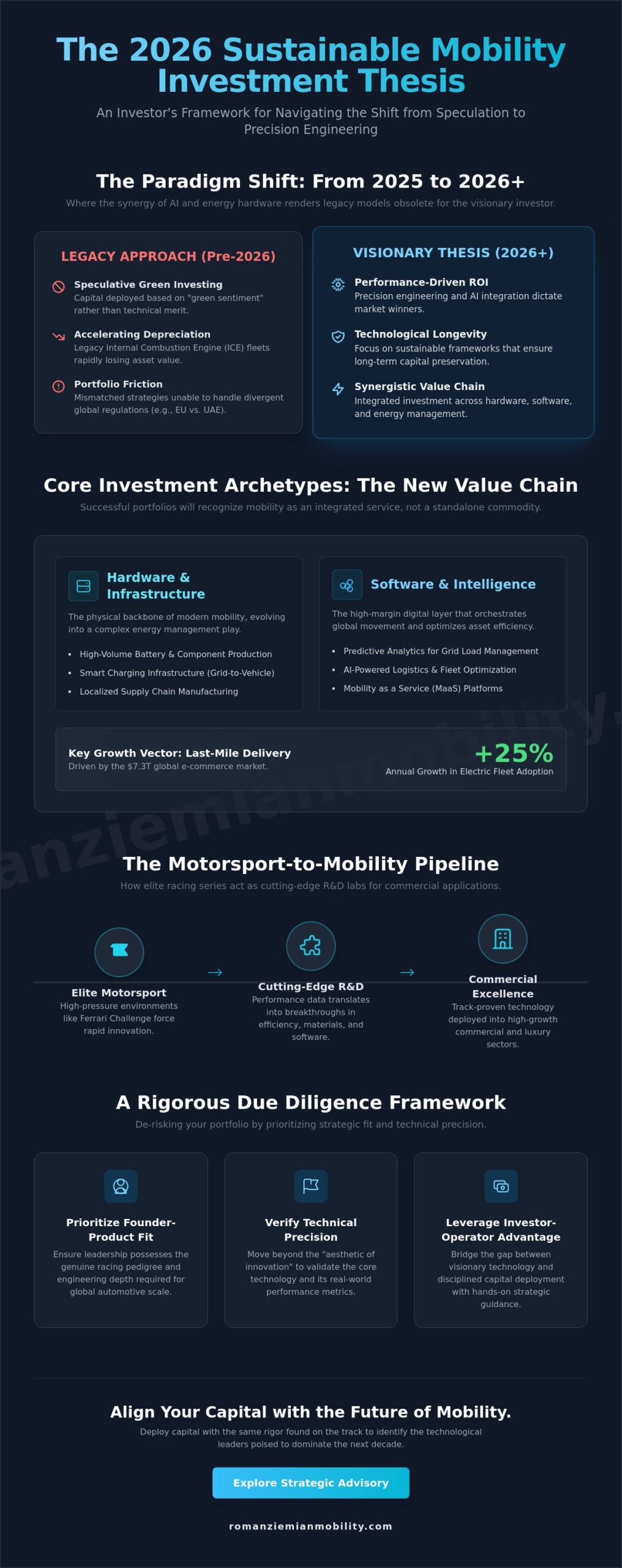
The year 2026 marks the definitive moment when the global transport sector transitions from a speculative venture into the bedrock of institutional portfolios. This shift isn’t merely about environmental stewardship; it’s a calculated move toward capital preservation. Legacy internal combustion engine (ICE) models are rapidly losing their status as viable long-term assets as depreciation rates for traditional fleets accelerate. Smart capital is pivoting toward a sustainable transport framework that prioritizes technological longevity and operational efficiency.
Central to this evolution is a robust sustainable mobility investment thesis that identifies high-velocity shifts at the intersection of luxury performance and industrial utility. Roman Ziemian Mobility views this transition not as a trend, but as a total realignment of how value is created and sustained. The focus has moved from “green sentiment” to “performance-driven ROI,” where precision engineering and AI integration dictate the winners of the next decade. It’s an era where speed is measured by data processing as much as it is by track times.
The Three Pillars of Modern Mobility Capital
The current capital landscape rests on a triad of innovation that demands deep industry knowledge. Electrification has matured beyond basic battery capacity into the sophisticated realm of grid-to-vehicle (G2V) power management. This creates a synergy between the energy sector and transport that was previously impossible. Autonomous intelligence acts as the operational engine, utilizing AI technology to optimize urban logistics and reduce idle times in ways that traditional systems can’t match. Finally, the move toward Mobility as a Service (MaaS) reflects a fundamental change in asset ownership. Shared infrastructure now provides a more resilient and scalable revenue stream than individual vehicle sales ever could.
Macro-Economic Tailwinds in 2026
Regulatory mandates serve as the primary catalysts for this massive capital migration. The EU Green Deal’s mandate for a 55% emission cut by 2030 has forced a total reallocation of funds into localized battery production and charging networks. These aren’t suggestions; they’re legal requirements that dictate market access. On a global scale, the UAE’s ‘Net Zero 2050’ initiative is driving unparalleled investment in regional mobility hubs, positioning the Middle East as a leader in clean energy logistics. Global supply chain resilience now depends on these localized investments. This creates a bespoke environment for investors who value stability and forward momentum in equal measure.
Core Investment Archetypes: Mapping the Sustainable Mobility Value Chain
The transition toward a decarbonized future has matured beyond speculative bets into a structured, multi-layered ecosystem. Investors seeking to capitalize on the sustainable mobility investment thesis must look past the vehicle itself to the sophisticated infrastructure that powers it. Capital flow is currently bifurcating between high-volume hardware production and the high-margin software layers that orchestrate global movement. By 2026, the most successful portfolios will be those that recognize mobility as an integrated service rather than a standalone commodity. This holistic sustainable mobility investment thesis centers on the synergy between precision engineering and digital intelligence.
Charging infrastructure has evolved into a complex energy management play. It’s no longer just about where a station is located; it’s about how it integrates with the local grid to provide stability. Investors are now prioritizing platforms that utilize predictive analytics to manage peak loads and optimize energy distribution. Understanding the value of sustainable transport investments requires looking at how these assets generate long-term social and economic returns through reduced congestion and improved air quality. The last-mile delivery sector is also seeing a 25% annual growth rate in electric fleet adoption, driven by the $7.3 trillion global e-commerce market’s demand for zero-emission logistics.
The smart city integration layer represents the most lucrative frontier for the 2026 capital shift. By connecting autonomous fleets with real-time energy pricing and traffic flow data, these systems create a high-margin digital moat. These platforms act as the brain of the urban environment, ensuring that every watt of energy and every second of travel is optimized for maximum efficiency.
Hardware vs. Software: Where Does the Alpha Lie?
While EV manufacturing requires billions in capital expenditure and faces thin margins, the mobility operating system offers unparalleled scalability. Software-defined vehicles are the new industry standard, where performance is optimized via over-the-air updates. Utilizing Roman Ziemian AI & web technology insights is essential for vetting the digital architecture that will define the next decade of transport. Battery-as-a-Service (BaaS) has also emerged as a powerful recurring revenue model, decoupling the cost of the battery from the vehicle and lowering the entry barrier for consumers while providing steady, predictable yields for institutional investors.
Urban Air Mobility (UAM) and Micro-Mobility
The horizon of mobility extends upward as urban centers reach their physical limits. Dubai has already committed to launching commercial flying taxi services by 2026, positioning eVTOL technology as a viable solution for high-end transit. Simultaneously, European cities are integrating micro-mobility to solve the first-mile gap, with 60% of urban trips currently being less than five kilometers. While regulatory hurdles remain a significant factor, the technological readiness of these platforms suggests a massive shift in urban density management is imminent. To understand the full scope of this evolution, one should explore the visionary approach of leaders who bridge the gap between racing precision and urban utility.
The Motorsport-to-Mobility Pipeline: Performance as a Catalyst
Elite racing series like the Ferrari Challenge function as the ultimate high-pressure R&D labs for commercial electric vehicles. While a traditional financial analyst might view a race track as a theatre of spectacle, an investor-operator with direct experience in the cockpit recognizes a crucible where the next generation of battery cooling systems is forged. The relentless demand for thermal efficiency at 200 mph provides data that a stationary lab could never replicate. This bridge between the circuit and the street is a cornerstone of a sophisticated sustainable mobility investment thesis, where performance isn’t just about speed; it’s about the unparalleled precision of energy management under duress.
The synergy between high-speed performance and sustainable endurance is becoming the primary differentiator for brands entering the 2026 capital shift. Investors who prioritize the motorsport-to-mobility pipeline gain access to technologies that have already survived the most grueling conditions on earth. This “trickle-down” effect ensures that the safety protocols and efficiency gains found in GT4 telemetry are ready for the complexities of consumer vehicle markets, providing a bespoke level of reliability that off-the-shelf solutions can’t match.
Telemetry and Data Precision
Real-time data processing in racing has evolved far beyond simple lap times. In the GT4 European Series, engineers process over 500 data points per second to optimize energy delivery and tire wear. Racing-grade telemetry is the precursor to modern smart-city traffic AI. These lessons in energy optimization under extreme conditions allow for the development of autonomous fleet management systems that can predict hardware failures 15% faster than standard diagnostic tools. This level of data precision is essential for the scalability of smart urban infrastructure.
Material Science and Weight Reduction
Weight is the natural enemy of EV range. Innovations in carbon fiber and composite materials from the track are now extending the mileage of commercial transport without requiring larger, heavier batteries. A 10% reduction in vehicle weight can lead to a 6% to 8% improvement in overall efficiency. Aerodynamics, once reserved for the pursuit of podiums, is now the key to reducing drag in commercial logistics fleets. This creates a significant investment opportunity in advanced materials startups that are currently translating aerospace-grade durability into modular, mass-market mobility platforms. By aligning with these cutting-edge innovators, the sustainable mobility investment thesis shifts from speculative to strategic, backed by the proven physics of the race track.
De-risking the Portfolio: A 2026 Due Diligence Framework
The 2026 landscape demands more than capital; it requires an uncompromising eye for engineering integrity and market resilience. As the sustainable mobility investment thesis matures, the distinction between a visionary breakthrough and a speculative failure often rests on the precision of the initial vetting process. Investors must look past the sleek aesthetics of a prototype to examine the industrial backbone of the enterprise. This involves a transition from hand-built concepts to high-volume manufacturing capabilities where a startup must prove it can maintain 99.9% precision at scale.
Founder-Product Fit acts as the ultimate filter. In the high-stakes arena of automotive engineering, a founder’s pedigree is as vital as the technology itself. We prioritize leadership teams that demonstrate a deep understanding of the kinetic realities of racing and the logistical complexities of global manufacturing. A startup’s Regulatory Moat is equally critical. By 2026, the ability to achieve compliance across disparate jurisdictions, such as the EU’s stringent safety standards and the GCC’s emerging smart-city frameworks, is a prerequisite for survival.
The Mobility Startup Due Diligence Checklist
- Technical IP: We scrutinize whether the technology represents a bespoke innovation or a repackaged commodity. We look for unique battery chemistry or drivetrain efficiencies that offer measurable performance gains. For deeper vetting of digital architectures, investors should consult AI and web technology insights to evaluate the software backbone of modern vehicles.
- Financial Health: Burn rate is analyzed through the lens of a 2026 high-interest-rate environment. A path to profitability must be visible within 24 months of Series A funding.
- Scalability: We assess the transition from lab-scale prototypes to mass-market deployment, ensuring the supply chain can withstand global shocks.
Geographic Arbitrage: The UAE-EU Corridor
The synergy between European engineering and Middle Eastern capital has created a formidable testing ground for mobility tech. Dubai and Abu Dhabi have committed $5 billion toward smart city infrastructure by 2030, offering a sandbox for autonomous and electric solutions. Leveraging the technology corridor between Poland and the UAE allows startups to access regional subsidies and tax incentives that can improve ROI by 15% to 20% compared to isolated European operations. This strategic alignment ensures that technology developed in European hubs finds its fastest route to deployment through the visionary infrastructure of the UAE.
This rigorous approach ensures the sustainable mobility investment thesis remains grounded in industrial reality, favoring precision over hype. By identifying firms that balance elite performance with regulatory agility, we secure a portfolio built for longevity.
Align your portfolio with the future of high-performance innovation by exploring the Roman Ziemian Mobility vision.
Strategic Advisory: The Roman Ziemian Approach to Mobility Capital
Roman Ziemian Mobility operates at the sophisticated intersection of high-octane performance and disciplined capital allocation. It’s a platform engineered to transform visionary concepts into market-dominant realities by applying a rigorous sustainable mobility investment thesis that prioritizes long-term resilience over short-term trends. The firm’s “Investor-Operator” advantage stems from firsthand experience within competitive environments like the GT4 European Series, where technical precision and rapid adaptation are the only metrics for success. This unique background allows the team to vet emerging technologies with a level of scrutiny that traditional venture capital firms often lack, ensuring that every portfolio company possesses the operational DNA required for global scale.
The bridge between a laboratory prototype and a commercially viable asset is often fraught with friction. Roman Ziemian mitigates this risk by offering bespoke advisory services tailored for family offices and institutional partners who demand more than passive exposure. By aligning with a leader who understands both the boardroom and the cockpit, investors gain a partner capable of steering through the 2026 capital shift with quiet confidence and elite ambition. This isn’t merely about funding the future; it’s about architecting a legacy of innovation that defines the next decade of transportation.
Beyond Capital: Engineering Strategic Momentum
RZ Mobility provides a comprehensive suite of resources that extends far beyond initial funding rounds. Partners benefit from strategic networking and market entry support that accelerates growth in complex international jurisdictions. By leveraging AI and web technology insights, the firm helps portfolio companies optimize their digital infrastructure for maximum efficiency. This holistic strategy integrates philanthropy and social responsibility into the core business model, reflecting a belief that true excellence must include a positive impact on the global community. It’s a method that ensures every investment generates both financial returns and societal momentum.
Partnering for the Future of Transportation
The invitation to join the RZ Mobility ecosystem is an opportunity to align with a visionary leader dedicated to driving the next wave of mobility innovation. As the industry prepares for a massive realignment by 2026, the need for precise, expert-led advisory has never been more critical. Bespoke investment opportunities within this framework allow partners to participate in high-value projects that are poised to redefine how the world moves. To learn more about the credentials and strategic foresight behind this movement, visit the About Roman Ziemian page. Together, we can accelerate the transition toward a more efficient, prestigious, and sustainable future for global transportation.
Accelerating Toward the 2026 Mobility Paradigm
The transition from speculative venture to foundational asset class is no longer a distant projection; it’s the defining reality of the 2026 capital shift. Successful execution within this sustainable mobility investment thesis demands a rare synergy between high-octane performance and disciplined financial architecture. By leveraging the motorsport-to-mobility pipeline, specifically the rigorous engineering standards found in the GT4 and Ferrari Challenge series, investors can identify technologies that have already survived the ultimate stress test. This isn’t just about moving people; it’s about the sophisticated intersection of AI and hardware within the critical UAE-EU technology corridor. Roman Ziemian applies the same precision required on the track to the complexities of global logistics and asset management. The era of passive observation has ended. Elite ambition now requires a partner who understands that speed is nothing without the stability of a proven, visionary framework. Partner with Roman Ziemian Mobility to redefine your investment strategy. Together, we’ll navigate the high-speed turns of the new economy with unparalleled confidence and grace.
Frequently Asked Questions
What is a sustainable mobility investment thesis?
A sustainable mobility investment thesis is a strategic roadmap for allocating capital toward transportation technologies that harmonize high-performance engineering with environmental stewardship. This framework prioritizes sectors like EV infrastructure, which BloombergNEF projects will require 588 billion dollars in investment by 2030. It’s a commitment to backing ventures that redefine how the world moves, focusing on precision, speed, and the decarbonization of global logistics.
Is sustainable mobility a good investment in 2026?
2026 marks a pivotal transition as the European Union’s “Fit for 55” mandate intensifies the shift away from internal combustion engines. A well-structured sustainable mobility investment thesis capitalizes on this regulatory momentum, especially as the global green mobility market is expected to exceed 800 billion dollars by 2027. Investors who position themselves now are targeting the synergy between elite automotive performance and the inevitable demand for carbon-neutral transport.
How does AI impact the future of mobility investment?
AI serves as the sophisticated intelligence behind autonomous navigation and predictive fleet maintenance. By 2026, the market for AI in the automotive sector will likely reach 15.1 billion dollars according to MarketsandMarkets. Investors are focusing on AI-driven platforms that improve route efficiency by 20 percent; these technologies reduce operational costs while enhancing the prestige and reliability of high-end logistics networks.
What are the biggest risks in the mobility sector for investors?
Supply chain dependencies for rare earth minerals like lithium and cobalt represent a significant hurdle for the industry. The International Energy Agency notes that mineral demand must grow sixfold by 2040 to satisfy current climate targets. Additionally, infrastructure gaps remain a concern, as the ratio of electric vehicles to public charging stations is still insufficient in 40 percent of emerging urban markets across the globe.
How do I evaluate a mobility startup for my portfolio?
You should prioritize startups that possess proprietary intellectual property and a Technology Readiness Level of 7 or higher. This ensures the tech has been demonstrated in a real-world operational environment. It’s essential to scrutinize the leadership’s pedigree; teams with a background in motorsport often bring a level of technical discipline and a drive for excellence that’s unparalleled in the standard corporate world.
What is the role of motorsport in sustainable transportation development?
Motorsport functions as an elite laboratory where extreme conditions accelerate the development of energy recovery systems and advanced composites. Technologies like the Kinetic Energy Recovery System, which became a Formula 1 staple in 2009, have directly influenced the efficiency of modern hybrid supercars. This bridge between the racetrack and the road ensures that sustainable solutions don’t sacrifice the thrill of performance or the standards of luxury.
Why is Dubai considered a hub for mobility innovation?
Dubai’s leadership is defined by the Dubai Autonomous Transportation Strategy, which targets a 25 percent conversion of all transportation to autonomous modes by 2030. The city offers a bespoke regulatory environment and world-class infrastructure that serves as a global stage for smart city integration. Its unique position as a crossroads of international trade makes it a visionary setting for testing the future of aerial and terrestrial mobility.
Can I invest in sustainable mobility through a private investment office?
Private investment offices offer a prestigious gateway to exclusive venture rounds and private equity opportunities that aren’t available to the general public. These entities provide the executive-level oversight required to manage complex investments in hydrogen fuel cells or solid-state battery technology. It’s an ideal path for those who wish to align their personal legacy with the cutting-edge evolution of global transport and technological leadership.