AI in Motorsports: How Data is Redefining the Ferrari Challenge?
April 21, 2026
Sustainable Mobility Investment Thesis: Performance, Precision, and the 2026 Capital Shift
April 23, 2026

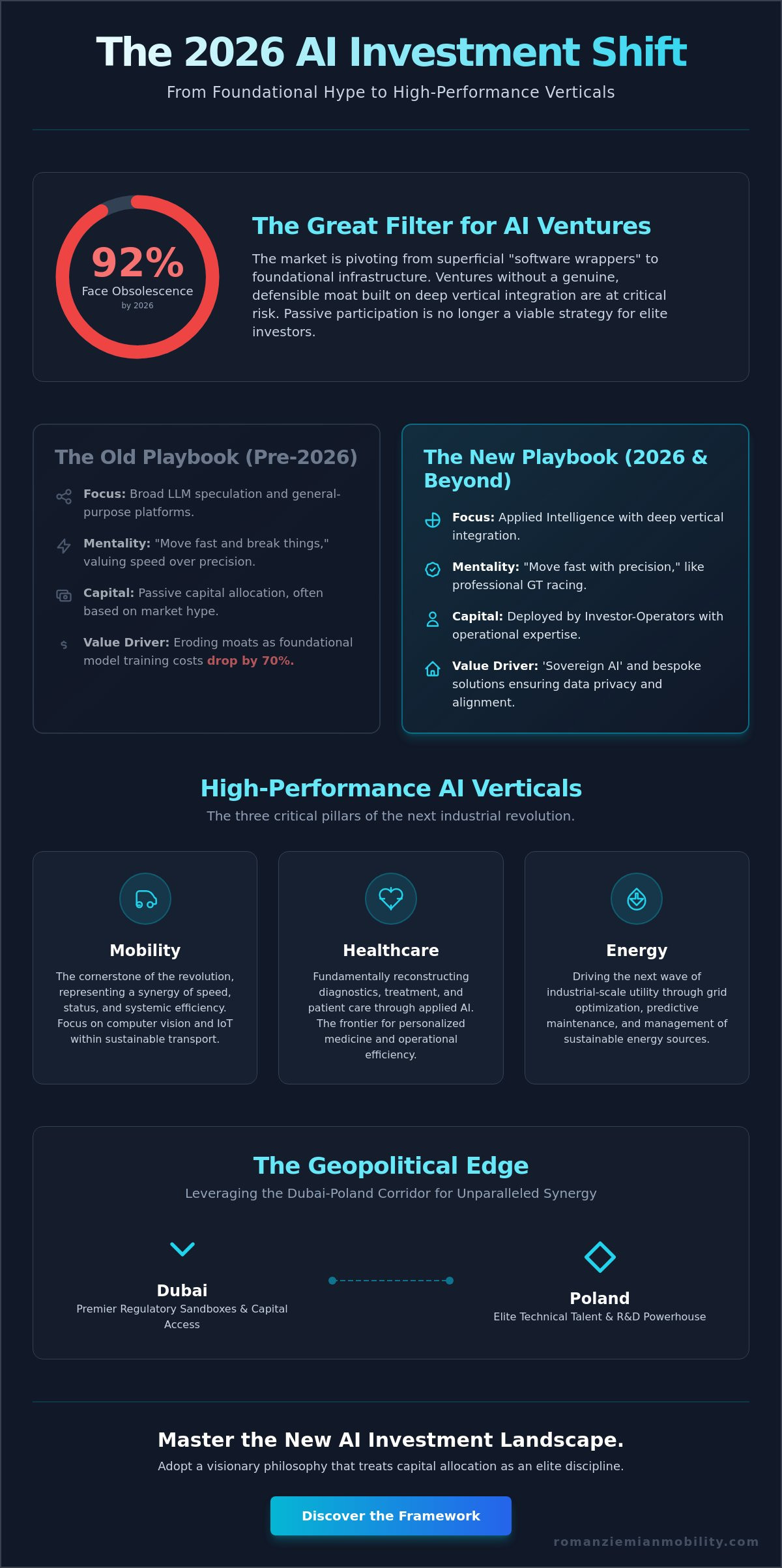
By 2026, 92% of current AI ventures will likely face obsolescence as the market pivots from superficial software wrappers toward foundational infrastructure, fundamentally shifting the landscape for AI startup investment opportunities. You’ve likely felt the exhaustion of filtering through a landscape saturated with high-volume noise, where the distinction between a fleeting trend and a truly transformative asset feels increasingly obscured. We recognize that for the elite investor, the primary concern is no longer just participation; it’s the risk of misallocating capital into ventures that lack a genuine, defensible moat.
This guide empowers you to identify and secure the most disruptive assets by utilizing a precision-engineered investor-operator framework built for an unparalleled era of innovation. You’ll discover a bespoke methodology for conducting deep-tier due diligence that separates technical excellence from mere marketing theater. We will outline how to align your portfolio with a visionary lead network, ensuring your capital benefits from the same synergy of speed and stability that defines the most prestigious sectors of international mobility and racing.
Key Takeaways
- Transition from broad LLM speculation to the era of applied intelligence, where deep vertical integration serves as the primary engine for sustainable value creation.
- Identify why mobility, healthcare, and energy are the three critical pillars of the next industrial revolution and how to strategically position capital within them.
- Leverage the unparalleled geopolitical synergy of the Dubai-Poland corridor to access a unique blend of premier regulatory sandboxes and elite technical talent.
- Master a bespoke investor-operator framework to identify and capitalize on the most sophisticated AI startup investment opportunities entering the 2026 global landscape.
- Adopt a visionary investment philosophy that treats capital allocation as an elite discipline, demanding the same level of precision and momentum as professional GT racing.
Navigating the AI Frontier: Why 2026 is the Year of Applied Intelligence
The era of speculative experimentation has reached its finish line. In 2026, the investment landscape isn’t defined by the sheer volume of parameters in a model, but by Applied Intelligence. This term describes the seamless integration of AI into specific, high-stakes industrial workflows where precision is the only metric that matters. While 2023 and 2024 were characterized by a frantic race to fund foundational Large Language Models (LLMs), the current market demands vertical depth. We’ve moved beyond the novelty of generative chat into a period where technological maturity aligns with a sophisticated market readiness. Investors who once threw capital at generic platforms now find those assets commoditized. True AI startup investment opportunities now reside in the bespoke application of these technologies to solve complex, real-world problems with surgical efficiency.
The synergy between high-velocity computing and industry-specific data has created a new gold standard for performance. Passive capital is no longer sufficient to secure outsized returns in this climate. The 2026 market rewards those who understand that AI is a tool for transformation, not just a buzzword for valuation. It’s a year where the “move fast and break things” mentality has been replaced by a “move fast with precision” philosophy, mirroring the disciplined world of international motorsport where every millisecond is engineered for victory.
The Shift from Foundational Models to Vertical Solutions
General-purpose AI has become a utility, much like electricity or cloud computing. By the start of 2026, the cost of training foundational models dropped by an estimated 70% compared to 2024 levels, eroding the competitive moats of broad-spectrum providers. The new value frontier lies in ‘Sovereign AI,’ where nations and regional enterprises invest in localized infrastructure to ensure data privacy and cultural alignment. This shift requires a deep understanding artificial intelligence and its architectural nuances. For a detailed exploration of how these shifts impact the mobility sector, our AI technology investment thesis provides a foundational framework for identifying high-performance assets that offer more than just algorithmic complexity.
The Investor-Operator Advantage in 2026
Passive capital is a relic of a less competitive era. In the high-velocity environment of 2026, the investor-operator has emerged as the elite strategist. These are individuals who bring more than a checkbook; they bring racing-grade precision to the boardroom. Vetting AI startup investment opportunities requires an intimate knowledge of the tech stack and the operational grit to scale under pressure. Having skin in the game means moving at the speed of innovation while maintaining the steady hand of a seasoned executive. This synergy between capital and capability ensures that startups don’t just survive the initial launch but dominate their respective sectors through unparalleled efficiency and strategic foresight.
Identifying High-Performance AI Verticals: Beyond the Hype
The era of speculative AI investment is giving way to a period of rigorous, high-performance capital allocation. By 2026, the distinction between fleeting trends and generational wealth creators will be defined by three specific verticals: Mobility, Healthcare, and Energy. These sectors aren’t just adopting technology; they’re being fundamentally reconstructed by it. Identifying the most lucrative AI startup investment opportunities requires a focus on ventures that offer more than just clever algorithms; they must provide industrial-scale utility and elite performance.
AI in Mobility stands as the cornerstone of this next industrial revolution. It represents a synergy of speed, status, and systemic efficiency. As Roman Ziemian often emphasizes, mobility is a holistic concept that encompasses freedom and technological mastery. Investors targeting AI startup investment opportunities must look toward the integration of computer vision and IoT within sustainable transport frameworks. This isn’t merely about moving objects; it’s about the intelligent orchestration of global movement.
The shift toward edge computing and on-device AI will reach a critical inflection point by 2026. Startups that process data at the source, rather than relying on centralized cloud latency, will dominate the landscape. This technical shift provides a bespoke level of security and performance that high-net-worth investors demand. According to research on corporate investment in AI startups from Georgetown University’s CSET, the involvement of strategic corporate partners is now a primary indicator of a startup’s long-term viability. Furthermore, proprietary data sets remain the ultimate investment moat. In a world where algorithms are increasingly commoditized, the unique, high-fidelity data harvested from racing telemetry or clinical trials serves as an unparalleled barrier to entry.
AI in Mobility and Autonomous Logistics
The convergence of computer vision and autonomous logistics is redefining global supply chains. By 2026, AI-driven efficiency will reduce operational costs in logistics by an estimated 15% to 20%. This evolution relies on the seamless interaction between intelligent sensors and sustainable transport networks. For those seeking deeper technical analysis, exploring our AI in mobility guide reveals how these systems achieve precision at scale. For those seeking to align with a legacy of excellence, exploring the vision behind Roman Ziemian Mobility offers a blueprint for future success.
Generative AI vs. Machine Learning: Where to Allocate Capital
Investors must balance the high-risk, high-reward moonshot nature of Generative AI with the stable, predictable returns of traditional Machine Learning. While GenAI captures headlines with creative synthesis, predictive analytics in ML provides the backbone for industrial stability. A strategic portfolio in 2026 requires a 70/30 split favoring established ML applications to ensure consistent growth. You can review our Generative AI vs. Machine Learning comparison to better understand these ROI profiles and how to protect your capital in a volatile market.
Strategic Investment Models: Venture Studios vs. Direct Equity
The strategic pursuit of AI startup investment opportunities demands a level of precision that mirrors the aerodynamic refinements of a championship-winning GT4 machine. Investors in 2026 are moving past the era of speculative fervor, instead adopting a disciplined entry lens that views current valuations through the prism of long-term utility. While some critics argue that AI sectors are overvalued, a 2025 market analysis revealed that companies with integrated operational frameworks maintained a 25% higher valuation stability than those relying solely on algorithmic hype. Success isn’t found in the broad market; it’s found in the structure of the deal itself.
Choosing between a venture studio and direct equity isn’t merely a financial decision. It’s a choice of velocity and control. High-performance capital requires a vehicle that can handle the tight corners of a shifting regulatory environment. This is where bespoke advisory becomes the differentiator, providing the strategic foresight necessary to ensure that technological innovation doesn’t outpace legal compliance.
The Venture Studio Model: De-risking Innovation
Venture studios offer an unparalleled synergy between capital and execution by deploying “tiger teams” of elite engineers and product architects. These teams provide the rapid validation necessary to turn a concept into a market-ready asset in record time. In 2025, startups born within these studio environments demonstrated a 30% higher survival rate through their first three years of operation. The trade-off involves a more complex equity structure where the studio acts as a co-founder, yet this model significantly reduces the “zero-to-one” risk that plagues early-stage AI. Corporate partners within the mobility and logistics sectors often serve as the first pilot grounds, offering these startups a controlled environment to prove their excellence before a global rollout.
Direct Strategic Investment: Engineering Momentum
For late-stage scaling, high-net-worth investors are increasingly favoring direct, high-conviction stakes that allow for a more intimate relationship with the founding team. This model is about engineering momentum. It’s about taking a proven concept and providing the high-octane capital required for international expansion. To ensure long-term stability, these deals are structured with rigorous performance milestones that align founder incentives with the investor’s vision for global leadership.
- Direct equity allows for greater influence over the startup’s technological roadmap and governance.
- Strategic advisory services play a vital role in post-investment scaling, helping founders transition from technical experts to global executives.
- Deal structures in 2026 often include “stability clauses” that protect capital against the volatility of the rapid AI development cycle.
Investors don’t just provide funding; they provide the infrastructure for success. Whether through the collaborative environment of a studio or the focused power of direct equity, the goal remains the same. We seek to align with innovators who possess the ambition to redefine the concept of mobility and the technical mastery to execute that vision with unwavering precision.
The Dubai-Poland Corridor: Geopolitical Advantages in AI Investment
A new axis of innovation is redefining the geography of global technology. The corridor connecting the United Arab Emirates and Poland has emerged as a high-performance ecosystem where liquid capital meets raw technical mastery. This partnership offers a unique arbitrage opportunity for those seeking AI startup investment opportunities that transcend traditional Silicon Valley limitations. While Western markets often grapple with legislative inertia, this corridor moves with the precision and speed of a professional racing team, creating a fertile environment for disruptive growth.
Dubai: The Global Sandbox for AI Innovation
Dubai’s regulatory environment is a deliberate masterpiece of economic engineering. By positioning itself as a global regulatory sandbox, the emirate offers a permissive yet structured arena for testing autonomous systems and generative models. The UAE National AI Strategy 2031 acts as a powerful macro tailwind, committing the nation to transform into a global leader through deep-tech integration. This environment attracts founders fleeing the restrictive frameworks of traditional markets. Within the ecosystems of Dubai Internet City and the Dubai International Financial Centre (DIFC), startups find the capital and clarity required to scale at a pace that mirrors the velocity of a GT4 race. These hubs provide a bespoke infrastructure where AI startup investment opportunities thrive amidst a culture of excellence. For those seeking exposure to this market, exploring AI investment opportunities in Dubai reveals a landscape defined by strategic foresight and unparalleled growth potential.
Poland: The Silicon Valley of Central Europe
Poland represents the high-performance engine of this corridor, boasting a density of technical talent that rivals any global tech hub. With over 430,000 IT professionals and a specialized focus on deep-tech engineering, Polish developers consistently rank in the top three globally for coding proficiency according to 2024 HackerRank data. This talent pool is the primary driver for the EU’s digital transformation, offering a unique value proposition when paired with Gulf capital. Roman Ziemian Mobility bridges these two distinct markets, facilitating a synergy where Polish technical precision meets the visionary scale of the UAE. It’s a partnership built on the philosophy that true innovation requires both the architect’s vision and the engineer’s mastery. This corridor doesn’t just move capital; it accelerates the deployment of cutting-edge solutions across the global mobility sector, ensuring that every investment is backed by world-class execution.
Discover how we are redefining the future of global technology by visiting Roman Ziemian’s AI and technology insights.
Engineering Momentum: The Roman Ziemian Mobility Investment Philosophy
Achieving elite returns in 2026 requires more than raw capital; it demands the surgical precision found in the cockpit of a GT racer. Roman Ziemian Mobility approaches AI startup investment opportunities with a methodology honed on the world’s most demanding circuits. We view every portfolio company as a high-performance machine where the hardware, software, and human element must synchronize perfectly. This visionary framework moves beyond traditional due diligence by analyzing the “velocity of innovation” alongside fiscal health. We prioritize ventures that demonstrate specific metrics, such as a 35% reduction in operational latency or a proprietary edge in decentralized processing.
The Roman Ziemian philosophy is built on the belief that status and performance are inseparable. When we evaluate the next wave of AI disruption, we look for founders who possess the same grit required to navigate a rain-slicked corner at Monza. It’s about finding the bespoke synergy between cutting-edge code and sustainable business models that can weather market volatility. Our process isn’t a simple checklist; it’s an engineering audit of a startup’s potential to redefine global mobility. We seek out the unparalleled, the bold, and the technologically formidable.
- Precision Due Diligence: Moving beyond surface-level metrics to analyze the core algorithmic integrity.
- Global Scalability: Ensuring the technology can adapt to diverse international regulatory environments.
- Strategic Synergy: Aligning founder vision with the high-octane growth targets of the Roman Ziemian brand.
From Racetrack to Boardroom: Lessons in Velocity
Success in the Ferrari Challenge depends on split-second decisions at speeds exceeding 200 km/h, a skill set that translates directly to identifying high-impact tech shifts. Our approach emphasizes the synergy between the founder and the investor, much like the relationship between a driver and their technical crew. You can explore Roman Ziemian’s insights on technology to see how this technical rigor applies to the digital frontier. We don’t just provide capital; we provide the engineering momentum required to dominate the market.
Partnering for the Future of Mobility
Our philosophy extends beyond the balance sheet to encompass a holistic legacy of sustainable innovation. We actively support initiatives that combine technological disruption with social responsibility, particularly in areas affecting global accessibility and community welfare. This commitment to humanity is a core pillar of our identity, as detailed in how Roman Ziemian inspires global change through his diverse endeavors. Visionary partners seeking to capitalize on AI startup investment opportunities are invited to join us. Let’s accelerate the future together by visiting our about page to begin the dialogue.
Accelerating Toward a Legacy of Intelligent Performance
The roadmap for 2026 reveals that the most lucrative AI startup investment opportunities lie at the intersection of applied intelligence and established industrial sectors. By leveraging the unique geopolitical advantages of the Dubai-Poland corridor, investors can access a dual-market synergy that provides both regulatory stability and rapid scalability. This transition from speculative interest to high-performance capital requires a partner who understands the mechanics of speed and the discipline of elite execution. Roman Ziemian Mobility brings a distinguished history of success from the world of international motorsport and tech advisory into the boardroom, offering a bespoke approach to portfolio acceleration. With a strategic presence in both Dubai and Europe, the firm provides an unparalleled vantage point for those ready to lead the next technological revolution. It’s an invitation to join a movement defined by precision, ambition, and a relentless pursuit of innovation. The future belongs to those who recognize that momentum isn’t found; it’s engineered. Explore bespoke AI investment opportunities with Roman Ziemian Mobility to secure your position at the forefront of global innovation.
Frequently Asked Questions
What are the best AI startup investment opportunities in 2026?
The most lucrative AI startup investment opportunities in 2026 reside within sector-specific generative models and autonomous logistics systems that define the next era of mobility. Investors are pivoting toward vertically integrated solutions where 80% of enterprises now utilize bespoke generative APIs to streamline operations. These ventures offer a unique synergy between technical excellence and market demand, providing a high-octane path for capital looking to lead the technological frontier.
How do I evaluate the technical moat of an AI startup?
Evaluating a technical moat requires a precise analysis of proprietary data sets and the architectural efficiency of the underlying neural networks. You should look for a data flywheel effect where a 10% increase in high-quality data yields a 30% improvement in model accuracy. This level of performance ensures a startup maintains its competitive edge against generic competitors. It’s the difference between a standard engine and a precision-tuned racing machine.
Is Dubai a good place for AI investment?
Dubai is a premier global destination for AI capital because of the Dubai Universal Blueprint for Artificial Intelligence which targets a 100 billion AED economic contribution. The city’s strategic decision in 2024 to appoint 22 Chief AI Officers across its government departments created a fertile ecosystem for innovation. This visionary environment offers unparalleled stability and growth potential for those seeking to align with a global leader in technological transformation.
What is the difference between investing in AI infrastructure vs. applied AI?
Infrastructure investment focuses on the foundational hardware and cloud layers that power the industry, while applied AI targets bespoke software solutions for specific professional sectors. Infrastructure requires 50% more initial capital but offers the stability of a foundational utility. Applied AI ventures often provide faster 3x returns by solving niche pain points with surgical precision. Both paths require strategic foresight to navigate the fast-paced evolution of the sector.
How does the investor-operator model differ from traditional venture capital?
The investor-operator model integrates elite industrial expertise and active management directly into the startup lifecycle to ensure total control over the narrative of success. Unlike traditional venture capital which often remains passive, this approach utilizes a 24/7 advisory framework to boost operational efficiency by 15%. This hands-on philosophy mirrors the dedication found in high-end motorsport where every adjustment is calculated for maximum performance and victory.
What role does AI play in the future of sustainable mobility?
AI serves as the central nervous system for sustainable mobility by optimizing power distribution in electric drivetrains and reducing fleet emissions by 25% through predictive routing. Advanced battery management systems now leverage machine learning to extend cell life by 4,000 cycles, ensuring long-term viability. This intersection of lifestyle and technology represents a bold step toward a future where speed and environmental stewardship exist in perfect harmony.
Can I invest in AI startups through a private investment office?
Private investment offices provide a sophisticated and discrete vehicle for securing exclusive AI startup investment opportunities that are typically shielded from the public market. These entities manage roughly 40% of global family office wealth, focusing on bespoke portfolios that reflect a legacy of excellence and ambition. Accessing these private rounds allows elite investors to share in the momentum of high-performance ventures before they reach institutional saturation.
What are the common risks associated with AI startup investments in 2026?
Regulatory fragmentation and the rapid obsolescence of non-proprietary models are the primary risks facing investors in the 2026 landscape. The full implementation of the EU AI Act in 2026 can impose compliance costs reaching 12% of a startup’s initial seed funding. Strategic foresight is essential to identify founders who have built resilient architectures capable of navigating these complex legal frameworks without sacrificing their innovative spirit or technical momentum.